Artist · French
Claude Monet: Life, Paintings and Legacy
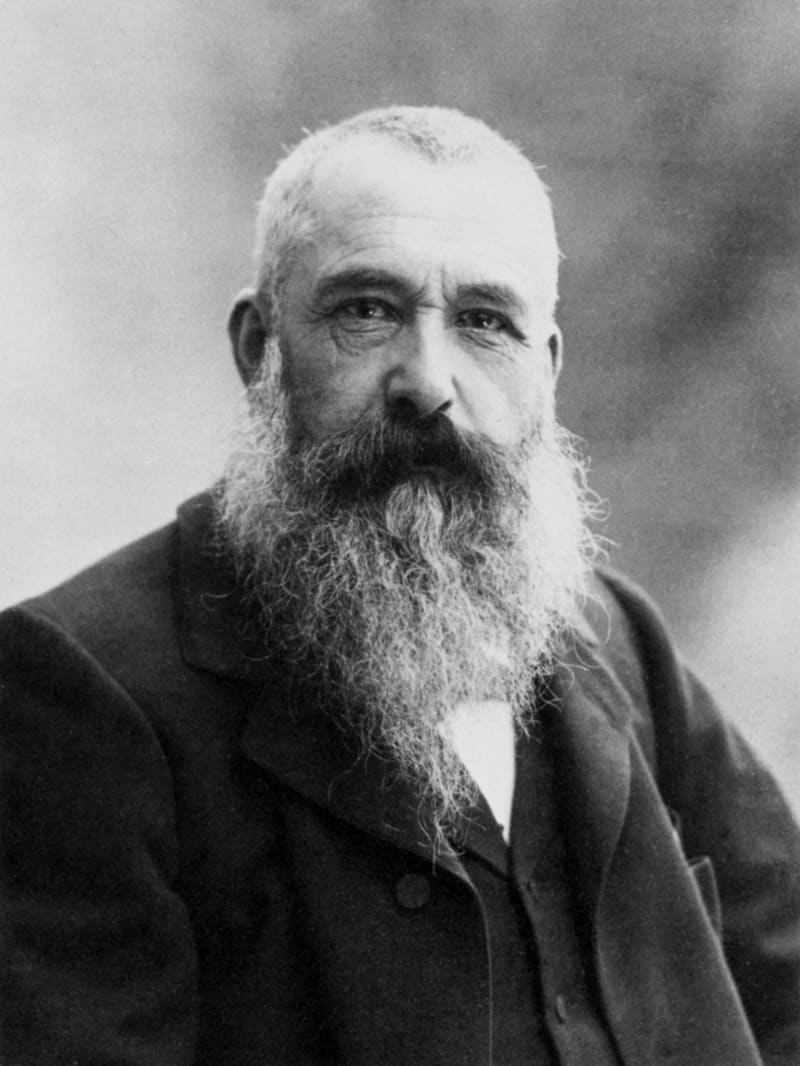
- Born
- November 14, 1840, Paris, France
- Died
- December 5, 1926, Giverny, France
- Nationality
- French
- Movement
- Impressionism
- Mediums
- Oil painting
- Era
- 19th century
Early life in Le Havre
Oscar-Claude Monet was born in Paris on 14 November 1840, and his family moved to the port of Le Havre in Normandy when he was about five. As a teenager he was known locally for his caricatures, which he sold in a frame shop. There he met the landscape painter Eugène Boudin, who persuaded him to paint outdoors, directly from nature. Monet later said that Boudin opened his eyes.
Paris and the birth of Impressionism
Monet moved to Paris to study, served briefly with the army in Algeria, and in 1862 entered the studio of Charles Gleyre, where he met Pierre-Auguste Renoir, Alfred Sisley and Frédéric Bazille. Through the 1860s the group painted together in the Forest of Fontainebleau and along the Seine, developing the quick, bright, open-air style that would become Impressionism.
To escape the Franco-Prussian War in 1870, Monet went to London, where he studied the paintings of Turner and Constable and met the dealer Paul Durand-Ruel, who would later make the Impressionists’ fortunes. Back in France he settled at Argenteuil on the Seine. In 1874 he helped organize the group’s first independent exhibition, where his view of Le Havre harbor, Impression, Sunrise, gave the movement its name.
Series paintings
From the 1890s Monet worked in series, painting the same subject again and again under different light and weather. His grainstacks (often called the Haystacks), poplars and the facade of Rouen Cathedral were exhibited in groups, so viewers could see how light, not the object, was the real subject. The series sold well and made him financially secure for the first time.
Giverny and the Water Lilies
Monet moved to Giverny, northwest of Paris, in 1883 and later bought the house. He dug a water garden with a Japanese-style footbridge and planted it with water lilies, then spent nearly thirty years painting it. Cataracts clouded his vision in his last years, shifting his colors toward reds and browns until surgery in 1923. His final project was a set of enormous water lily panels that he gave to France. He died at Giverny on 5 December 1926, and the panels were installed in two oval rooms at the Musée de l’Orangerie in Paris the following year.
Legacy
Monet stayed faithful to the core Impressionist idea, painting what the eye perceives in a single moment, longer than any of his colleagues. His late, near-abstract water lily paintings were rediscovered after the Second World War by painters of the New York School, and they are now seen as a bridge between Impressionism and abstract art.
Works by Claude Monet
- Impression, Sunrise · 1872
Frequently asked questions
What is Claude Monet's most famous painting?
Impression, Sunrise (1872) is the most historically important, because it gave Impressionism its name. His most widely recognized works are the Water Lilies, the series of pond paintings he made at Giverny over the last decades of his life.
How many Water Lilies paintings did Monet make?
About 250. The largest are the panoramic panels installed at the Musée de l'Orangerie in Paris in 1927, the year after his death.
Where did Monet live?
He was born in Paris and grew up in Le Havre on the Normandy coast. He lived at Argenteuil and Vétheuil in the 1870s, then settled at Giverny in 1883, where he stayed until his death in 1926. His house and gardens there are open to visitors.