Art movement · c. 1867–1886
Impressionism: History, Artists and Key Works
What is Impressionism?
Impressionism is a style of painting that began in France in the late 1860s and tried to capture a single moment: how light falls on a river at sunrise, how a crowded boulevard looks from a high window, how colors shift on a haystack as the afternoon goes on. Instead of smooth, carefully finished surfaces, Impressionists used quick, visible brushstrokes and bright, unmixed colors, often working outdoors to paint what they saw before the light changed.
It was the first great break with the official art of the Paris Salon, and almost every modern movement that followed, from Post-Impressionism to abstraction, grew out of the freedom it won.
Origins in 1870s Paris
In the 1860s, a painter’s career in France depended on the Salon, the state-sponsored annual exhibition whose juries favored polished history paintings and classical subjects. A group of younger artists kept being rejected. Several of them had met as students in the studio of Charles Gleyre (Claude Monet, Pierre-Auguste Renoir, Alfred Sisley and Frédéric Bazille), and by the late 1860s they gathered with Camille Pissarro, Edgar Degas and others at the Café Guerbois in Paris, around the older painter Édouard Manet.
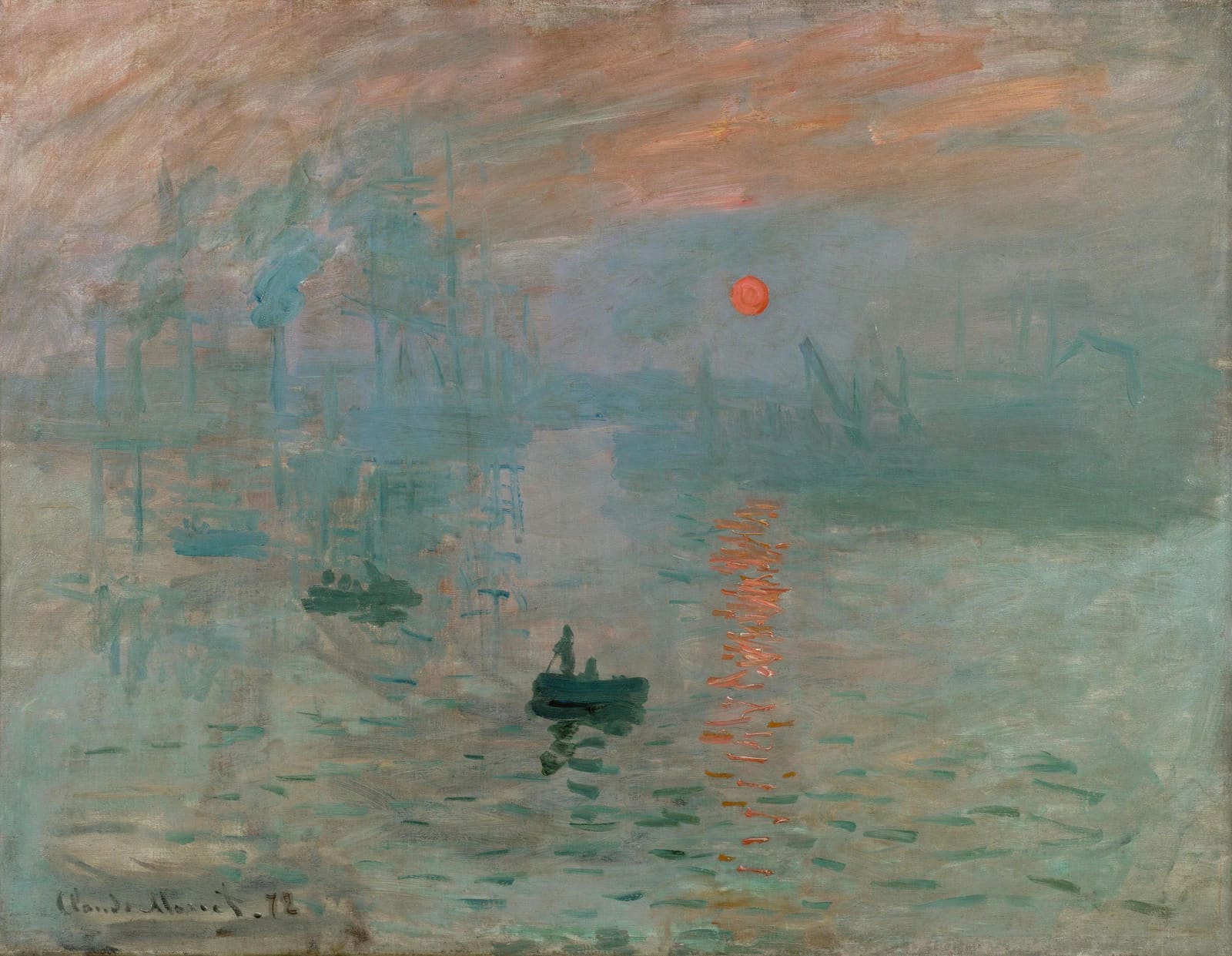
In 1874 they stopped waiting for the Salon. Calling themselves the Société anonyme des artistes peintres, sculpteurs, graveurs, they rented the former studio of the photographer Nadar on the boulevard des Capucines and opened their own exhibition, with about thirty artists taking part. Among Monet’s entries was a small, hazy view of the harbor at Le Havre that he titled Impression, Sunrise. The critic Louis Leroy seized on the title for a sarcastic review in the satirical paper Le Charivari, calling the group “Impressionists.” The insult stuck, and the artists eventually took it on themselves.
The group held eight exhibitions between 1874 and 1886. Its membership shifted from show to show, and not everyone liked the label: Degas preferred to call himself a realist or an “independent.”
Key characteristics
Visible brushstrokes
Academic painters blended their strokes until the surface looked like glass. Impressionists left their brushwork on show: short dabs, commas and dashes of paint that read as water, leaves or crowds from a distance and dissolve into texture up close. Critics called the results unfinished. For the painters, the speed was the point.
Light and color
Impressionists cared less about the objects in a scene than about the light on them. They placed pure colors side by side and let the eye mix them, painted shadows in blues and violets rather than brown or black, and returned to the same subject at different times of day to show how its colors changed. Monet’s later series of haystacks, poplars and Rouen Cathedral take this idea as far as it can go.
Painting outdoors
Painting en plein air (outdoors) was not new, but the Impressionists made it central. Oil paint sold in collapsible metal tubes, invented in 1841, let them carry a full palette into fields and onto riverbanks and finish a canvas on the spot rather than in the studio. Renoir is reported to have said that without paint in tubes there would have been no Impressionism.
Modern subjects
Instead of myths and battles, they painted the life around them: railway stations, boating parties on the Seine, cafés, dance halls, suburban gardens and the new boulevards of Paris. Berthe Morisot and Mary Cassatt, who joined the group’s exhibitions in 1879, painted the private world of women and children with the same loose, luminous touch.
Impressionism vs Post-Impressionism
By the mid-1880s, some painters who had exhibited with the Impressionists wanted more than a fleeting impression. Paul Cézanne sought solid structure, Georges Seurat broke color into a system of tiny dots, and Vincent van Gogh and Paul Gauguin used color for emotion and symbolism. The English critic Roger Fry grouped these artists as “Post-Impressionists” for a London exhibition in 1910. They kept Impressionism’s bright palette and visible brushwork but turned away from simply recording what the eye sees.
Major Impressionist artists
- Claude Monet · 1840–1926
- Berthe Morisot · 1841–1895
Famous Impressionist works
- Impression, Sunrise · 1872
Before and after Impressionism
- Came before: Realism (c. 1840–1880)
- Came after: Post-Impressionism (c. 1886–1905)
Mediums and era
- Medium: Oil painting
- Era: 19th century
Frequently asked questions
Who started Impressionism?
No single artist founded it. Claude Monet, Pierre-Auguste Renoir, Alfred Sisley, Camille Pissarro, Edgar Degas and Berthe Morisot were among the group who organized the first independent exhibition in Paris in 1874. The movement's name came from Monet's painting Impression, Sunrise, shown there.
Why is it called Impressionism?
The critic Louis Leroy borrowed the title of Monet's Impression, Sunrise for a mocking review of the 1874 exhibition, calling the artists 'Impressionists'. The painters soon adopted the name themselves.
When did Impressionism end?
The group held eight exhibitions between 1874 and 1886, and 1886 is usually taken as the movement's end. Many of the artists kept painting in an Impressionist manner long afterwards; Monet worked until his death in 1926.
What is the difference between Impressionism and Post-Impressionism?
Impressionists tried to record the passing effects of light as they saw them. Post-Impressionists such as Cézanne, Van Gogh, Gauguin and Seurat kept the bright color but pushed toward structure, symbolism or emotion rather than pure observation.