Artist · Dutch
Rembrandt: Life, Paintings and Legacy
- Born
- July 15, 1606, Leiden, Dutch Republic
- Died
- October 4, 1669, Amsterdam, Dutch Republic
- Nationality
- Dutch
- Movement
- Baroque
- Mediums
- Oil painting
Early years in Leiden
Rembrandt Harmenszoon van Rijn was born on 15 July 1606 in Leiden, the son of a miller. He briefly attended the university before training as a painter, including six months in Amsterdam with Pieter Lastman, a painter of biblical and historical scenes. By his early twenties he was running his own studio in Leiden and already painting penetrating studies of faces, including his own.
Success in Amsterdam
In the early 1630s he moved to Amsterdam, the booming commercial capital of the Dutch Republic. His group portrait The Anatomy Lesson of Dr. Nicolaes Tulp (1632) made his name, and commissions for portraits poured in. In 1634 he married Saskia van Uylenburgh, and in 1639 they bought a large house in the city, now the Rembrandt House Museum.
The Night Watch
In 1642 Rembrandt completed his most famous work, a group portrait of a civic militia company led by Captain Frans Banninck Cocq. Instead of lining the men up in rows, as was usual, he painted them in motion, with dramatic Baroque light picking out key figures. Long known as The Night Watch because darkened varnish obscured it, the painting is now the centerpiece of the Rijksmuseum. The same year, Saskia died, leaving him with their infant son Titus.
Hard times and late masterpieces
Rembrandt’s spending outran his income, and in 1656 he was forced to declare insolvency. His house and his collection were sold. He moved to a smaller house with Titus and his partner Hendrickje Stoffels and kept working.
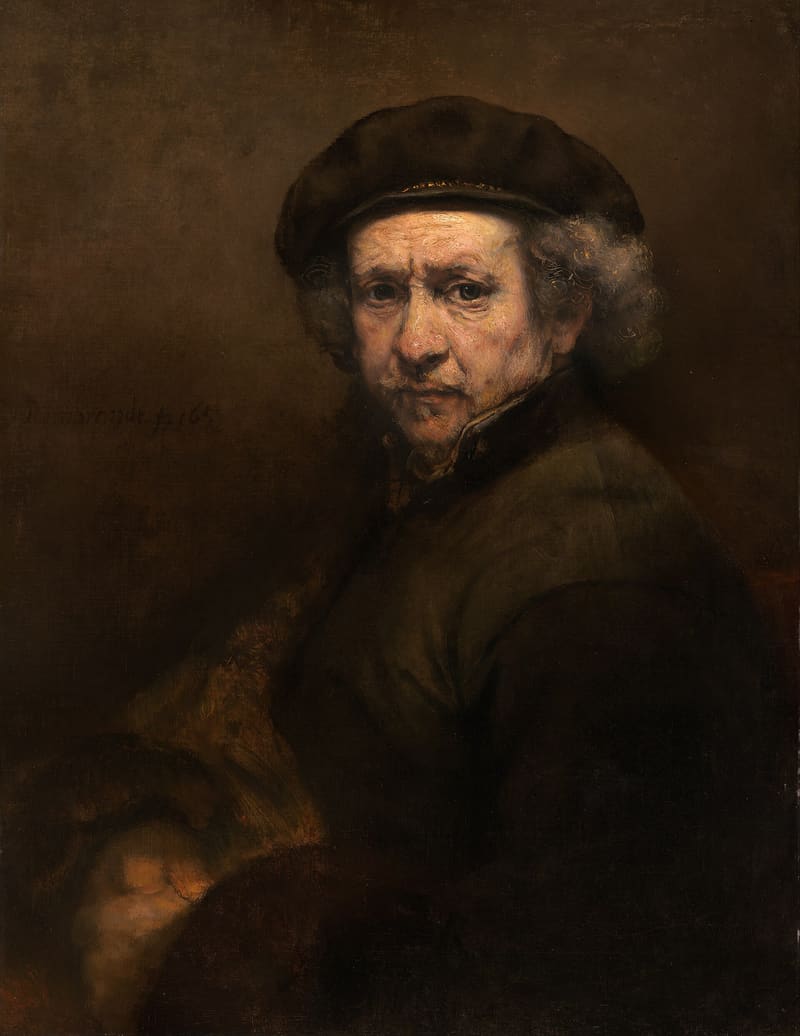
His late works, painted with thick, rough brushwork, are often considered his greatest: the group portrait The Syndics of the Drapers’ Guild (1662), The Jewish Bride, and a series of unflinching self-portraits. Hendrickje died in 1663 and Titus in 1668. Rembrandt died in Amsterdam on 4 October 1669.
Self-portraits and etchings
Rembrandt made around eighty self-portraits in paint, etching and drawing, tracing his face from confident youth to weathered old age. He was also one of the greatest printmakers in history, using etching with the freedom of a sketch, and his prints spread his reputation across Europe in his lifetime.
Legacy
Rembrandt’s mastery of light and shadow and his insight into human character made him the defining artist of the Dutch Golden Age. His late, loose brushwork was admired by later painters from Delacroix to Van Gogh.
Frequently asked questions
What is Rembrandt's most famous painting?
The Night Watch (1642), a huge group portrait of an Amsterdam civic militia company, now the centerpiece of the Rijksmuseum. Its real subject is the militia of Captain Frans Banninck Cocq; the nickname came later, when darkened varnish made it look like a night scene.
How many self-portraits did Rembrandt make?
Around eighty, counting paintings, etchings and drawings. Together they record his face from his early twenties to the last year of his life.
Why did Rembrandt go bankrupt?
He spent heavily on a large house and on his collection of art and curiosities, while demand for his work cooled. In 1656 he applied for a form of bankruptcy, and his house and possessions were sold.