Art movement · c. 1140–1400
Gothic Art: History, Characteristics and Key Works
What is Gothic art?
Gothic art is the art of Europe’s late Middle Ages, from the middle of the 12th century to around 1400. It was born with a new kind of architecture: cathedrals that soared higher than any buildings before them, with walls opened up into vast windows of colored glass. Sculpture, stained glass, illuminated manuscripts and painting all grew up around these churches, and almost all of it served the Christian faith.
Compared with the heavy, round-arched Romanesque style before it, Gothic art feels light, vertical and full of color. Its figures gradually became more natural and more human, preparing the way for the Renaissance.
Origins in 12th-century France
The style began near Paris. Around 1140 Abbot Suger rebuilt the choir of the royal Abbey of Saint-Denis using pointed arches, ribbed vaults and large windows, and filled the space with colored light, which he saw as a reflection of the divine. The choir was consecrated in 1144, and within decades cathedral builders across northern France were competing to go higher and brighter, at Chartres, Notre-Dame de Paris, Reims and Amiens.
Stained glass and sculpture
Gothic engineering, especially the flying buttress, which carries the weight of the vault outside the building, let builders replace walls with glass. Chartres Cathedral still holds most of its medieval windows, and the Sainte-Chapelle in Paris (consecrated 1248) is almost a cage of glass, telling biblical stories in deep blues and reds.
Sculpture covered the doorways. The tall, column-like figures of the Royal Portal at Chartres (about 1145 to 1155) became more lifelike over the following century, turning toward one another, smiling and moving in their robes.
Gothic painting
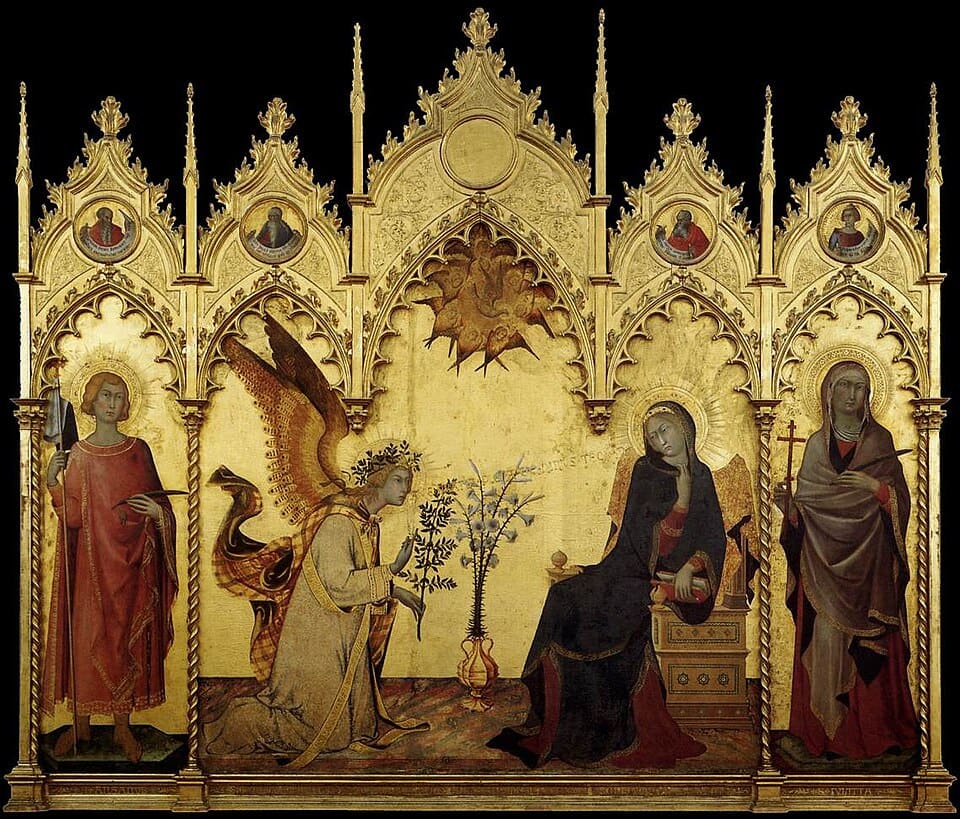
Painting flourished in manuscripts and in altarpieces of tempera and gold leaf on wood. In Siena, Duccio’s great Maestà (1308 to 1311) and Simone Martini’s Annunciation (1333) combined shimmering gold backgrounds and elegant line with new emotion. In Florence, Giotto went further, giving his figures weight and space so convincingly that he is often seen as the first step toward the Renaissance.
Around 1400, a refined, courtly style known as International Gothic spread across Europe. The richly detailed calendar pages of the Très Riches Heures du Duc de Berry, painted by the Limbourg brothers, are its most famous example.
Key characteristics
Height and light
Pointed arches, ribbed vaults and flying buttresses allowed tall, thin walls and huge windows.
Gold and color
Altarpieces glow with gold leaf and jewel-like tempera colors, and stained glass floods interiors with colored light.
Elegant line
Figures are slender and graceful, often with a gentle S-shaped curve and flowing drapery.
Growing naturalism
Over two centuries, faces and bodies became steadily more expressive and lifelike.
Gothic art vs Renaissance art
Gothic painters set holy figures against flat gold, a symbol of heaven. Renaissance painters replaced the gold with real landscapes and rooms drawn in mathematical perspective, and modeled figures on ancient sculpture. The change happened first in Florence in the early 1400s, while the Gothic style continued for another century in much of northern Europe.
Before and after Gothic art
- Came after: Renaissance (c. 1400–1600)
Frequently asked questions
Why is it called Gothic art?
Renaissance Italians used 'Gothic' as an insult, blaming the barbarian Goths for the style they saw as crude compared with classical art. The Goths had nothing to do with it, but the name stuck and lost its negative meaning.
When was the Gothic period?
Gothic art began in France around 1140, spread across Europe, and lasted until around 1400 in Italy and into the 1500s in northern Europe, where it overlapped with the Renaissance.
What is the first Gothic building?
The choir of the Abbey of Saint-Denis near Paris, rebuilt under Abbot Suger and consecrated in 1144, is usually considered the first Gothic building.