Art movement · c. 1400–1600
Renaissance Art: History, Artists and Key Works
What is Renaissance art?
Renaissance art is the painting, sculpture and architecture made in Europe between about 1400 and 1600, when artists turned back to the art of ancient Greece and Rome and set out to show the world as the eye actually sees it. They invented a mathematical system of perspective to create convincing space, studied anatomy to make bodies solid and believable, and treated the artist not as an anonymous craftsman but as an intellectual and a genius.
The ideas behind it came from humanism, a movement of scholars who recovered classical texts and put human experience and achievement at the center of learning. Religious subjects still dominated, but the saints now stood in real rooms and real landscapes, and pagan myths returned to painting for the first time in a thousand years.
Origins in 15th-century Florence
The Renaissance started in Florence, a rich banking city whose merchant families, above all the Medici, competed to commission churches, chapels and art. Around 1415 to 1420 the architect Filippo Brunelleschi demonstrated linear perspective, a method for drawing space with lines that meet at a single vanishing point, and in 1435 Leon Battista Alberti wrote it down for painters in his treatise On Painting.
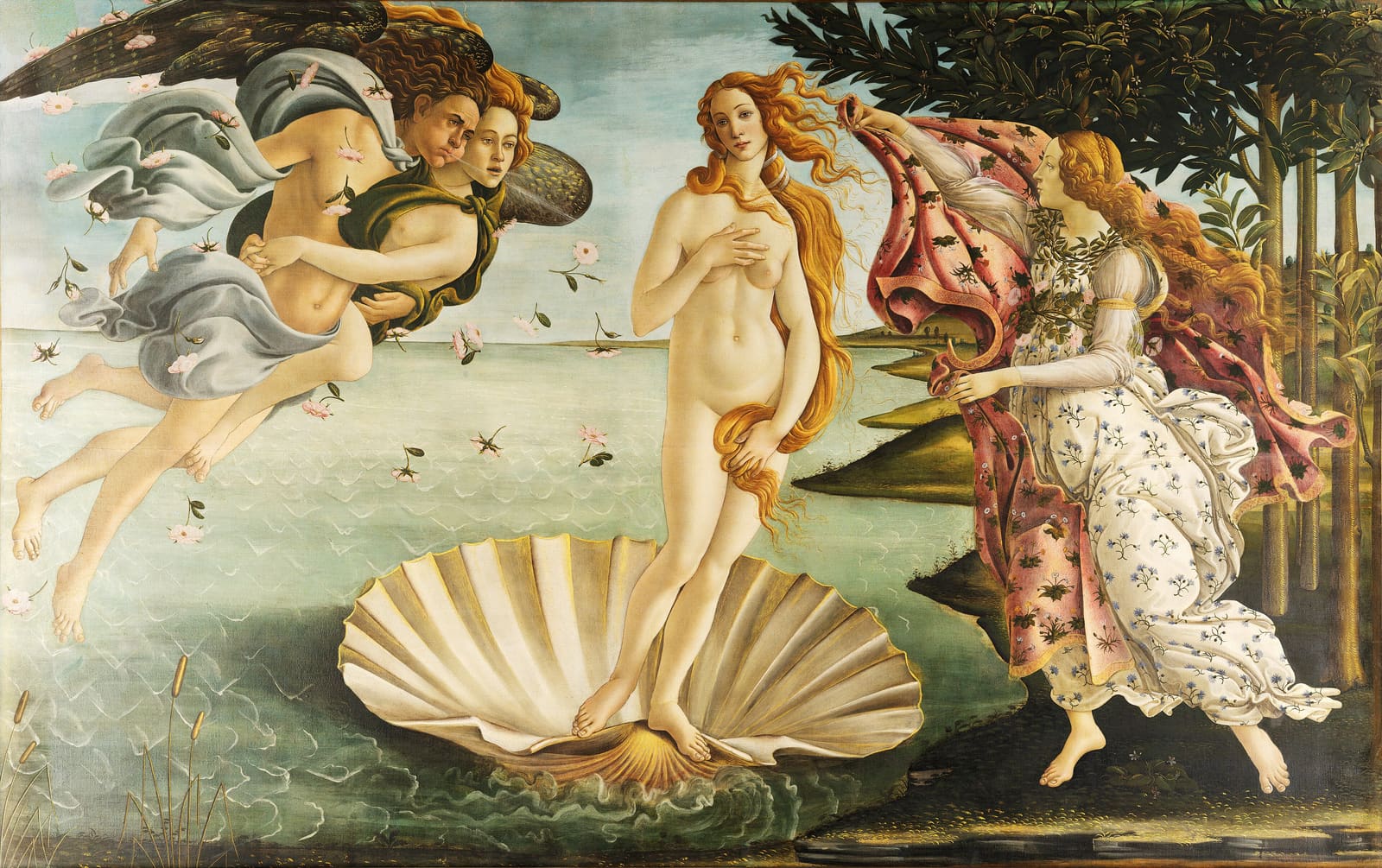
Masaccio was among the first to use the system in paint: his Holy Trinity fresco in Santa Maria Novella (about 1427) seems to open a real chapel in the church wall. The sculptor Donatello revived the free-standing classical nude with his bronze David. Later in the century Sandro Botticelli painted mythological scenes such as The Birth of Venus for the Medici circle.
The High Renaissance
Between about 1490 and 1527 the movement reached its peak, and its center moved to Rome, where the popes were rebuilding the city. In a single generation Leonardo da Vinci painted The Last Supper and the Mona Lisa, Michelangelo carved the David and painted the Sistine Chapel ceiling (1508 to 1512), and Raphael painted The School of Athens in the Vatican. The Sack of Rome by imperial troops in 1527 is usually taken as the end of this classical high point.
Venice developed its own tradition built on color and light rather than drawing, led by Giovanni Bellini, Giorgione and Titian, and Venetian painters helped make oil on canvas the standard for European painting.
The Northern Renaissance
North of the Alps, Flemish painters such as Jan van Eyck developed oil painting into a medium of astonishing detail. His Arnolfini Portrait (1434) records every reflection in a convex mirror. Later, Albrecht Dürer brought Italian ideas to Germany and spread them through his prints, and Hieronymus Bosch and Pieter Bruegel the Elder painted fantastical visions and scenes of peasant life.
Key characteristics
Linear perspective
Lines receding into the picture meet at a vanishing point, so flat walls and panels appear to open into deep, measurable space.
Realistic anatomy and light
Artists dissected bodies and studied classical statues to model believable figures. Leonardo’s sfumato, soft transitions from light to shadow without hard outlines, gave faces a lifelike haze.
Classical models
Columns, arches, balanced compositions and idealized nudes came straight from ancient Rome, along with subjects from Greek and Roman myth.
Balance and harmony
High Renaissance works favor stable, often pyramid-shaped compositions and calm, idealized beauty, the qualities the Baroque would later overturn.
Renaissance vs Baroque
Renaissance art aims for balance, clarity and calm. The Baroque art of the 1600s took the same skills and pushed them toward drama: diagonal compositions, violent contrasts of light and dark, and figures caught mid-action. A Renaissance altarpiece invites contemplation; a Baroque one tries to overwhelm.
Major Renaissance artists
- Leonardo da Vinci · 1452–1519
- Michelangelo · 1475–1564
Before and after Renaissance
- Came before: Gothic art (c. 1140–1400)
- Came after: Mannerism (c. 1520–1600)
- Came after: Baroque (c. 1600–1750)
Mediums and era
- Medium: Oil painting
Frequently asked questions
When was the Renaissance in art?
Roughly 1400 to 1600. It began in Florence in the early 15th century, peaked in the High Renaissance of about 1490 to 1527, and gave way to Mannerism and then the Baroque by around 1600.
What does Renaissance mean?
It is French for 'rebirth', meaning the revival of the art and learning of ancient Greece and Rome. The Italian writer Giorgio Vasari spoke of a 'rinascita' in 1550, and 19th-century historians such as Jules Michelet and Jacob Burckhardt made 'Renaissance' the standard name for the period.
Who are the most famous Renaissance artists?
In Italy: Leonardo da Vinci, Michelangelo, Raphael, Donatello, Botticelli and Titian. In Northern Europe: Jan van Eyck, Albrecht Dürer, Hieronymus Bosch and Pieter Bruegel the Elder.
What is the difference between the Early and High Renaissance?
The Early Renaissance (about 1400 to 1490), centered on Florence, worked out perspective, anatomy and classical forms. The High Renaissance (about 1490 to 1527), centered on Rome, brought those skills to a peak of balance and grandeur in the work of Leonardo, Michelangelo and Raphael.