Artist · French
Berthe Morisot: Life, Paintings and Legacy
- Born
- January 14, 1841, Bourges, France
- Died
- March 2, 1895, Paris, France
- Nationality
- French
- Movement
- Impressionism
- Mediums
- Oil painting
- Era
- 19th century
Early life and training
Berthe Marie Pauline Morisot was born on 14 January 1841 in Bourges, in central France, into a prosperous family that moved to Paris when she was a child. Women could not enroll at the École des Beaux-Arts, so she and her sister Edma took private lessons and copied paintings in the Louvre. The landscape painter Camille Corot advised them on painting outdoors. Berthe first showed at the official Salon in 1864.
Manet and the Impressionists
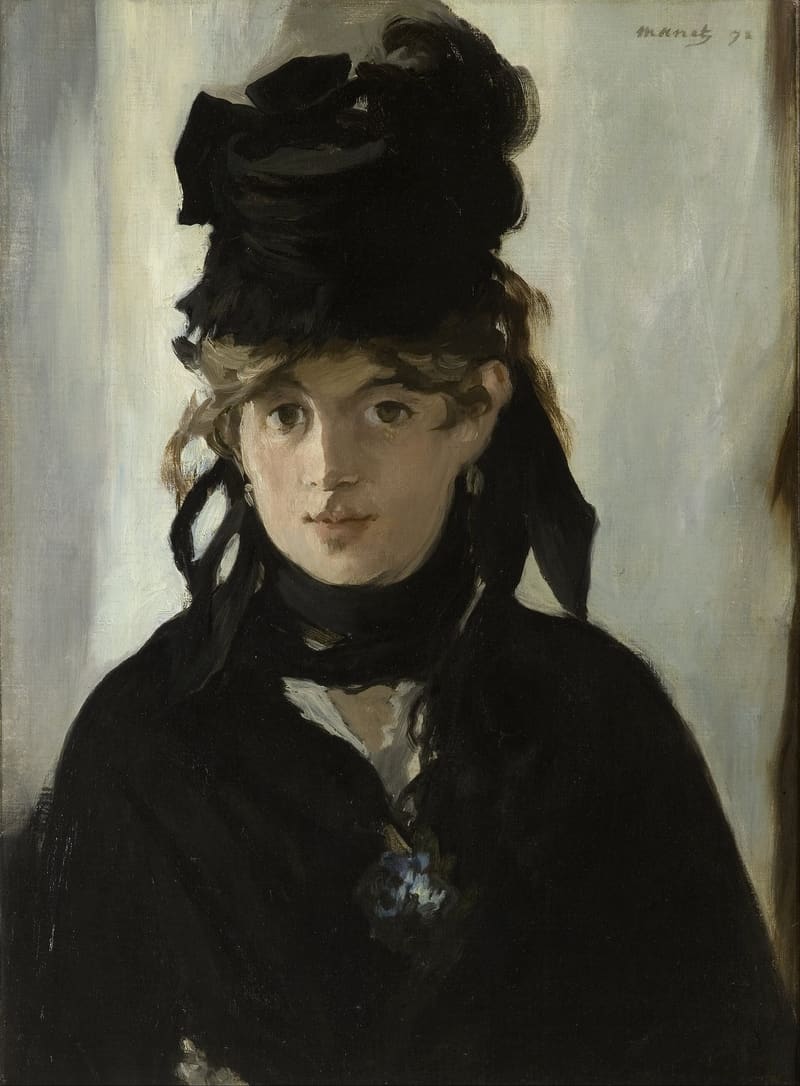
In 1868 Morisot met Édouard Manet at the Louvre. They became close friends, influencing each other’s work, and she posed for several of his paintings, including The Balcony and the portrait shown above.
When the independent artists who became the Impressionists organized their first exhibition in 1874, Morisot was one of the founders, alongside Claude Monet, Renoir, Degas and Pissarro. She showed her painting The Cradle there, and she went on to exhibit at seven of the group’s eight exhibitions. Later that year she married Manet’s brother Eugène; their daughter Julie was born in 1878.
Subjects and style
Barred by convention from the cafés, theaters and boulevards her male colleagues painted, Morisot made her subject the modern lives of women: mothers and children, women dressing, reading, boating or sitting in gardens. She painted with some of the freest, most rapid brushwork of any Impressionist, leaving her canvases open and sketch-like, and she was equally skilled in watercolor and pastel. Summer’s Day (1879), in the National Gallery, London, shows two women in a boat on a lake in the Bois de Boulogne, painted with flickering strokes of light.
Later life
After Eugène’s death in 1892, Morisot continued to paint, often using Julie as her model. Her first solo exhibition came that same year. She died of pneumonia in Paris on 2 March 1895, aged 54, having caught it while nursing her daughter.
Legacy
For much of the 20th century Morisot was remembered mainly as Manet’s model and sister-in-law. A wave of exhibitions and scholarship since the 1980s has restored her to her place as one of the central painters of Impressionism, and one of its most daring.
Frequently asked questions
Was Berthe Morisot an Impressionist?
Yes, a founding one. She exhibited at the first Impressionist exhibition in 1874 and at seven of the group's eight shows, missing only 1879, after the birth of her daughter.
What is Berthe Morisot's most famous painting?
The Cradle (1872), showing her sister Edma watching over her sleeping baby. It was shown at the first Impressionist exhibition in 1874 and is now in the Musée d'Orsay in Paris.
Was Berthe Morisot related to Édouard Manet?
By marriage. She was Manet's friend and frequent model, and in 1874 she married his younger brother, the painter Eugène Manet.