Artist · French
Jean-Honoré Fragonard: Life, Paintings and Legacy
- Born
- April 5, 1732, Grasse, France
- Died
- August 22, 1806, Paris, France
- Nationality
- French
- Movement
- Rococo
- Mediums
- Oil painting
Early life and training
Jean-Honoré Fragonard was born on 5 April 1732 in Grasse, the perfume town in Provence, and moved to Paris with his family as a child. After a short apprenticeship to a notary, he was sent to study painting, briefly with Jean-Siméon Chardin and then with François Boucher, the favorite painter of Madame de Pompadour and the leading artist of the Rococo.
Rome
In 1752 Fragonard won the Prix de Rome, the Academy’s top prize for young painters, and from 1756 to 1761 he studied at the French Academy in Rome. He filled sketchbooks with Italian gardens, fountains and cypresses, especially those of the Villa d’Este at Tivoli, which he drew in red chalk. Their overgrown, sunlit greenery would fill his paintings for the rest of his career.
Success in Paris
Back in Paris, Fragonard was admitted to the Academy in 1765 with a grand history painting, and seemed set for an official career. Instead he turned to private collectors and the kind of painting they wanted: amorous garden scenes, playful bedroom pictures and decorative cycles for their houses.
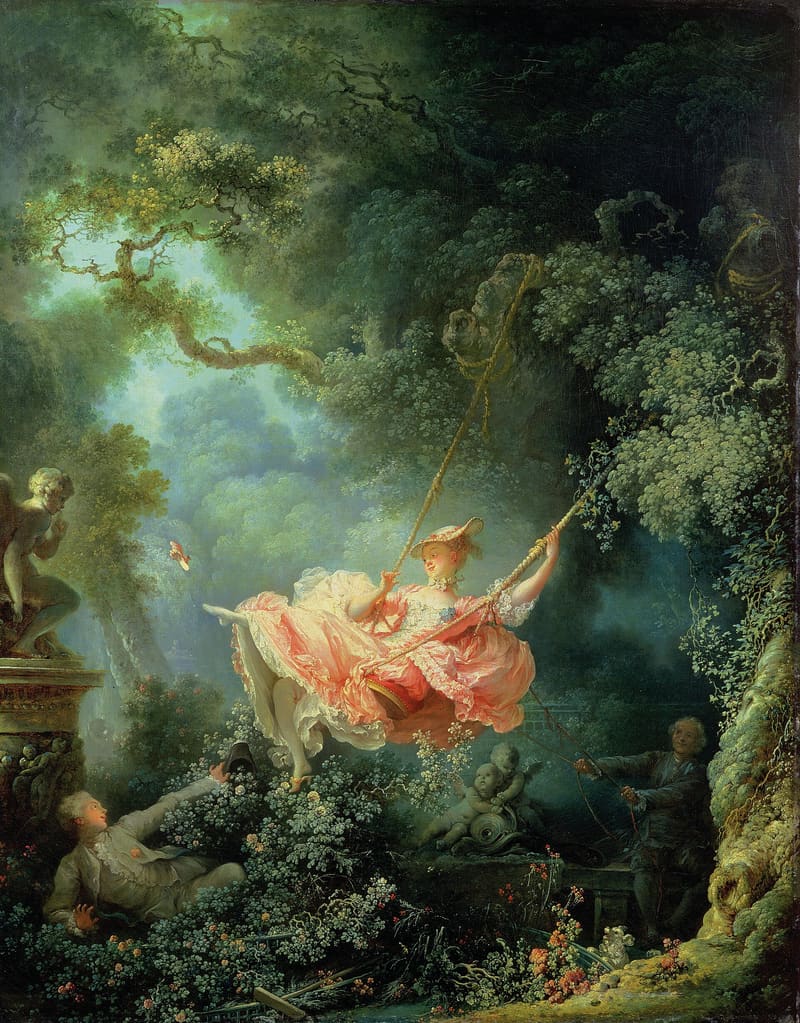
The Swing (c. 1767) is the most famous. A young woman in a foaming pink dress flies high on a swing pushed by an older man, kicking her slipper into the air, while her young lover lies hidden in the roses below, looking up her skirts. Statues of Cupid look on. According to a contemporary account, the patron who commissioned it asked for exactly this scene. For Madame du Barry, Louis XV’s mistress, he painted a series of large panels, The Progress of Love (1771–1772), but she rejected them; they are now in the Frick Collection in New York.
Speed and brushwork
Fragonard was a famously fast painter. His so-called fantasy figures of about 1769, half-length portraits in theatrical costume, are dashed off with broad, slashing strokes, and an old label on one of them claims it was painted in an hour. That freedom of touch, visible even in his most finished works, is one reason modern viewers find him so fresh.
Revolution and decline
By the 1780s taste was moving toward the moral seriousness of Neoclassicism, and the Revolution of 1789 swept away Fragonard’s aristocratic clients. The painter Jacques-Louis David helped him find a place on the committee organizing the new public museum at the Louvre. He died in Paris on 22 August 1806, largely forgotten. His reputation recovered in the later 19th century, when collectors and the Impressionists rediscovered the Rococo and his work’s lightness and color.
Frequently asked questions
What is Fragonard's most famous painting?
The Swing (c. 1767), in the Wallace Collection in London: a young woman in pink kicks off her slipper on a swing while her lover hides in the bushes below. It has become the defining image of the Rococo.
What happened to Fragonard after the French Revolution?
His aristocratic patrons disappeared and his playful style fell out of favor. With help from the painter Jacques-Louis David he took a post with the new national museum at the Louvre, but he died in 1806 largely forgotten.
Where can you see Fragonard's work?
The largest groups are in the Louvre in Paris, the Wallace Collection in London and the Frick Collection in New York, which owns his panels The Progress of Love. His hometown of Grasse has a museum devoted to him.