Art movement · c. 1720–1780
Rococo Art: History, Artists and Key Works
What is Rococo?
Rococo is the light, playful and highly decorative style that flourished in Europe from about 1720 to 1780, above all in France. After the solemn grandeur of the Baroque, it offered pleasure and charm: pastel colors, curving, asymmetrical ornament inspired by shells and foliage, and scenes of flirtation, music and games in dreamy gardens.
It began as an interior style, in the salons and private rooms of Paris townhouses, and spread to painting, furniture, porcelain and the pilgrimage churches of southern Germany and Austria.
Origins in 18th-century Paris
When Louis XIV died in 1715, the French aristocracy left the formality of Versailles for Paris, where they built elegant townhouses decorated in an intimate new style. Instead of gods and military triumphs, they wanted art for conversation and pleasure.
Antoine Watteau gave Rococo painting its defining subject. His Pilgrimage to Cythera (1717) shows elegant couples on the island of love, and the French Academy invented a new category, the fête galante, to admit it. His figures are tinged with a gentle melancholy that sets him apart from his followers.
Key Rococo artists
François Boucher
The favorite painter of Madame de Pompadour, mistress of Louis XV, Boucher painted rosy mythological scenes, pastoral fantasies and tapestry designs, and portraits of his patron. He became First Painter to the King in 1765.
Jean-Honoré Fragonard
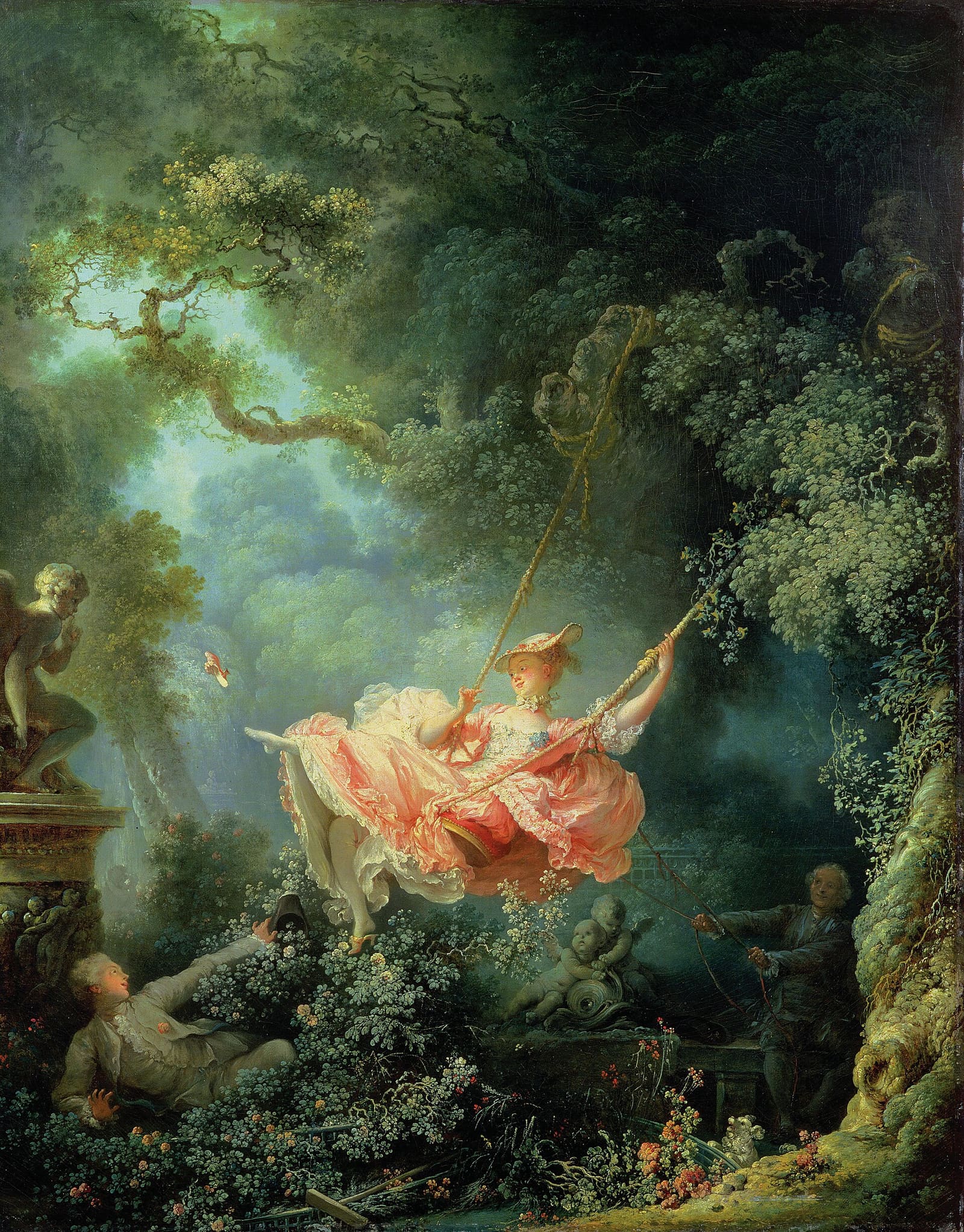
Fragonard’s The Swing (about 1767), in the Wallace Collection in London, is the emblem of Rococo: a young woman kicks her slipper into the air as she swings, while her lover hides in the bushes below, all in a frothing garden of greens and pinks. He painted with dazzling speed and freedom.
Giovanni Battista Tiepolo
In Italy and Central Europe, Tiepolo painted vast, luminous ceilings full of figures floating in pale skies, most spectacularly in the Würzburg Residence in Germany (1752 to 1753).
Key characteristics
Pastel color
Soft pinks, blues, creams and pale greens replace the deep shadows of the Baroque.
Curves and asymmetry
Ornament curls in S- and C-shaped scrolls, shells and leaves, deliberately off-balance.
Love and leisure
Flirtation, music, swings, picnics and pastoral fantasy dominate subjects.
Intimate scale
Works were made for private rooms and personal pleasure rather than public instruction.
The decline of Rococo
By the 1760s Enlightenment critics such as Denis Diderot attacked Rococo as frivolous and immoral, and the excavations of Herculaneum and Pompeii sparked enthusiasm for ancient art. Neoclassicism, serious and moral, replaced it. After the French Revolution, Rococo became a symbol of the aristocracy’s excesses, and Fragonard died in 1806 largely forgotten.
Before and after Rococo
- Came before: Baroque (c. 1600–1750)
- Came after: Neoclassicism (c. 1760–1830)
Mediums and era
- Medium: Oil painting
Frequently asked questions
What does Rococo mean?
It comes from the French 'rocaille', the shell and rock work used to decorate garden grottoes, whose curving forms the style imitated. The word 'Rococo' was coined later, as a mocking term, by critics who preferred the stricter Neoclassical style.
What is the difference between Baroque and Rococo?
Baroque art is grand, dramatic and often religious, built for churches and palaces. Rococo is lighter, smaller in scale and playful, with pastel colors, delicate curves and themes of love and leisure, made for private rooms and aristocratic salons.
What is a fête galante?
A type of painting showing elegant people at leisure in a parkland setting, flirting, playing music and dancing. The French Academy created the category in 1717 to accept Antoine Watteau's Pilgrimage to Cythera.