Art movement · c. 1760–1830
Neoclassicism: History, Artists and Key Works
What is Neoclassicism?
Neoclassicism was the dominant style in European and American art and architecture from about 1760 to 1830. Its artists looked back to ancient Greece and Rome for models of beauty and virtue. After the playful, sensual Rococo, they wanted art that was serious, rational and morally uplifting: heroic subjects from ancient history, clear outlines, balanced compositions and smooth, polished surfaces.
It was also political. Neoclassical images of Roman self-sacrifice and republican virtue spoke directly to the age of the American and French Revolutions, and later to Napoleon’s empire.
Origins
The rediscovery of the ancient world drove the movement. Excavations at Herculaneum and Pompeii, Roman towns buried by the eruption of Vesuvius in 79 CE, began in 1738 and 1748 and revealed paintings, furniture and everyday objects. The German scholar Johann Joachim Winckelmann praised Greek art for its “noble simplicity and quiet grandeur,” and young artists from across Europe went to Rome to study ancient sculpture.
Jacques-Louis David
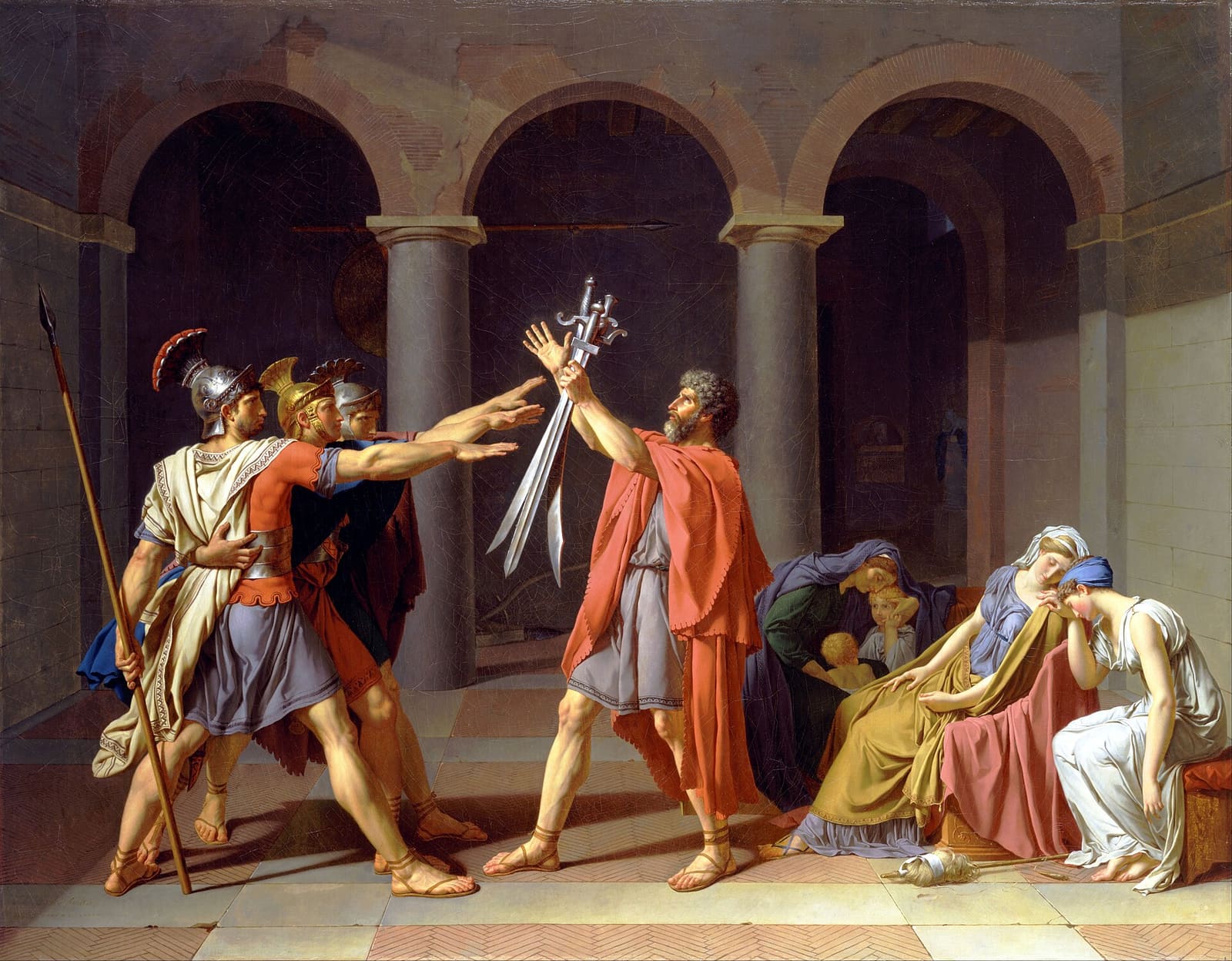
The French painter Jacques-Louis David became the movement’s leader. His Oath of the Horatii (1784), painted in Rome and shown at the Paris Salon of 1785, shows three brothers swearing to fight for Rome while the women of their family grieve. Its stark composition, hard light and message of patriotic duty made it a sensation. David went on to become the leading artist of the French Revolution, painting The Death of Marat (1793), and later served as painter to Napoleon.
Other key artists
Jean-Auguste-Dominique Ingres
David’s pupil Ingres carried Neoclassicism deep into the 19th century, with flawless drawing and cool, perfect surfaces. His Grande Odalisque (1814) shows how his pursuit of elegant line could bend anatomy.
Antonio Canova
The Italian sculptor Canova was the most celebrated artist in Europe in his day. His marble Psyche Revived by Cupid’s Kiss (1787 to 1793), in the Louvre, combines classical purity with tenderness.
Angelica Kauffman
The Swiss-born painter Angelica Kauffman worked in London and Rome, painting classical and historical subjects, and was one of the two women among the founding members of Britain’s Royal Academy in 1768.
Neoclassical architecture
The style shaped buildings everywhere: the Panthéon in Paris, the British Museum in London, and in the United States, Thomas Jefferson’s Virginia State Capitol and the U.S. Capitol in Washington, where classical columns and domes expressed the ideals of the new republic.
Key characteristics
Classical subjects
Scenes from Greek and Roman history and myth teach lessons of duty, courage and sacrifice.
Line over color
Crisp drawing and clear contours matter more than color or brushwork.
Order and balance
Compositions are stable, often frieze-like, with figures arranged across a shallow stage.
Smooth finish
Brushstrokes are hidden to create a polished, timeless surface.
Neoclassicism vs Romanticism
From the 1790s, Romanticism challenged Neoclassical order with emotion, imagination and color. In 1820s Paris the two camps had champions in Ingres and Delacroix, and their rivalry over line versus color defined French art for a generation.
Before and after Neoclassicism
- Came before: Rococo (c. 1720–1780)
- Came after: Romanticism (c. 1790–1850)
Mediums and era
- Medium: Oil painting
- Era: 19th century
Frequently asked questions
What is Neoclassicism in art?
A movement of roughly 1760 to 1830 that revived the styles and subjects of ancient Greece and Rome. It favored clear outlines, balanced compositions, smooth finish and serious moral themes of duty, sacrifice and civic virtue.
What started Neoclassicism?
The excavation of the buried Roman towns of Herculaneum (from 1738) and Pompeii (from 1748), the writings of the German scholar Johann Joachim Winckelmann, and a reaction against the frivolity of Rococo all drove the new taste for antiquity.
What is the difference between Neoclassicism and Romanticism?
Neoclassicism values reason, order, clear line and classical ideals. Romanticism, which followed, values emotion, imagination, rich color and the power of nature. The rivalry between Ingres and Delacroix in 1820s France is often seen as the clash between them.