Artist · Dutch
Vincent van Gogh: Life, Paintings and Legacy
- Born
- March 30, 1853, Zundert, Netherlands
- Died
- July 29, 1890, Auvers-sur-Oise, France
- Nationality
- Dutch
- Movement
- Post-Impressionism
- Mediums
- Oil painting
- Era
- 19th century
Early life and false starts
Vincent Willem van Gogh was born on 30 March 1853 in Zundert, in the south of the Netherlands, the son of a Protestant minister. At sixteen he joined the international art dealers Goupil & Cie, working in The Hague, London and Paris, but was dismissed in 1876. He then tried teaching and preaching, including a period among coal miners in the Borinage region of Belgium. Only in 1880, at the age of 27, did he decide to become an artist, supported financially by his younger brother Theo, an art dealer.
The Dutch years
Largely self-taught, Van Gogh spent his first years drawing and painting peasants and laborers in dark, earthy tones. The major work of this period is The Potato Eaters (1885), a somber scene of a peasant family at their evening meal.
Paris and color
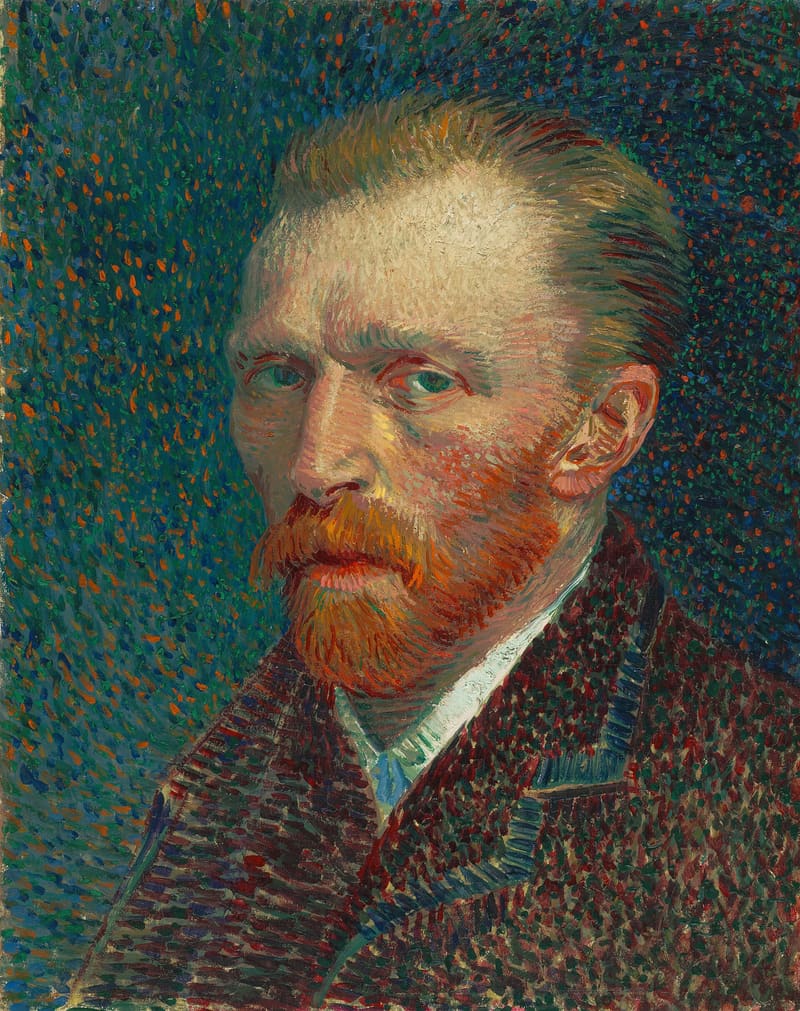
In 1886 he moved to Paris to live with Theo. There he met the Impressionists and younger painters such as Henri de Toulouse-Lautrec, Émile Bernard and Paul Gauguin, studied Japanese woodblock prints, and experimented with the dotted technique of Seurat. His palette changed completely, from browns to brilliant color, as in the self-portrait of 1887 shown above.
Arles
In February 1888 Van Gogh moved to Arles in the south of France, hoping to found an artists’ colony. Inspired by the southern light, he painted at astonishing speed: orchards, wheat fields, The Yellow House, The Night Café, and the Sunflowers series. Gauguin joined him in October, but the two quarreled bitterly. On 23 December 1888, during a mental crisis, Van Gogh cut off part of his left ear.
Saint-Rémy and Auvers
In May 1889 he voluntarily entered the asylum at Saint-Rémy-de-Provence. Between attacks of illness he kept painting, producing works including irises, cypresses, olive groves and The Starry Night (June 1889). In May 1890 he moved to Auvers-sur-Oise, near Paris, under the care of Dr. Paul Gachet, and painted almost a picture a day. On 27 July 1890 he shot himself in the chest, and he died two days later, on 29 July, aged 37.
Letters and legacy
More than 800 of Van Gogh’s letters survive, most of them to Theo. They describe his ideas about color and art in vivid detail and are one of the great documents of an artist’s life. After Vincent’s death, Theo’s widow Johanna van Gogh-Bonger worked tirelessly to exhibit his paintings and publish the letters.
Within two decades of his death Van Gogh had become one of the most influential figures of Post-Impressionism. His expressive color and brushwork inspired the Fauves and the German Expressionists, and today his paintings are among the most valuable and widely loved in the world.
Frequently asked questions
Did Van Gogh only sell one painting in his lifetime?
Only one sale is firmly documented: The Red Vineyard, bought by the painter Anna Boch in Brussels in 1890. He probably sold or traded a few other works, but he was far from successful while alive.
How many paintings did Van Gogh make?
About 860 oil paintings and more than 2,000 works in all, including drawings and watercolors, made in roughly ten years. Many of the best-known date from his last two years.
Where can I see Van Gogh's paintings?
The Van Gogh Museum in Amsterdam has the largest collection, and the Kröller-Müller Museum in Otterlo has the second largest. The Starry Night is at the Museum of Modern Art in New York.