Art movement · c. 1886–1905
Post-Impressionism: History, Artists and Key Works
What is Post-Impressionism?
Post-Impressionism is the name given to the work of painters who, from the mid-1880s, took what Impressionism had taught them, bright color, visible brushwork and modern subjects, and pushed it somewhere new. They felt that capturing a fleeting impression of light was not enough. Some wanted solid structure, some a scientific system of color, some intense emotion or spiritual symbolism.
It was never an organized movement. The four central figures, Paul Cézanne, Vincent van Gogh, Paul Gauguin and Georges Seurat, worked largely apart and in very different styles. The label was applied later, by the English critic Roger Fry, who grouped them for his London exhibition “Manet and the Post-Impressionists” in 1910.
Origins in the 1880s
By the mid-1880s the Impressionist group was splintering. At its eighth and final exhibition in 1886, Georges Seurat showed A Sunday on La Grande Jatte, a huge park scene built from thousands of tiny dots of pure color. That painting is often taken as the moment painting moved past Impressionism.
The four central artists
Paul Cézanne
Cézanne wanted to make Impressionism “something solid and durable, like the art of museums.” He built his landscapes and still lifes from patches of color laid like bricks, often painting the same subject, such as Mont Sainte-Victoire near his home in Provence, dozens of times. In a 1904 letter he advised treating nature “by means of the cylinder, the sphere and the cone,” an idea the Cubists later took to heart.
Georges Seurat
Seurat turned color theory into method. In Pointillism (also called Neo-Impressionism), small dots of unmixed color are placed side by side to blend in the viewer’s eye, producing calm, carefully ordered compositions.
Vincent van Gogh
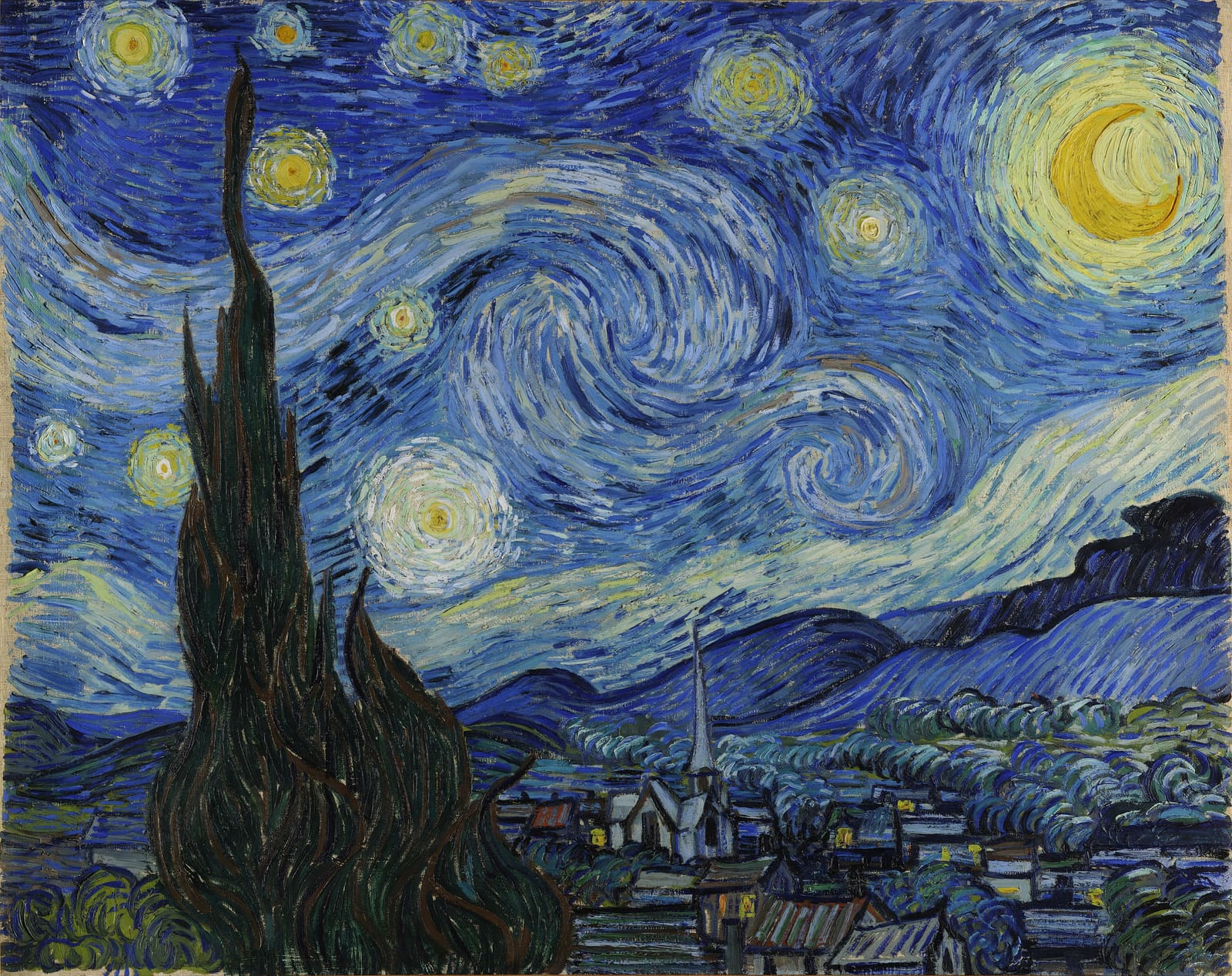
Van Gogh used color and brushwork to express emotion. In the last few years of his life, in Arles and then at the asylum in Saint-Rémy, he painted with thick, swirling strokes and vivid, non-natural color. He painted The Starry Night in June 1889, based on the view from his window at Saint-Rémy, with the village and cypress added from memory and imagination. He died in 1890, little known, and became famous only afterwards.
Paul Gauguin
Gauguin rejected Western civilization and painting from observation. He used flat areas of bold, symbolic color and simplified forms, first in Brittany and then in Tahiti, where he moved in 1891. His Where Do We Come From? What Are We? Where Are We Going? (1897 to 1898) is a meditation on human life.
Key characteristics
Bold, expressive color
Color is used for structure, emotion or symbolism, not just to describe what the eye sees.
Visible brushwork
Brushstrokes stay visible, but they are more deliberate than in Impressionism: Cézanne’s blocks, Seurat’s dots, Van Gogh’s swirls.
Structure and simplification
Forms are simplified, flattened or reorganized, which opened the door to abstraction.
Personal vision
Each artist developed a distinct, individual style, a trait that would define modern art.
Post-Impressionism and modern art
Almost every major movement of the early 20th century grew from one of these painters. Cézanne’s geometry led to Cubism; Van Gogh’s emotional color fed Expressionism; Gauguin’s flat, symbolic color shaped Fauvism and the Nabis. Matisse and Picasso are both reported to have called Cézanne “the father of us all.”
Post-Impressionism vs Impressionism
Impressionists tried to record exactly what they saw in a passing moment of light. Post-Impressionists kept the bright palette and loose handling, but they used them to express structure, ideas and feelings. The Impressionists painted their impressions; the Post-Impressionists painted their responses to them.
Major Post-Impressionist artists
- Vincent van Gogh · 1853–1890
Before and after Post-Impressionism
- Came before: Impressionism (c. 1867–1886)
Mediums and era
- Medium: Oil painting
- Era: 19th century
Frequently asked questions
What is Post-Impressionism?
A label for French painting of roughly 1886 to 1905 by artists who started from Impressionism but rejected its focus on simply recording light. They used bold color and visible brushwork for structure, emotion or symbolism instead.
Who coined the term Post-Impressionism?
The English critic and painter Roger Fry, for his exhibition 'Manet and the Post-Impressionists' at the Grafton Galleries in London, which opened in November 1910.
Who are the main Post-Impressionist artists?
Paul Cézanne, Vincent van Gogh, Paul Gauguin and Georges Seurat are the four central figures. Henri de Toulouse-Lautrec, Paul Signac and the group known as the Nabis are often included too.
Was Post-Impressionism a single movement?
No. The artists never formed a group or shared a program, and their styles differ widely. The term groups them by what they had in common: moving beyond Impressionism.