Artwork · c. 1484–1486
The Birth of Venus by Botticelli: Myth, Meaning and Details
- Artist
- Sandro Botticelli
- Date
- c. 1484–1486
- Medium
- Tempera on canvas
- Dimensions
- 172.5 × 278.9 cm
- Collection
- Uffizi Gallery, Florence
- Movement
- Renaissance
The myth
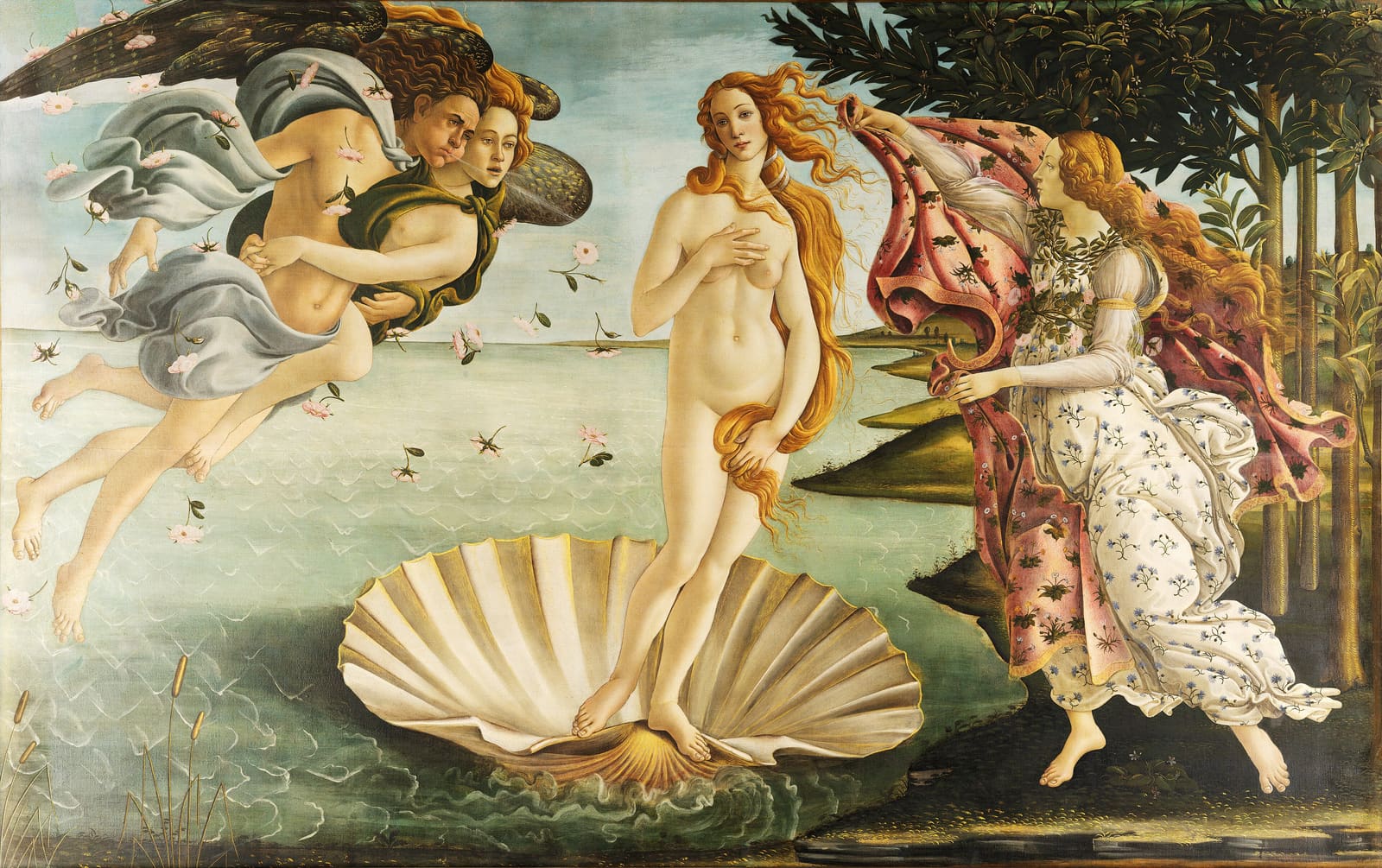
According to ancient Greek poets, Venus (Aphrodite to the Greeks) was born fully grown from the foam of the sea and carried ashore on the island of Cyprus or Cythera. Botticelli shows the moment of her arrival. She stands, naked and dreamy, on a giant scallop shell that floats to the shore. Zephyr, the west wind, and a female companion blow her in, in a shower of roses. On land, one of the Horae, the goddesses of the seasons, rushes forward to wrap her in a cloak embroidered with flowers.
Venus’s pose
Venus covers herself with her hands and her long golden hair in a pose borrowed from ancient sculpture, the type known as the Venus Pudica (“modest Venus”). Botticelli could have seen a Roman example in the Medici collection. Yet his figure is not a solid classical statue. Her neck is impossibly long, her left shoulder slopes steeply, and her weight could not really rest on one foot on the edge of a shell. Botticelli cared more for the flowing rhythm of line than for anatomy, and the effect is weightless and otherworldly.
The Medici connection
Nobody knows for certain who commissioned the painting. In the 16th century the biographer Giorgio Vasari saw it at the Medici villa at Castello, outside Florence, and it is usually linked with Lorenzo di Pierfrancesco de’ Medici, a younger cousin of Lorenzo the Magnificent, who also owned Primavera. It was one of the first large paintings since antiquity to show a nude goddess from classical myth as its subject.
For the scholars in the Medici circle, Venus could stand for divine love and beauty as well as earthly desire, so a pagan subject could carry a spiritual meaning. That blend of classical learning and Christian thought is typical of the Florentine Renaissance.
How it was painted
Botticelli painted in tempera, pigment bound with egg, on canvas rather than the wooden panel usual in Florence at the time, possibly because the painting was meant for a country villa. Touches of gold highlight Venus’s hair, the trees and the flowers.
Where to see it
The Birth of Venus entered the Uffizi in 1815 and is one of the museum’s most visited works. It hangs in the Botticelli rooms of the Uffizi Gallery in Florence, near Primavera. It is large, about 1.7 × 2.8 meters.
Frequently asked questions
Where is The Birth of Venus?
In the Uffizi Gallery in Florence, where it hangs in the same room as Botticelli's Primavera.
Who are the figures in The Birth of Venus?
Venus, the goddess of love, stands on the shell. On the left Zephyr, the west wind, blows her ashore, holding a female companion usually identified as the breeze Aura or the nymph Chloris. On the right one of the Horae, goddesses of the seasons, holds out a flowered cloak.
Was Simonetta Vespucci the model for Venus?
That is a popular romantic legend, but there is no evidence for it. Simonetta, a famous Florentine beauty, died in 1476, years before the painting was made, and Venus's face is an idealized type that appears in many of Botticelli's works.