Artist · Italian
Sandro Botticelli: Life, Paintings and Legacy
- Born
- 1445, Florence, Italy
- Died
- May 17, 1510, Florence, Italy
- Nationality
- Italian
- Movement
- Renaissance
Early life and training
Alessandro di Mariano Filipepi was born in Florence around 1445, the son of a tanner. The nickname “Botticelli,” meaning “little barrel,” came from his older brother and stuck to the whole family. He trained in the workshop of the painter Fra Filippo Lippi, from whom he learned a graceful line and a delicate, melancholy kind of beauty, and by about 1470 he had his own workshop in the city.
The Medici and the mythologies
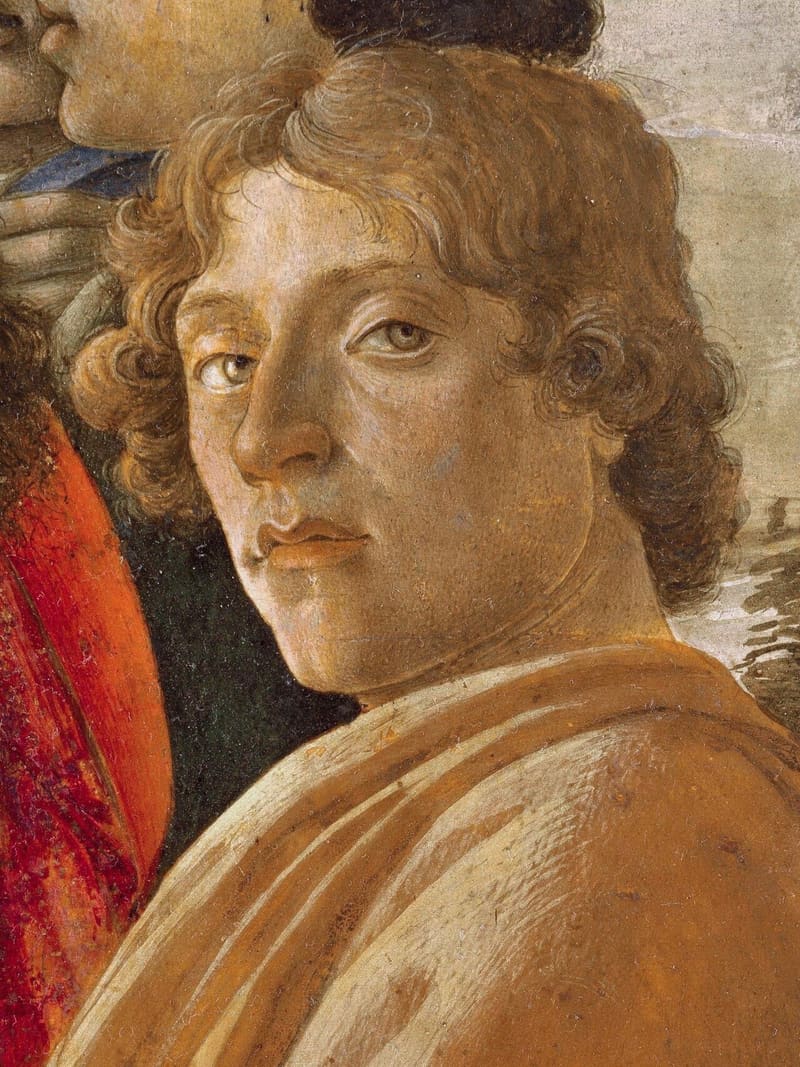
Florence’s ruling Medici family and their circle became Botticelli’s most important patrons. In The Adoration of the Magi (c. 1475), now in the Uffizi, he painted members of the family as the three kings and, it is generally believed, himself, at the far right edge, looking out at the viewer. That face is shown above.
For the same circle he painted the works that made his name: Primavera (c. 1477–1482), a spring garden of gods and nymphs, and The Birth of Venus (c. 1484–1486), with the goddess of love blown ashore on a scallop shell. They were among the first large paintings since antiquity to take classical myths as their subject, and their nude Venus was a bold choice. Both reflect the ideas of the Florentine scholars who tried to reconcile ancient philosophy with Christian faith. Read more about the age in our guide to the Renaissance.
Rome and the Sistine Chapel
In 1481 Pope Sixtus IV called Botticelli to Rome with other leading painters, including Perugino and Ghirlandaio, to decorate the walls of the new Sistine Chapel. He painted three large frescoes there, decades before Michelangelo painted the ceiling above them.
The Savonarola years
In the 1490s the Dominican friar Girolamo Savonarola preached against luxury and pagan art in Florence. Botticelli’s work changed: his later paintings are intensely religious, with sharper emotion and stranger, more archaic compositions. The Mystic Nativity (1500), in the National Gallery, London, is his only signed and dated painting. By the time of his death, on 17 May 1510, his style seemed old-fashioned beside that of Leonardo da Vinci and the young Raphael.
Rediscovery
Botticelli was largely forgotten for more than three centuries. In the 19th century English critics and the Pre-Raphaelite painters fell in love with his flowing lines and wistful faces, and he became one of the most admired artists of the Renaissance. Today The Birth of Venus is among the most recognized paintings in the world.
Works by Sandro Botticelli
- The Birth of Venus · c. 1484–1486
Frequently asked questions
What is Botticelli's most famous painting?
The Birth of Venus (c. 1484–1486), showing the goddess arriving on a scallop shell. It hangs in the Uffizi Gallery in Florence, in the same room as his other great mythology, Primavera.
What does the name Botticelli mean?
It is a nickname, from botticello, 'little barrel'. It seems to have belonged first to his older brother Giovanni and was then used for the whole family. His real name was Alessandro di Mariano Filipepi.
Did Botticelli burn his paintings?
There is a long-standing story that he threw some of his own paintings onto Savonarola's 'bonfires of the vanities' in the 1490s, but there is no firm evidence for it. What is clear is that his late work became more austere and religious.