Artwork · 1839
The Fighting Temeraire by J.M.W. Turner: Meaning and History
- Artist
- J.M.W. Turner
- Date
- 1839
- Medium
- Oil on canvas
- Dimensions
- 90.7 × 121.6 cm
- Collection
- National Gallery, London
- Movement
- Romanticism
- Medium guide
- Oil painting
What the painting shows
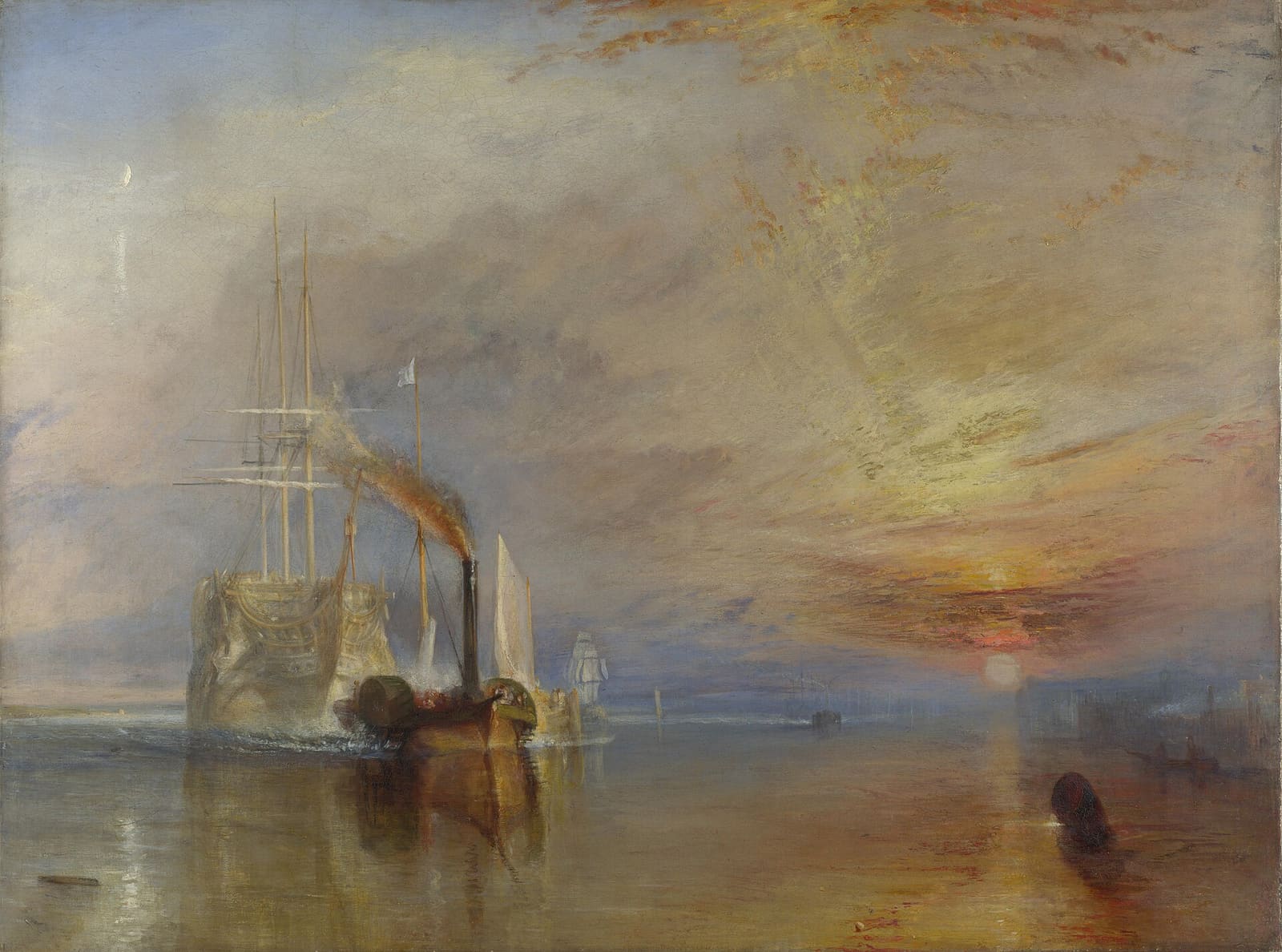
On a broad, calm river, a small, dark steam tug churns forward, its tall funnel pouring out smoke and sparks. Behind it, towed like a ghost, comes a great sailing warship, pale and silvery, its masts rising into the evening air. On the right the sun sets in a blaze of red, orange and gold, reflected in the water; on the left a thin new moon rises in a cool blue sky.
The ship
HMS Temeraire was a 98-gun ship of the line launched in 1798. At the Battle of Trafalgar in 1805 she fought immediately behind Nelson’s flagship Victory and came to its aid, earning the nickname “the Fighting Temeraire”. By 1838 she was old and obsolete. The Admiralty sold her, and in September of that year she was towed up the Thames from Sheerness to a shipbreaker’s yard at Rotherhithe in London to be taken apart for timber.
The end of an era
Turner turned the event into a meditation on time and change. The old ship, a symbol of national glory, is pale and passive; the tug, the new technology of steam, is dark, small and businesslike. The setting sun seems to mark the end of her life and of the age of sail itself. Turner did not paint a factual record: by 1838 the Temeraire had already lost her masts and rigging, but he gave them back to her, to make her as beautiful as possible at her end.
The thick, glowing paint of the sky, laid on with brush and palette knife, shows the freedom of Turner’s late style, which led critics to call him the painter of light.
Turner’s darling
Turner exhibited the picture at the Royal Academy in 1839 under the title The Fighting Temeraire, tugged to her last berth to be broken up, 1838, and it was widely praised. He refused to sell it, reportedly calling it his “darling”, and left it to the nation in his bequest. In 2005 listeners to a BBC Radio 4 poll voted it the greatest painting in a British collection, and it appears on the back of the Bank of England £20 note behind Turner’s self-portrait.
Where to see it
The Fighting Temeraire is in the National Gallery in London, Trafalgar Square, which also owns Turner’s Rain, Steam and Speed. Much more of his work is at Tate Britain.
Frequently asked questions
What was the Temeraire?
HMS Temeraire was a 98-gun Royal Navy warship that fought with great distinction at the Battle of Trafalgar in 1805, sailing into action just behind Nelson's flagship, HMS Victory. In 1838 she was sold and towed up the Thames to be broken up.
Is The Fighting Temeraire accurate?
Not entirely. By 1838 the ship had been stripped of her masts and rigging, but Turner painted her with masts standing, pale and ghostly. He was after the meaning of the moment, the end of the age of sail, more than a factual record.
What is the full title of the painting?
When Turner exhibited it at the Royal Academy in 1839 he called it The Fighting Temeraire, tugged to her last berth to be broken up, 1838.