Artist · British
J.M.W. Turner: Life, Paintings and Legacy
- Born
- April 23, 1775, London, England
- Died
- December 19, 1851, London, England
- Nationality
- British
- Movement
- Romanticism
- Mediums
- Oil painting
- Era
- 19th century
A barber’s son at the Royal Academy
Joseph Mallord William Turner was born in Covent Garden, London, in the spring of 1775; he gave his birthday as 23 April. His father was a barber and wigmaker who proudly displayed the boy’s drawings in his shop window. At 14 Turner entered the Royal Academy Schools, and the next year one of his watercolors was accepted for the Academy’s exhibition. He was elected a full Royal Academician in 1802, at just 26.
As a young man he toured Britain making topographical watercolors of castles, abbeys and mountains, and he never stopped traveling: the Alps, the Rhine, France and, from 1819, Italy and above all Venice.
Painting the power of nature
Turner wanted landscape to rival history painting, the most prestigious type of art. In Snow Storm: Hannibal and His Army Crossing the Alps (1812, Tate) the ancient general’s soldiers are tiny figures beneath a vast, swirling vortex of black cloud. Nature’s overwhelming force, the sublime, was a central theme of Romanticism, shared with his German contemporary Caspar David Friedrich.
Light, steam and modern life
In his later work outlines dissolved into light and color. The Fighting Temeraire (1839, National Gallery, London) shows a veteran warship from the Battle of Trafalgar being towed to the breaker’s yard by a small, dark steam tug, under a flaming sunset: the end of the age of sail. Rain, Steam and Speed: The Great Western Railway (1844, National Gallery) shows a train rushing toward the viewer across a bridge, almost lost in rain and mist.
Turner claimed that for Snow Storm: Steam-Boat off a Harbour’s Mouth (1842) he had himself tied to a ship’s mast during a storm. Whether or not it is true, critics of the time mocked such pictures as “soapsuds and whitewash”. The young critic John Ruskin defended him passionately in Modern Painters (1843).
Death and the Turner Bequest
Turner never married and lived increasingly privately in later life. He died in Chelsea, London, on 19 December 1851 and was buried in St. Paul’s Cathedral. He left the contents of his studio to the nation: about 300 oil paintings and some 30,000 sketches and watercolors, now known as the Turner Bequest and housed mainly at Tate Britain.
Legacy
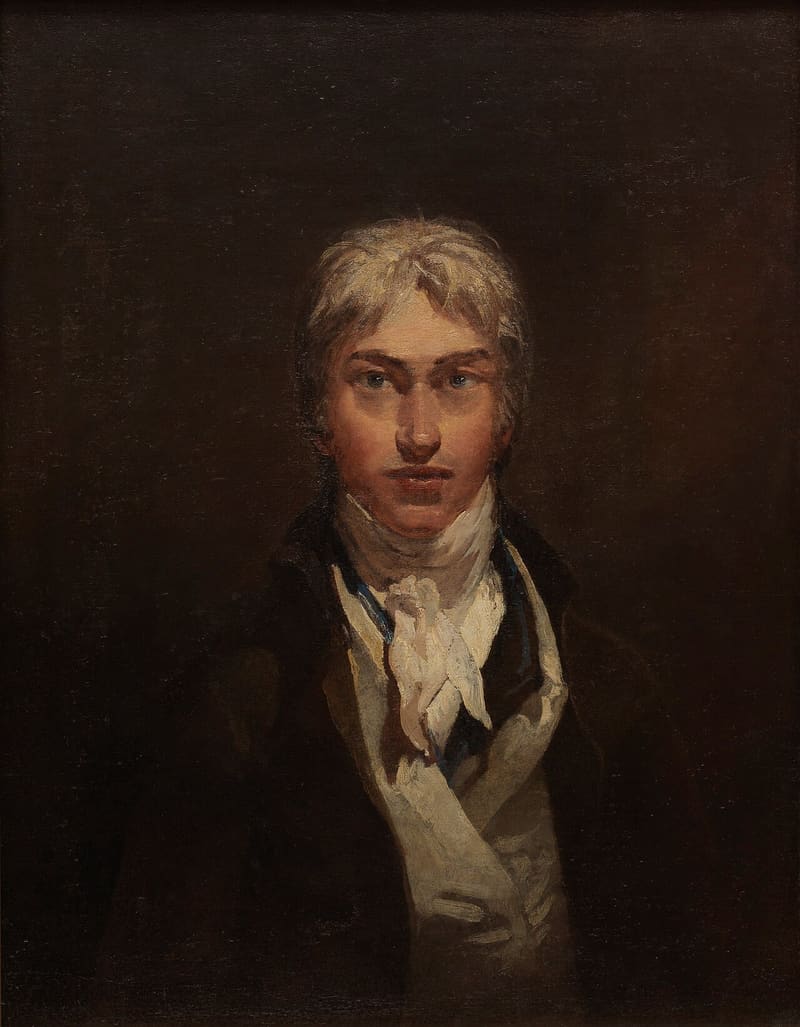
Claude Monet studied Turner’s paintings during his stay in London in 1870–1871, and Turner’s late works are often seen as anticipating Impressionism and even abstract art. Britain’s leading contemporary art award, the Turner Prize, has been named after him since 1984, and his self-portrait appears on the Bank of England £20 note.
Works by J.M.W. Turner
- The Fighting Temeraire · 1839
Frequently asked questions
What is J.M.W. Turner famous for?
For landscapes and seascapes in which light, weather and color matter more than outlines: storms at sea, blazing sunsets, Venice in haze, and steam trains in the rain. He is often called 'the painter of light'.
Where can I see Turner's paintings?
The largest collection by far is the Turner Bequest at Tate Britain in London, which holds hundreds of his oil paintings and tens of thousands of watercolors and sketches. The National Gallery in London owns The Fighting Temeraire and Rain, Steam and Speed.
Was Turner an Impressionist?
No. He died in 1851, before Impressionism began, and he is counted among the Romantics. But Claude Monet saw his paintings in London in 1870–1871, and Turner's loose, light-filled late works are often seen as a forerunner of Impressionism.