Art movement · c. 1790–1850
Romanticism in Art: History, Artists and Key Works
What is Romanticism?
Romanticism was a movement in art, literature and music that spread across Europe from the 1790s to the middle of the 19th century. It rebelled against the cool reason of the Enlightenment and the strict rules of Neoclassical art, which prized clear outlines, balanced compositions and moral lessons drawn from ancient history. Romantic artists trusted feeling instead: awe before nature, horror at violence, longing for the past, the passions of revolution.
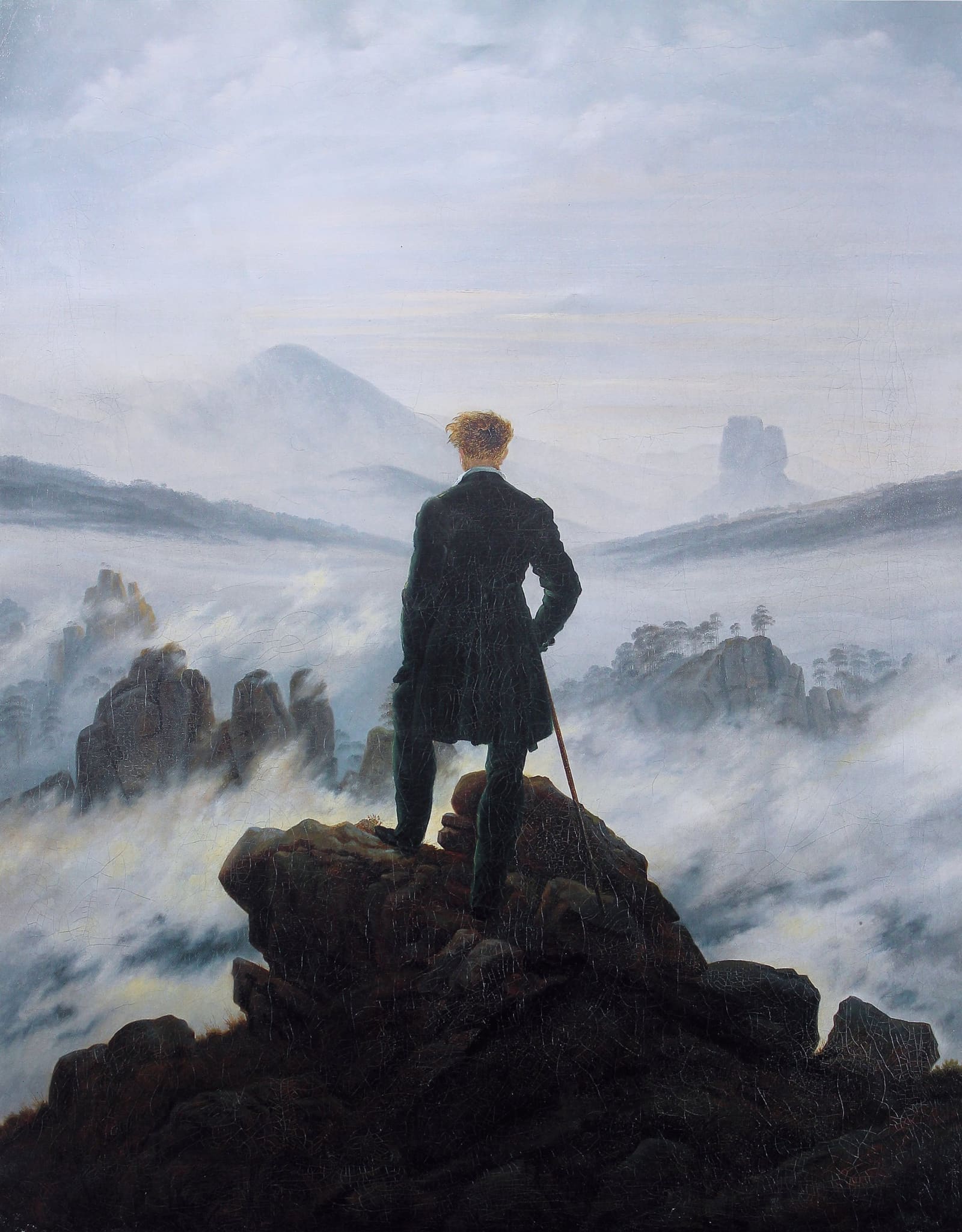
There was never one Romantic style. A misty German mountaintop, a blazing English sunset and a crowded French battle scene can all be Romantic, because what unites them is the artist’s urge to move the viewer and express an inner experience.
Origins
Romanticism grew out of an age of upheaval. The French Revolution of 1789 and the Napoleonic Wars that followed overturned the old order across Europe, and the Industrial Revolution was transforming the countryside. Writers such as Goethe, Wordsworth and Byron celebrated the individual, the imagination and the power of nature, and painters followed.
An important idea was the sublime, described by the philosopher Edmund Burke in 1757: the thrilling mixture of awe and fear we feel before something vast and dangerous, such as a storm at sea or a towering mountain.
Romanticism across Europe
Germany
Caspar David Friedrich painted lonely figures, often seen from behind, contemplating vast landscapes, ruined abbeys and empty seas. In Wanderer above the Sea of Fog (about 1818) the viewer stands with the traveler on the summit, sharing his view into the unknown.
Britain
J.M.W. Turner dissolved ships, storms and steam trains into swirling light and color in works such as The Fighting Temeraire (1839) and Rain, Steam and Speed (1844). John Constable painted the English countryside with new freshness in The Hay Wain (1821), and William Blake created visionary images for his own poems.
France
Théodore Géricault’s huge Raft of the Medusa (1818 to 1819) turned a recent shipwreck scandal into a scene of desperation and hope. Eugène Delacroix became the leader of French Romanticism with vivid color and violent energy, most famously in Liberty Leading the People (1830), painted to commemorate the July Revolution in Paris.
Spain
Francisco Goya bridged Romanticism and modern art. The Third of May 1808 (1814) shows the execution of Spanish civilians by Napoleon’s troops with brutal directness, and his late “Black Paintings” explore nightmare and madness.
Key characteristics
Emotion over reason
Paintings aim to make you feel awe, pity, terror or longing, rather than to instruct.
Nature and the sublime
Landscape rose from a minor genre to a major one, showing nature as vast, powerful and spiritual.
Color and brushwork
Many Romantics, Delacroix and Turner above all, favored rich color and energetic, visible brushwork over the crisp drawing of Neoclassicism.
History, revolution and the exotic
Contemporary events, medieval legends and imagined visions of North Africa and the Middle East replaced the calm heroes of ancient Rome.
Romanticism vs Realism
By the 1840s a younger generation found Romanticism too theatrical. The painters of Realism, led by Gustave Courbet, turned away from imagination and drama to paint ordinary people and everyday life exactly as they found them.
Before and after Romanticism
- Came before: Neoclassicism (c. 1760–1830)
- Came after: Realism (c. 1840–1880)
Mediums and era
- Medium: Oil painting
- Era: 19th century
Frequently asked questions
What is Romanticism in art?
A movement of roughly 1790 to 1850 that valued emotion, imagination and individual experience over reason and classical rules. Romantic artists painted wild nature, dramatic history, revolution and the exotic, aiming to stir feeling rather than teach a lesson.
Does Romanticism have to do with love?
Not mainly. The name comes from the medieval 'romance', a tale of adventure and imagination. Romantic art is about intense feeling of every kind: awe, terror, longing, grief and political passion as much as love.
What is the sublime?
A feeling of awe mixed with fear, inspired by things vast or powerful enough to overwhelm us, such as storms, mountains or the sea. The philosopher Edmund Burke described it in 1757, and it became central to Romantic landscape painting.
Who are the most famous Romantic painters?
Caspar David Friedrich in Germany; J.M.W. Turner, John Constable and William Blake in Britain; Théodore Géricault and Eugène Delacroix in France; and Francisco Goya in Spain.