Artwork · c. 1495–1498
The Last Supper by Leonardo da Vinci: Meaning, Technique and Survival
- Artist
- Leonardo da Vinci
- Date
- c. 1495–1498
- Medium
- Tempera and oil on plaster
- Dimensions
- 460 × 880 cm
- Collection
- Santa Maria delle Grazie, Milan
- Movement
- Renaissance
The moment it shows
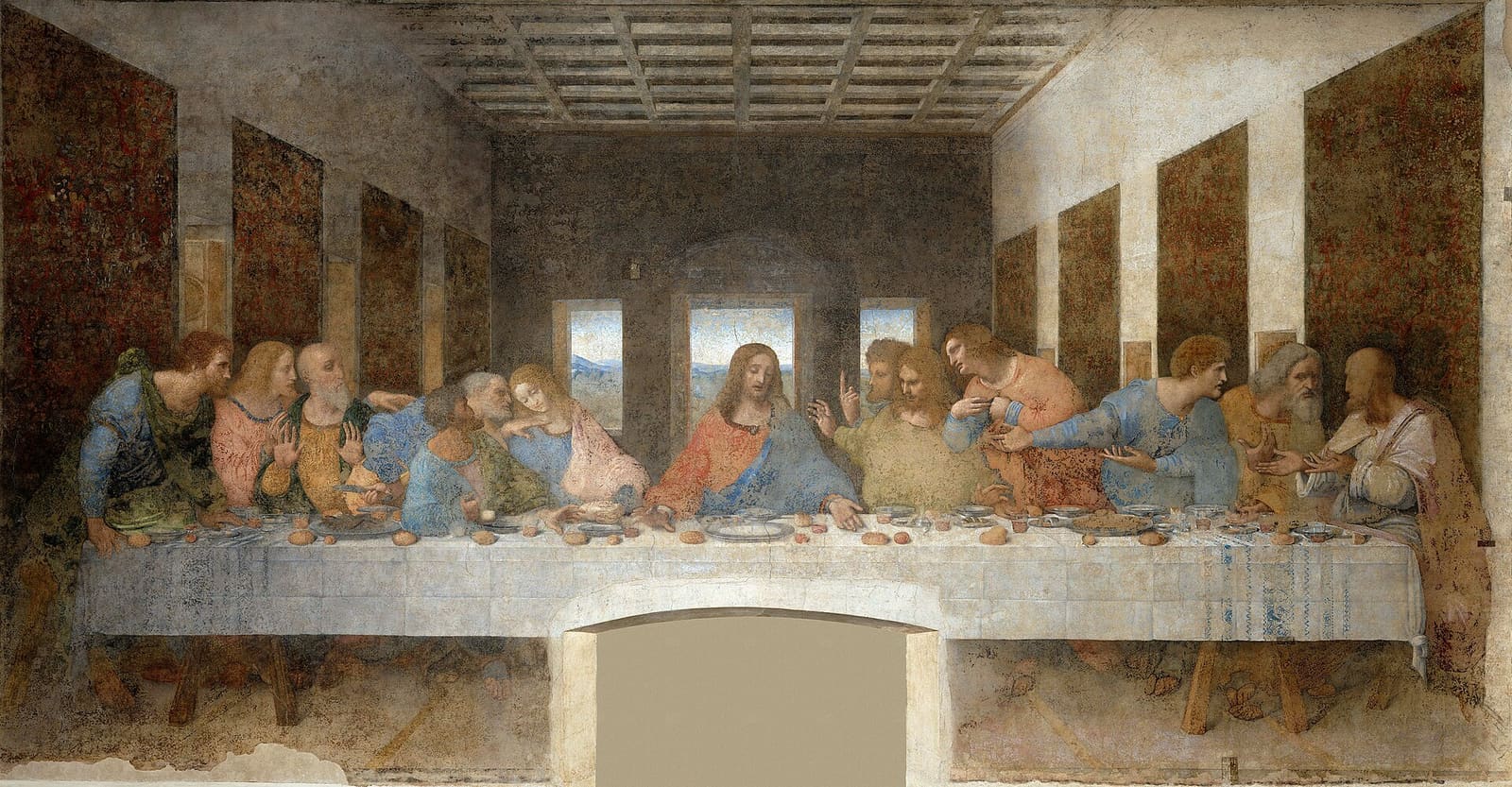
Leonardo chose the most dramatic instant of the story, from the Gospels: Jesus has just told his twelve disciples, “One of you will betray me.” He sits calm at the center, arms spread across the table. Around him the apostles erupt in shock, questions and denial, arranged in four groups of three. Peter leans in with a knife, John sways away, Thomas raises a finger, and Judas pulls back into shadow, clutching his purse.
The architecture holds the uproar together. All the lines of the ceiling and walls run toward a single vanishing point at Jesus’s head, and the brightest window frames him like a halo. It is a textbook of the one-point perspective that Renaissance painters had perfected.
An experiment that failed
Ludovico Sforza, Duke of Milan, commissioned the mural for the dining hall of the Dominican friars at Santa Maria delle Grazie, and Leonardo da Vinci worked on it from about 1495 to 1498. True fresco must be painted fast on wet plaster, which did not suit an artist who liked to think, revise and build up subtle layers. So Leonardo sealed the dry wall and painted on it with tempera and oil. It looked magnificent, but the paint did not bind to the wall. Within decades visitors were describing it as ruined.
How it survived
The painting has survived almost everything. In 1652 a doorway was cut through the bottom of the wall, removing Jesus’s feet. Clumsy repaintings over the centuries buried Leonardo’s work. In August 1943 an Allied bomb destroyed much of the refectory; the mural survived, protected by sandbags and scaffolding.
A restoration lasting from 1978 to 1999 removed centuries of grime and earlier overpainting. What remains of Leonardo’s own paint is fragile and incomplete, but the faces and gestures now read with a clarity that had not been seen for hundreds of years.
How to visit
The refectory, known as the Cenacolo Vinciano, is next to the church of Santa Maria delle Grazie in Milan. The church and convent are a UNESCO World Heritage Site. Entry is by timed ticket only, in small groups for about 15 minutes, with the air filtered to protect the wall. Book as early as you can. The mural is huge, about 4.6 × 8.8 meters, and is best seen from the back of the room, where Leonardo’s perspective makes the painted room seem to open out of the real one.
More works by Leonardo da Vinci
- Mona Lisa · c. 1503–1519
Frequently asked questions
Where is The Last Supper?
On the end wall of the refectory (dining hall) of the former Dominican convent of Santa Maria delle Grazie in Milan, Italy, where Leonardo painted it. It cannot be moved.
Is The Last Supper a fresco?
Not a true one. Instead of painting quickly onto wet plaster, Leonardo used tempera and oil on a dry, sealed wall so he could work slowly. The paint failed to bond and began flaking within his lifetime.
Which one is Judas in The Last Supper?
Judas is in the group of three immediately to the viewer's left of Jesus, the dark-haired figure leaning back in shadow and clutching a small bag, usually read as the silver he was paid. Unusually for the time, Leonardo seated him on the same side of the table as everyone else.
How do you visit The Last Supper?
Only with a timed ticket. Small groups are admitted for about 15 minutes at a time to protect the painting, and tickets usually need to be booked well in advance.