Artwork · 1893
The Scream by Edvard Munch: Meaning, Versions and Thefts
- Artist
- Edvard Munch
- Date
- 1893
- Medium
- Tempera and crayon on cardboard
- Dimensions
- 91 × 73.5 cm
- Collection
- National Museum, Oslo
- Movement
- Expressionism
The sunset walk
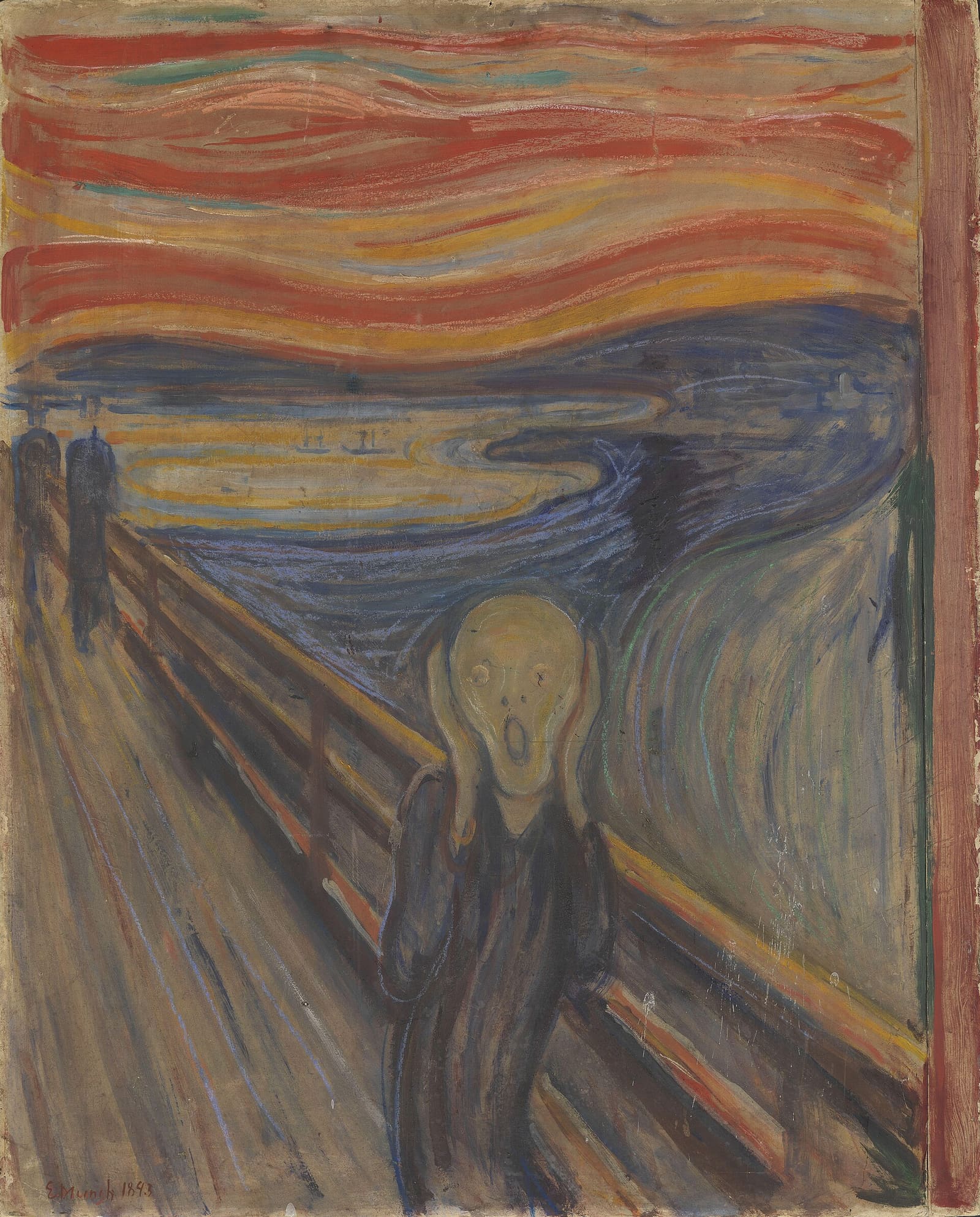
Edvard Munch described the experience behind the painting in his notebooks. Walking along a road above the fjord of Kristiania (now Oslo) with two friends at sunset, he felt a wave of sadness. The sky turned blood red. His friends walked on, while he stood “trembling with anxiety,” and sensed “an infinite scream passing through nature.” The road is generally identified with the hill of Ekeberg, which looks out over the city and the fjord.
What the painting shows
A figure with a skull-like head and a sinuous, almost boneless body stands at a railing, hands pressed to its face. Behind it the road and railing shoot back in a steep diagonal toward two dark figures walking away. Beyond, the blue-black fjord and land swirl in waves, and the sky burns in bands of orange, red and yellow. The whole landscape seems to vibrate with the scream, as if the figure’s anguish had spread into the world.
How it was painted
The 1893 version is painted in tempera and crayon on cardboard, with areas of the board left bare. Munch’s German title was Der Schrei der Natur, “The Scream of Nature.” In the red sky, faintly penciled, are the words “Can only have been painted by a madman!” For years it was thought a visitor had written them; in 2021 the National Museum concluded from handwriting analysis that they were written by Munch himself.
People have suggested many sources for the sky, including the vivid sunsets seen across Europe after the eruption of Krakatoa in 1883 and rare mother-of-pearl clouds over Norway. Munch’s own account describes a feeling rather than a weather event.
Versions and thefts
Munch returned to the image several times: a pastel in 1893, another pastel and a lithograph in 1895, and a second painting around 1910. In 2012 the 1895 pastel, the only version in private hands, sold at auction in New York for nearly 120 million dollars.
On 12 February 1994, the day the Winter Olympics opened in Lillehammer, thieves climbed a ladder into the National Gallery in Oslo and took the 1893 painting, leaving a note thanking the museum for its poor security. It was recovered undamaged in May. In 2004 armed men stole the later painted version from the Munch Museum in front of visitors; it was found in 2006, damaged by moisture, and restored.
Where to see it
The 1893 painting hangs in the National Museum in Oslo, in a room devoted to Munch. It is the most famous forerunner of Expressionism and has become a universal symbol of modern anxiety.
Frequently asked questions
Is the figure in The Scream screaming?
Not exactly. Munch described hearing 'an infinite scream passing through nature'. The figure covers its ears against that scream, so it is reacting to the cry rather than making it.
How many versions of The Scream are there?
Munch made two painted versions (1893 and 1910), two in pastel (1893 and 1895) and a lithograph (1895). The 1893 painting is in the National Museum in Oslo; the 1910 painting and the 1893 pastel are in the MUNCH museum, also in Oslo.
Was The Scream stolen?
Twice, in different versions. The 1893 painting was stolen from the National Gallery in Oslo in February 1994 and recovered three months later. The 1910 version was taken from the Munch Museum by armed robbers in 2004 and recovered in 2006.