Artwork · 1889
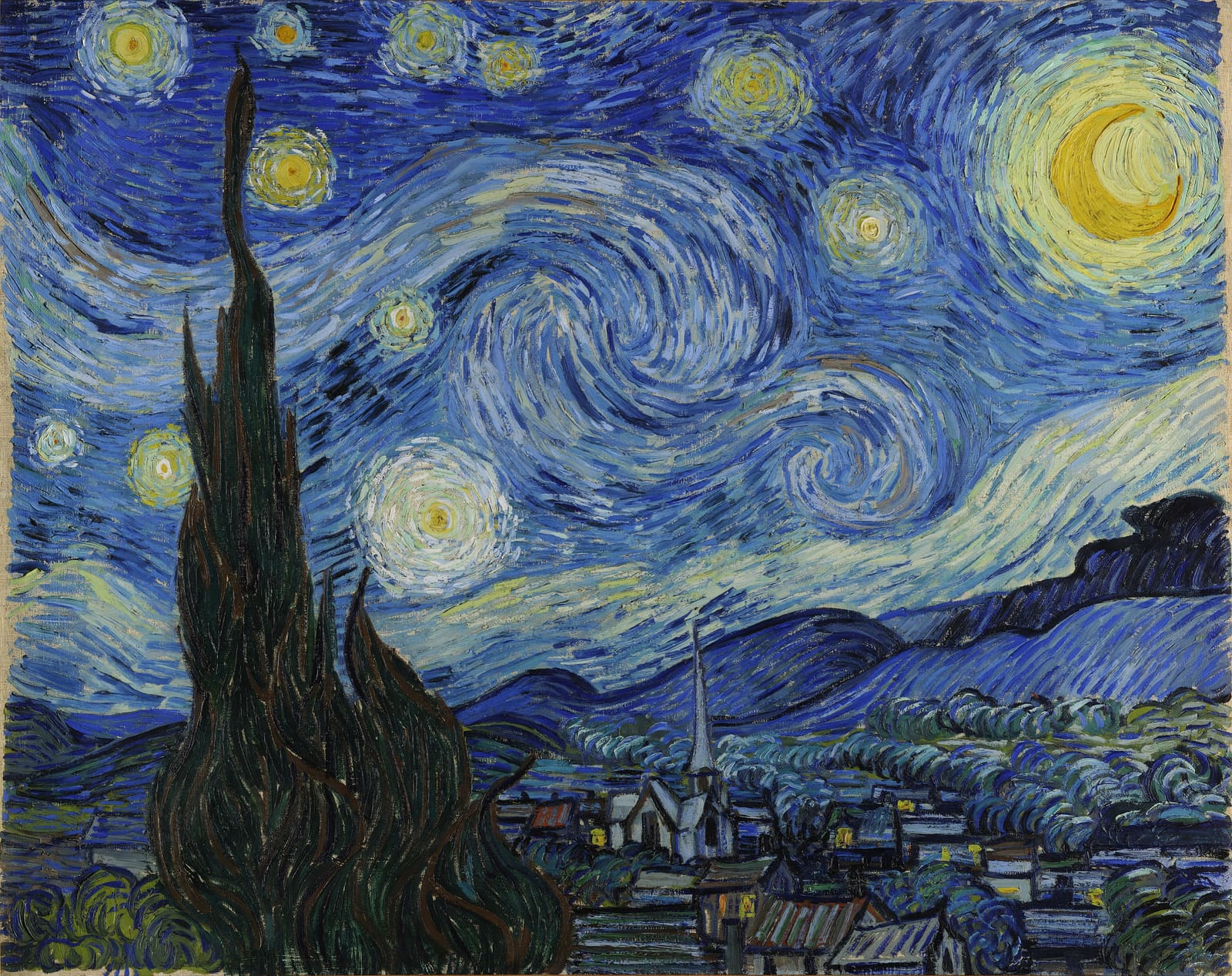
The Starry Night by Vincent van Gogh: The View From an Asylum Window
- Artist
- Vincent van Gogh
- Date
- 1889
- Medium
- Oil on canvas
- Dimensions
- 73.7 × 92.1 cm
- Collection
- Museum of Modern Art, New York
- Movement
- Post-Impressionism
- Medium guide
- Oil painting
Where and when it was painted
In May 1889, after months of crises that followed the famous episode with his ear in Arles, Vincent van Gogh admitted himself to the asylum of Saint-Paul-de-Mausole outside Saint-Rémy-de-Provence. His barred bedroom window looked east over a walled wheat field toward the low Alpilles hills. He painted that view more than a dozen times, at different hours and seasons.
The Starry Night was painted in June 1889. Van Gogh was not allowed to paint in his bedroom, so he worked from drawings and memory in a ground-floor studio room he had been given.
What is real and what is imagined
The hills, the field and the sky above them come from the window. Much of the rest does not. The view from his room did not include a village, and the church spire is taller and more pointed than any in Provence, closer to the churches of his native Netherlands. The great cypress in the foreground, shaped like a dark flame, was moved forward to tie the earth to the sky.
The sky is the painting’s real subject. Eleven stars and a crescent moon blaze inside halos of yellow and white, and a huge spiral rolls across the center. The brightest point, just right of the cypress, is probably Venus: shortly before, Van Gogh had written to his brother Theo that he had watched the countryside “a long time before sunrise, with nothing but the morning star, which looked very big.”
How it was painted
Van Gogh laid the paint on thickly, in short, directional strokes that follow the shapes they describe: curving through the sky, flickering upward in the cypress, running horizontally across the hills. Dark contour lines and strong blues and yellows make it far more expressive than the Impressionist landscapes he had admired in Paris. This move from recording what the eye sees to expressing what the painter feels is the heart of Post-Impressionism.
What Van Gogh thought of it
He did not think of it as a masterpiece. He sent it to Theo in Paris that autumn among a batch of canvases, and in a letter to Émile Bernard he described reaching for “stars that are too big” as another failure. He died the following summer, in July 1890, never knowing it would become one of the most reproduced images in the world.
Where to see it
The Starry Night has been in the collection of the Museum of Modern Art in New York since 1941. It measures 73.7 × 92.1 cm, about 29 × 36 inches.
Frequently asked questions
Where is The Starry Night?
At the Museum of Modern Art (MoMA) in New York, which acquired it in 1941 through the Lillie P. Bliss Bequest.
Where did Van Gogh paint The Starry Night?
At the Saint-Paul-de-Mausole asylum in Saint-Rémy-de-Provence, in southern France, where he admitted himself in May 1889. It is based on the view from his bedroom window, though the village was largely imagined.
Did Van Gogh think The Starry Night was a good painting?
Not especially. He sent it to his brother Theo with other works and, in a letter to the painter Émile Bernard later that year, grouped it with experiments he considered failures.
What is the bright star in The Starry Night?
Probably Venus, the morning star. Van Gogh wrote to Theo that he had watched the countryside from his window before sunrise with nothing but the morning star, which looked very big.