Art movement · c. 1905–1925
Expressionism: History, Artists and Key Works
What is Expressionism?
Expressionism is art that shows how the world feels rather than how it looks. Expressionist painters bent and exaggerated forms, used harsh or unnatural color and handled paint roughly, all to convey emotions such as anxiety, longing, ecstasy or alienation. The term covers painting, printmaking, theater, film and architecture, and was used most of all for German and Austrian art from about 1905 to the mid-1920s.
Forerunners
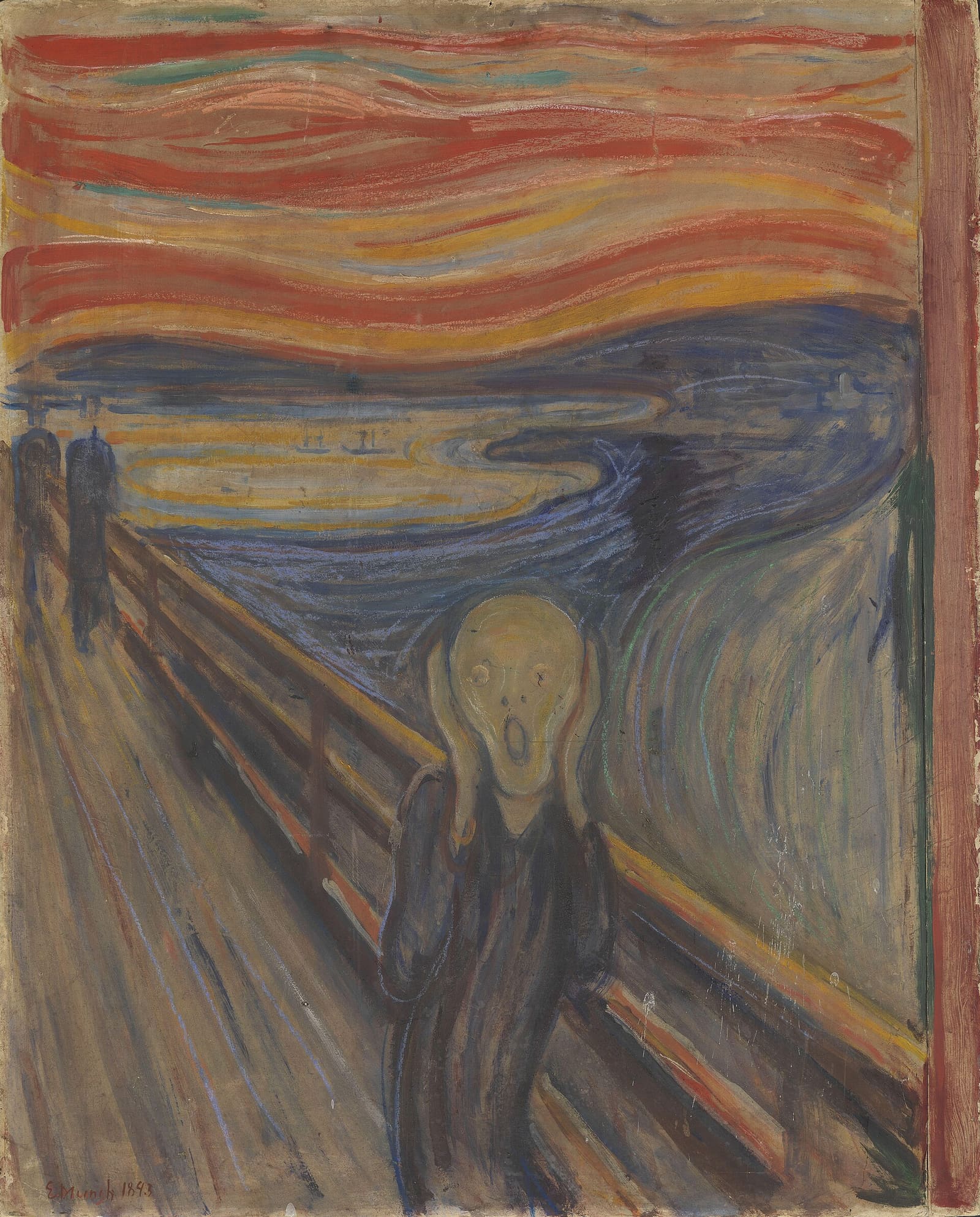
The Expressionists had important ancestors. Vincent van Gogh used color and swirling brushwork to express emotion. The Belgian James Ensor painted crowds of grotesque masks. Above all, the Norwegian Edvard Munch turned his own fears into images. The Scream (1893), shown above, grew from a moment he described when walking at sunset: the sky turned blood red, and he sensed “an infinite scream passing through nature.” The painting has become an emblem of modern anxiety.
Die Brücke (The Bridge)
In 1905, the same year the Fauves exhibited in Paris, four architecture students in Dresden, Ernst Ludwig Kirchner, Erich Heckel, Karl Schmidt-Rottluff and Fritz Bleyl, founded Die Brücke. They wanted to make a bridge to the art of the future. They painted nudes in the open air, harsh city scenes and portraits in clashing colors with jagged outlines, and they revived the woodcut, gouging bold black-and-white images from the block. After moving to Berlin, Kirchner painted his famous street scenes of the city’s nervous, glittering nightlife. The group broke up in 1913.
Der Blaue Reiter (The Blue Rider)
In Munich in 1911, the Russian painter Wassily Kandinsky and the German Franz Marc formed Der Blaue Reiter, named after a painting by Kandinsky and the two artists’ love of horses and of the color blue. Their concerns were more spiritual than Die Brücke’s. Marc painted animals in symbolic colors, blue horses and yellow cows, and Kandinsky moved step by step toward pure abstraction, believing that color and form could speak directly to the soul, like music. The First World War ended the group: Marc and August Macke were both killed in action.
Vienna
In Vienna, Egon Schiele and Oskar Kokoschka created a raw, psychological Expressionism of their own: twisted, angular bodies and portraits that seem to expose their sitters’ nerves.
Key characteristics
Distortion
Bodies, faces and spaces stretched, simplified or twisted for emotional effect.
Intense, unnatural color
Color used for its emotional charge, often clashing and harsh.
Raw technique
Rough brushwork, jagged outlines and the bold cuts of the woodcut.
Inner experience
The subject is the artist’s feelings, or the anxieties of modern life, not the visible world.
Suppression and legacy
After the Nazis came to power, Expressionism was condemned as “degenerate.” In 1937 they confiscated thousands of works from German museums and paraded many in the Degenerate Art exhibition; Kirchner, devastated, took his own life the following year. Yet the movement’s influence outlived its persecutors. It shaped German silent cinema, and after 1945 Abstract Expressionism in New York took its name and its emotional intensity from these artists.
Major Expressionist artists
- Edvard Munch · 1863–1944
Famous Expressionist works
- The Scream · 1893
Before and after Expressionism
- Came before: Post-Impressionism (c. 1886–1905)
- Came before: Fauvism (c. 1905–1908)
Mediums and era
- Medium: Oil painting
Frequently asked questions
What is Expressionism in art?
An approach to art, strongest in Germany and Austria from about 1905 to 1925, in which artists distorted form and color to express inner emotion rather than to show the world as it looks.
Is The Scream Expressionist?
It came before the movement, in 1893, but it is the most famous forerunner of Expressionism. Munch's use of distorted form and lurid color to express anxiety was a direct inspiration for the German Expressionists.
What were Die Brücke and Der Blaue Reiter?
The two main German Expressionist groups. Die Brücke ('The Bridge') was founded in Dresden in 1905 by Ernst Ludwig Kirchner and friends; Der Blaue Reiter ('The Blue Rider') was formed in Munich in 1911 around Wassily Kandinsky and Franz Marc.
Why did the Nazis ban Expressionism?
They condemned modern art as 'degenerate'. In 1937 they seized thousands of works from German museums, and they mocked Expressionist paintings in a touring exhibition called Entartete Kunst (Degenerate Art).