Artwork · c. 1818
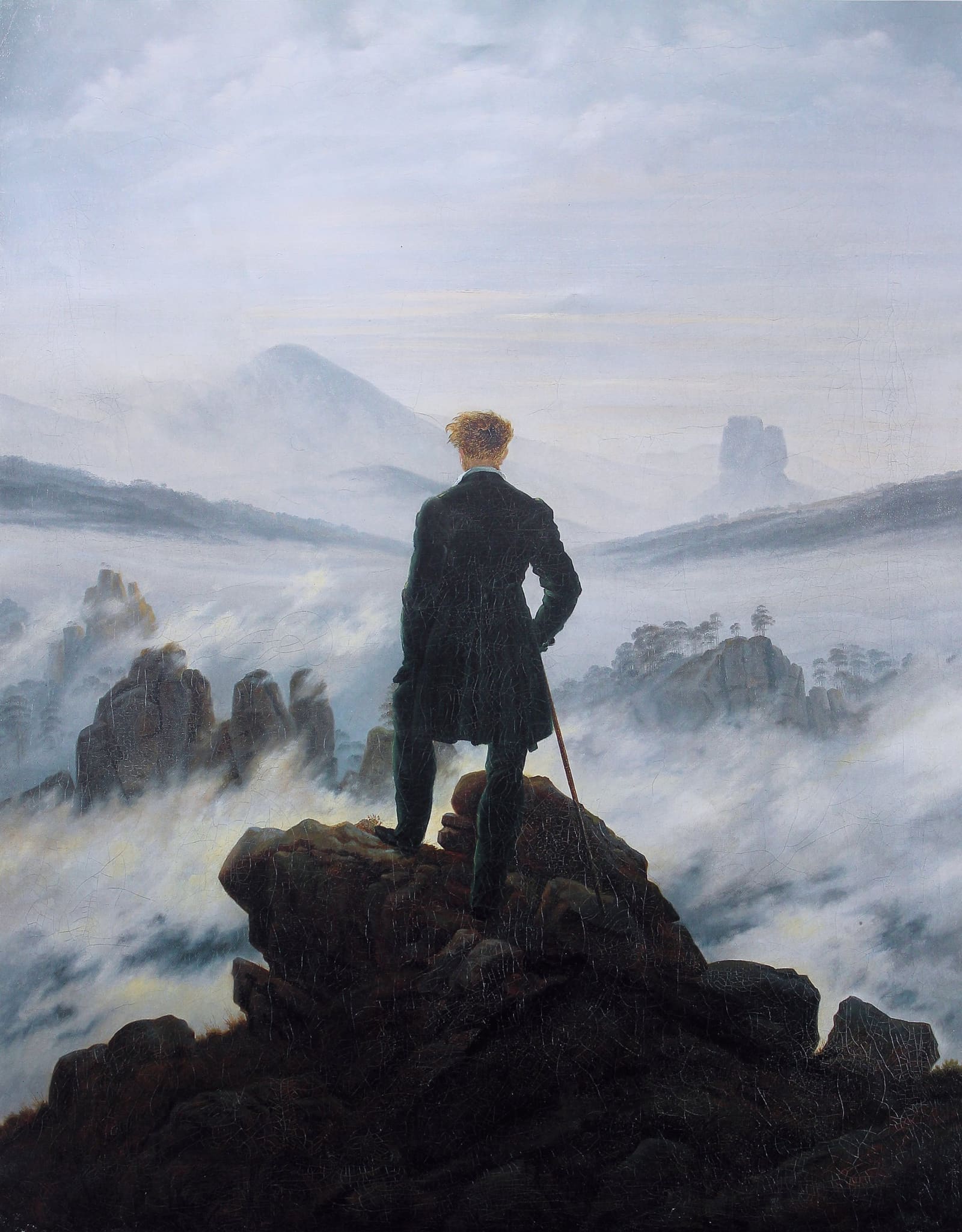
Wanderer above the Sea of Fog by Caspar David Friedrich
- Artist
- Caspar David Friedrich
- Date
- c. 1818
- Medium
- Oil on canvas
- Dimensions
- 94.8 × 74.8 cm
- Collection
- Hamburger Kunsthalle, Hamburg
- Movement
- Romanticism
- Medium guide
- Oil painting
What the painting shows
A man in a dark green frock coat stands on a jagged outcrop of rock, his back to us, leaning on a walking stick. Below him a sea of fog fills the valleys, broken by rocky ridges and the tops of trees. In the distance a mountain rises, and beyond it the mist merges with the sky. His hair is ruffled by the wind. We do not see his face; we see what he sees.
The figure from behind
Caspar David Friedrich often placed figures with their backs to the viewer, a device known in German as the Rückenfigur. Here the wanderer stands right in the center, at the peak of the composition, so that we look over his shoulder and share his experience. He becomes a stand-in for each of us, alone before nature. His old-fashioned German costume, worn by patriotic students in the years of the wars against Napoleon, may also have carried a political meaning for Friedrich’s first viewers.
A composed landscape
Friedrich did not paint outdoors. He made careful drawings on walking tours and combined them in the studio. The rocks and peaks of this view come from sketches made in the Elbe Sandstone Mountains, the region known as Saxon Switzerland, south-east of Dresden, rearranged into a single imaginary vision. The fog hides how they connect, making the space seem endless.
The sublime
The painting is the best-known image of the Romantic idea of the sublime: the awe, and even fear, a person feels before something vast and overwhelming, such as mountains, storms or the sea. Whether the wanderer is triumphant, lost in thought or facing the unknowable is left open. That openness, and the turn from describing nature to expressing feeling through it, makes this a defining work of Romanticism.
Where to see it
The painting’s early history is poorly documented, and its date is usually given as about 1818. It has hung in the Hamburger Kunsthalle since 1970, and is now one of the most reproduced images in German art, found on countless book covers about philosophy, history and the self. It is smaller than many visitors expect, about 95 × 75 cm.
Frequently asked questions
Where is Wanderer above the Sea of Fog?
In the Hamburger Kunsthalle, the art museum of Hamburg, Germany, which acquired it in 1970.
Is the landscape in Wanderer above the Sea of Fog real?
Its parts are. Friedrich combined rock formations and peaks from sketches made in the Elbe Sandstone Mountains, south-east of Dresden, into an imaginary view. No single spot looks exactly like it.
Who is the man in Wanderer above the Sea of Fog?
Nobody knows. Because we see him only from behind, he stands for anyone, which is the point. Some have suggested he is a portrait of a particular person, or of Friedrich himself, but there is no firm evidence.