Art movement · c. 1909–1916
Futurism: History, Artists and Key Works
What is Futurism?
Futurism was a movement that wanted to tear down the past and build an art for the machine age. Its painters, poets, musicians and architects celebrated speed, cars, trains, airplanes, electricity, crowds and the roaring industrial city. In painting they tried to show not objects but motion itself: the energy of a running horse, a speeding car, a street full of noise.
Futurism was launched not with a painting but with a manifesto, and it produced dozens more, on painting, sculpture, architecture, music, cooking and even clothing.
The 1909 manifesto
On 20 February 1909 the Italian poet Filippo Tommaso Marinetti published The Founding and Manifesto of Futurism on the front page of the Paris newspaper Le Figaro. It declared that “a roaring car that seems to ride on grapeshot is more beautiful than the Victory of Samothrace,” the famous ancient Greek statue in the Louvre. It called for museums and libraries to be destroyed, praised war as “the world’s only hygiene,” and expressed contempt for women. Italy, Marinetti felt, was weighed down by its glorious past.
In 1910 five painters, Umberto Boccioni, Carlo Carrà, Luigi Russolo, Giacomo Balla and Gino Severini, signed manifestos applying these ideas to painting.
Key artists
Umberto Boccioni
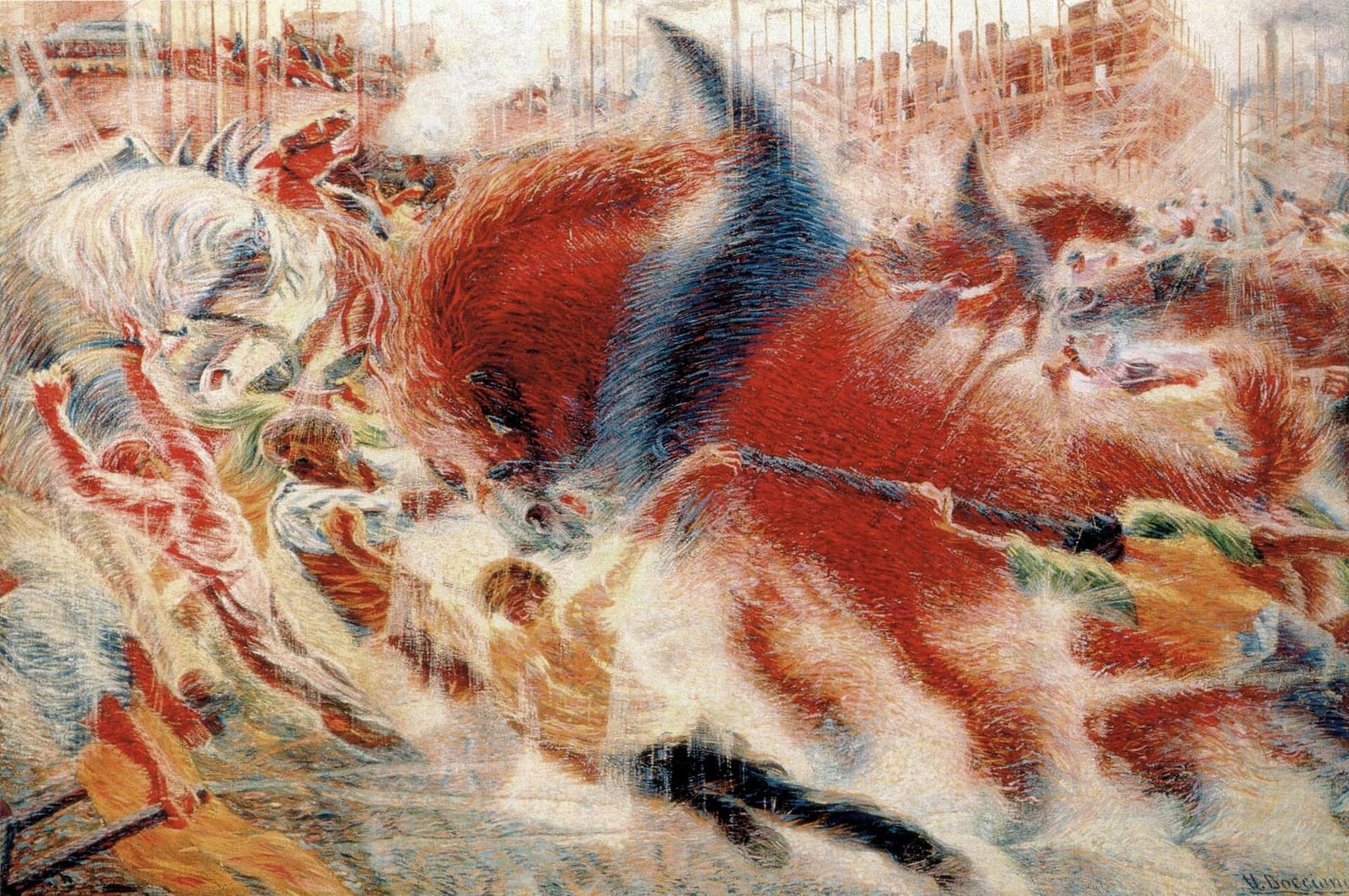
The movement’s leading painter and sculptor. The City Rises (1910), shown above, shows workers and a giant red horse straining to build a new industrial quarter on the edge of Milan, all dissolving into lines of force. His bronze Unique Forms of Continuity in Space (1913) is the most famous Futurist sculpture.
Giacomo Balla
Balla, older than the others, studied movement almost scientifically. In Dynamism of a Dog on a Leash (1912), a dachshund’s legs and its owner’s feet multiply into a blur, like frames of a film.
Gino Severini and Carlo Carrà
Severini, who lived in Paris, painted glittering dance-hall scenes. Carrà’s Funeral of the Anarchist Galli (1910–1911) turns a riot into a storm of clashing diagonals.
Luigi Russolo
A painter who became a pioneer of noise music, Russolo wrote The Art of Noises (1913) and built machines to make sounds of the modern city.
Key characteristics
Dynamism
Repeated forms, blurred edges and lines of force to suggest movement.
Speed and technology
Cars, trains, factories, electric light and the modern city.
Fragmentation
Faceted forms borrowed from Cubism, but full of energy and color rather than still.
Manifestos and provocation
Public declarations, performances and deliberate scandal.
War and legacy
The Futurists campaigned for Italy to enter the First World War, and several volunteered. Boccioni died in 1916 after falling from a horse during military training, and the architect Antonio Sant’Elia was killed in action the same year, ending the movement’s first and most important phase. Marinetti went on to support Mussolini, which has colored the movement’s reputation ever since.
Futurism nonetheless had a wide influence: on Vorticism in Britain, on the Russian avant-garde, on Dada’s provocative performances, and on graphic design and advertising, which took up its dynamic typography.
Before and after Futurism
- Came before: Cubism (c. 1907–1914)
Mediums and era
- Medium: Oil painting
Frequently asked questions
What is Futurism?
An Italian avant-garde movement launched in 1909 by the poet Filippo Tommaso Marinetti. It celebrated speed, machines, violence and the modern city, and called for the destruction of museums and the art of the past.
Who were the Futurist artists?
The main painters were Umberto Boccioni, Carlo Carrà, Luigi Russolo, Giacomo Balla and Gino Severini, who signed the Manifesto of Futurist Painters in 1910. The architect Antonio Sant'Elia and the poet Marinetti were also central.
What is Boccioni's most famous work?
The bronze sculpture Unique Forms of Continuity in Space (1913), a striding figure that seems to stream through the air. It appears on the Italian 20-cent euro coin.
Was Futurism connected to Fascism?
Partly. Marinetti glorified war and later became a supporter of Mussolini, and a 'second Futurism' continued under the Fascist regime. Most of the movement's founding painters were dead or had moved on by then.