Art movement · c. 1907–1914
Cubism: History, Artists and Key Works
What is Cubism?
Cubism is the movement that broke the rules of Western painting set out in the Renaissance. Since the 15th century painters had shown the world from one fixed viewpoint, using perspective to create an illusion of depth. The Cubists gave that up. They broke objects into geometric facets and showed several sides of them at once, as if the viewer were walking around them, and flattened the picture so that it became a construction on the canvas rather than a window onto space.
Origins
Cubism’s roots lie in the late work of Paul Cézanne, who had built landscapes from blocks of color and advised treating nature “by means of the cylinder, the sphere and the cone” (see Post-Impressionism). After his death in 1906, large exhibitions of his work in Paris made a deep impression on young painters. Another influence was African and Oceanic sculpture, which Picasso and others saw in Paris collections.
In 1907 Pablo Picasso painted Les Demoiselles d’Avignon, a large picture of five nude women with fractured bodies and mask-like faces that shocked even his friends. Georges Braque, who had been painting in the style of Fauvism, began working in a similar direction, and in 1908 the critic Louis Vauxcelles, the man who had named the Fauves, described Braque’s new landscapes as reducing everything to “cubes.”
Analytic Cubism (c. 1909–1912)
From 1909 Picasso and Braque worked side by side, seeing each other almost daily. Their paintings of these years, mostly still lifes and figures, are so alike they can be hard to tell apart. Objects such as guitars, bottles and faces are dissected into small, overlapping planes in a narrow palette of browns, ochres and grays, so that the subject almost dissolves. Painted letters and a few clues, a pipe stem, a moustache, the scroll of a violin, help the viewer find their way.
Synthetic Cubism (c. 1912–1914)
In 1912 the two painters began to build their pictures in a new way. Picasso glued a piece of oilcloth printed with a chair-caning pattern onto Still Life with Chair Caning, generally considered the first collage in fine art, and Braque invented papier collé, pasted paper. Images were now assembled from flat, bold shapes, brighter color and real materials such as newspaper and wallpaper. It was a radical idea: a painting could be a real object, not just an illusion of one.
Juan Gris and the wider movement
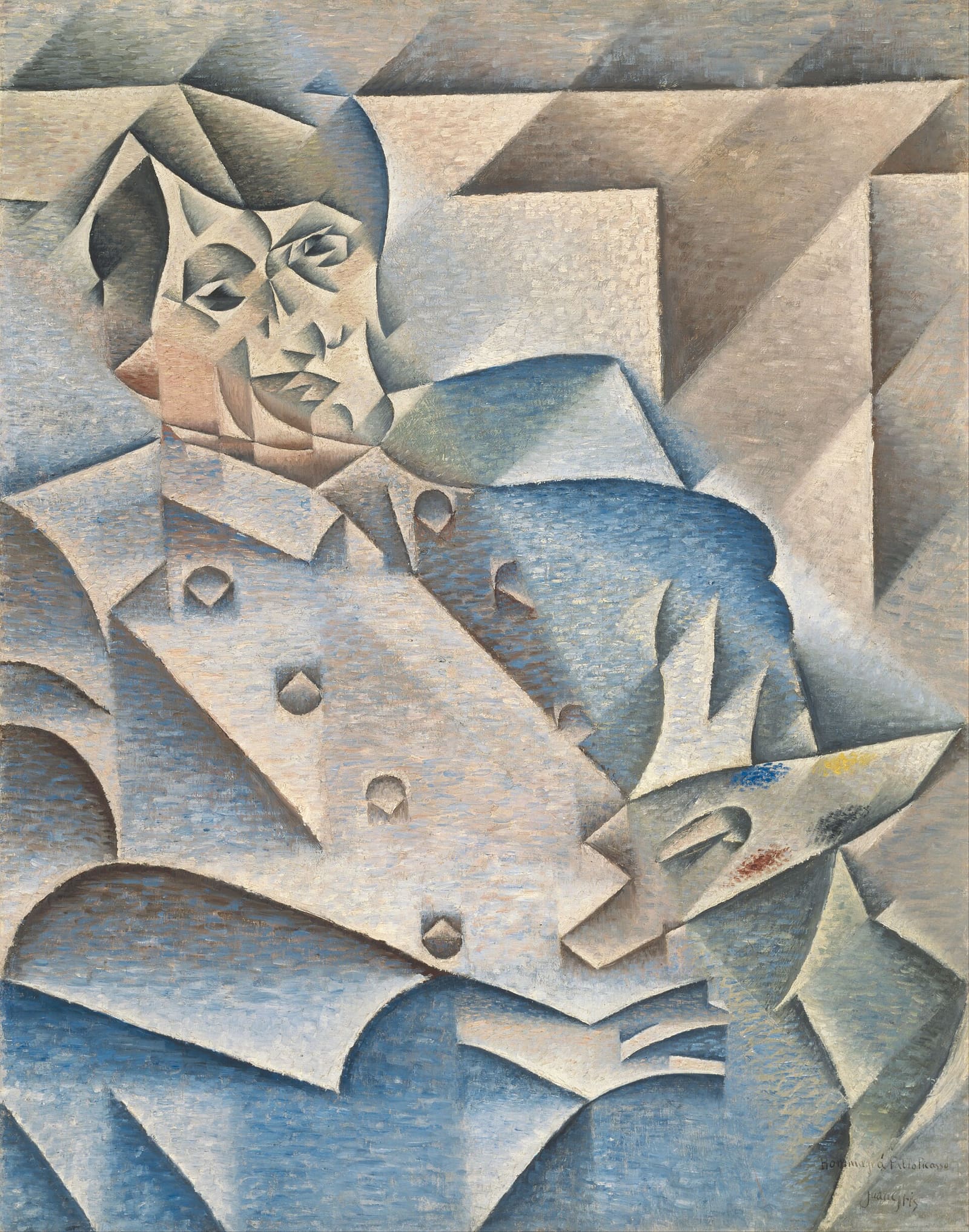
The Spanish painter Juan Gris, a neighbor of Picasso’s in Montmartre, made Cubism clearer and more mathematical. His Portrait of Pablo Picasso, shown above, was exhibited in 1912 as a homage to the movement’s founder. Meanwhile other artists, among them Fernand Léger, Robert Delaunay, Albert Gleizes and Jean Metzinger, showed together at the Paris Salons; in 1912 Gleizes and Metzinger published the first book on the subject, Du “Cubisme.”
Key characteristics
Multiple viewpoints
Several sides of an object shown at once.
Geometric fragmentation
Forms broken into facets, cubes, cones and planes.
Flattened space
Little or no traditional perspective; the picture surface is emphasized.
Collage and new materials
From 1912, pasted paper, newspaper and other everyday materials.
Legacy
The First World War scattered the Cubists; Braque was badly wounded at the front in 1915. But Cubism had already changed art for good. It led directly to Futurism in Italy, to abstract art in Russia and the Netherlands, and to collage and assemblage, and it showed that a painting could be a thing in its own right rather than a picture of something else.
Before and after Cubism
- Came before: Post-Impressionism (c. 1886–1905)
- Came before: Fauvism (c. 1905–1908)
- Came after: Futurism (c. 1909–1916)
Mediums and era
- Medium: Oil painting
Frequently asked questions
What is Cubism?
A revolutionary style of painting and sculpture invented by Pablo Picasso and Georges Braque in Paris around 1907–1908. Objects are broken into geometric facets and shown from several viewpoints at once, rather than from a single fixed point.
Who invented Cubism?
Pablo Picasso and Georges Braque, working so closely between about 1908 and 1914 that Braque compared them to two mountaineers roped together. Juan Gris, Fernand Léger, Robert Delaunay, Albert Gleizes and Jean Metzinger soon developed their own versions.
What is the difference between Analytic and Synthetic Cubism?
Analytic Cubism (c. 1909–1912) breaks objects down into many small facets in a narrow palette of browns and grays. Synthetic Cubism (c. 1912–1914) builds images up from flatter, simpler shapes, brighter colors and collage, using real materials such as newspaper and wallpaper.