Art movement · c. 1848–1900
The Pre-Raphaelites: History, Artists and Key Works
What were the Pre-Raphaelites?
The Pre-Raphaelite Brotherhood was a group of young English painters and writers who set out, in 1848, to reform British art. They believed the Royal Academy’s teaching, built on the example of the Renaissance painter Raphael and on rules of composition handed down from him, had made painting formulaic. They wanted to go back to the sincerity and close observation they saw in art before Raphael, in the late Middle Ages and the early Renaissance.
Their name was half a joke and half a manifesto. They signed their early paintings with the mysterious initials “PRB.”
Origins in 1848
The Brotherhood was founded in September 1848, the year of revolutions across Europe, in the London home of John Everett Millais’s parents. Its leaders were three Royal Academy students: Millais, a brilliant technician who had entered the Academy schools at 11; William Holman Hunt, earnest and religious; and Dante Gabriel Rossetti, a poet as much as a painter.
Their first paintings caused a storm. In 1850 Charles Dickens attacked Millais’s Christ in the House of His Parents, which showed the Holy Family as working people in a dusty carpenter’s shop. The tide turned in 1851, when the critic John Ruskin defended the group in letters to The Times.
Key artists
John Everett Millais
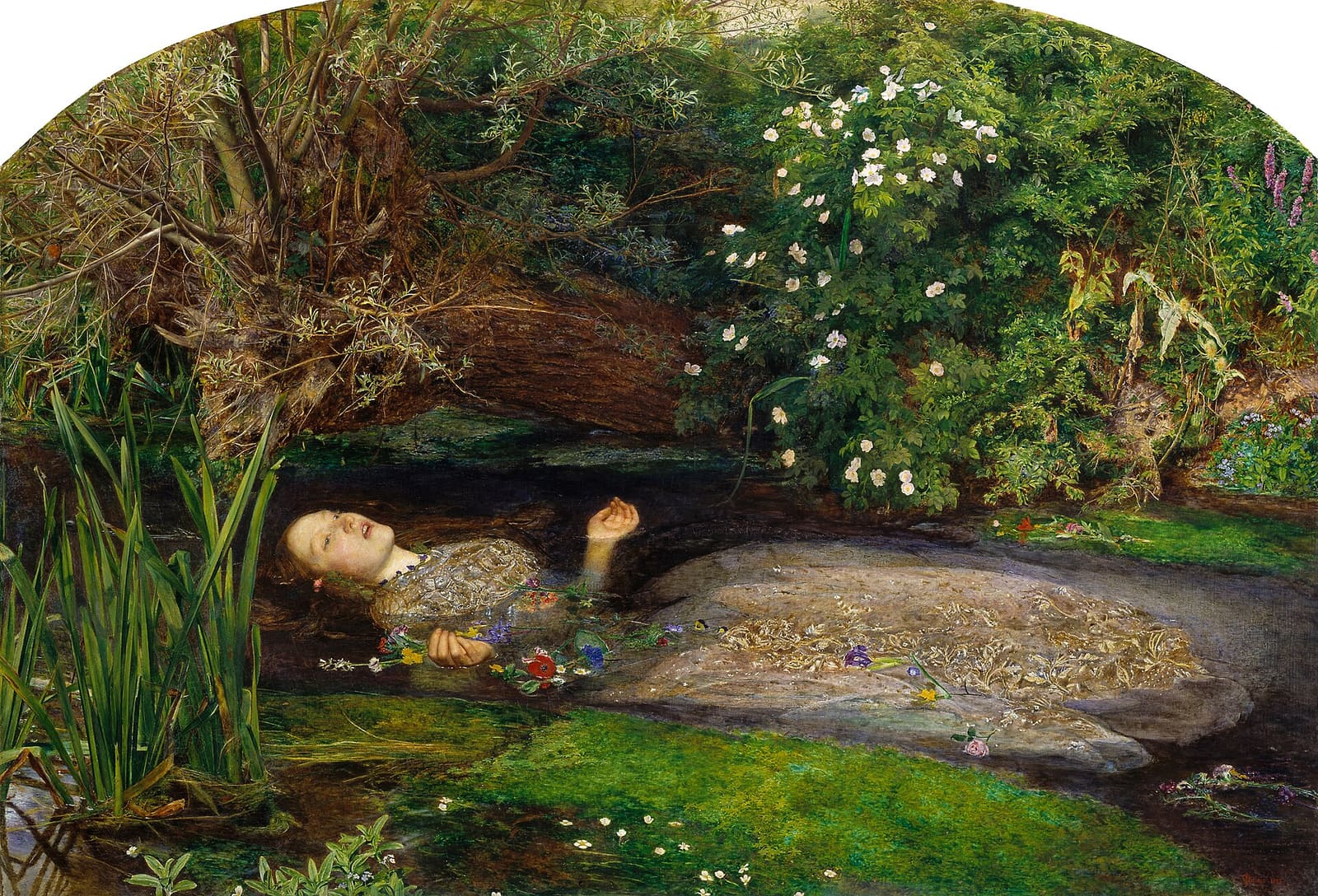
Millais painted Ophelia (1851–1852), the drowning heroine from Shakespeare’s Hamlet, shown above. He spent months painting the riverbank outdoors beside the Hogsmill River in Surrey, recording every leaf and flower, then painted the figure in his London studio from Elizabeth Siddal, who posed in a bath. In 1853 he was elected to the very Academy the group had rebelled against.
William Holman Hunt
Hunt stayed truest to the original ideals of moral seriousness and exact detail. He traveled to the Holy Land to paint biblical scenes in their real settings, and his The Light of the World (1851–1853), showing Christ knocking at an overgrown door, became one of the most reproduced religious images of the Victorian age.
Dante Gabriel Rossetti
Rossetti cared less for nature than for poetry, legend and beauty. His later paintings of women with heavy, flowing hair and dreamy expressions, often modeled by Siddal and later by Jane Morris, defined the “Pre-Raphaelite” look that most people picture today.
Key characteristics
Truth to nature
Painted outdoors or from real objects, in minute, even detail across the whole canvas.
Brilliant color
The painters often laid their colors over a wet white ground, which keeps them jewel-bright.
Literary and moral subjects
Scenes from the Bible, Shakespeare, Keats, Tennyson and medieval legend, often packed with symbols.
The second wave and legacy
The Brotherhood itself broke up within about five years, but its ideas spread. Around 1857 Rossetti drew in two young Oxford students, William Morris and Edward Burne-Jones. Their dreamier, medieval-inspired art led to the Aesthetic Movement and, through Morris’s designs for furniture, wallpaper and books, to the Arts and Crafts Movement. That emphasis on beautiful, handmade design fed directly into Art Nouveau.
Pre-Raphaelites vs Romanticism
Both looked to the past and to the emotional power of nature, and the Pre-Raphaelites owe much to Romanticism. But where the Romantics often painted nature as vast and atmospheric, the Pre-Raphaelites studied it leaf by leaf, with a sharpness closer to Realism.
Before and after The Pre-Raphaelites
- Came before: Romanticism (c. 1790–1850)
- Came after: Art Nouveau (c. 1890–1910)
Mediums and era
- Medium: Oil painting
- Era: 19th century
Frequently asked questions
What does Pre-Raphaelite mean?
It means 'before Raphael'. The young founders believed that art had gone wrong since the High Renaissance painter Raphael, whose style the Royal Academy taught as a model, and they looked back to the simpler, more truthful art of the late Middle Ages and early Renaissance.
Who founded the Pre-Raphaelite Brotherhood?
Three students of the Royal Academy in London, John Everett Millais, William Holman Hunt and Dante Gabriel Rossetti, in September 1848. Four others joined them: William Michael Rossetti, Thomas Woolner, James Collinson and Frederic George Stephens.
Who was the model for Millais's Ophelia?
Elizabeth Siddal, herself an artist and poet, who later married Rossetti. She posed in a bath of water warmed by lamps underneath; when the lamps went out she caught a severe cold, and her father demanded that Millais pay the doctor's bill.