Art movement · c. 1840–1880
Realism in Art: History, Artists and Key Works
What is Realism?
Realism was an art movement that began in France in the 1840s and set out to paint the world as it really was, especially the lives of ordinary working people. Its artists rejected the idealized gods and heroes of academic painting and the emotional drama of Romanticism. Instead they painted stone breakers, peasants, laundresses and village funerals, honestly and often on a grand scale.
That choice of subject was itself a statement. Putting a poor laborer on a canvas the size of a history painting suggested he deserved the same attention as a king or a saint.
Origins in 1840s France
Realism took shape around the Revolution of 1848, when workers and peasants briefly pressed their demands on the French state. Interest in social conditions was growing, and photography, announced in 1839, had shown that the everyday world could be recorded with startling accuracy.
Gustave Courbet became the movement’s leader. His A Burial at Ornans (1849 to 1850) shows a funeral in his home village with life-size, unglamorous townspeople on a canvas more than six meters wide, a scale reserved for heroic subjects. The Stone Breakers (1849) showed two road workers at back-breaking labor; that painting was destroyed during the bombing of Dresden in 1945. In 1855, when the jury of the Paris World’s Fair rejected some of his works, Courbet built his own “Pavilion of Realism” next door and published a manifesto.
Key Realist artists
Jean-François Millet
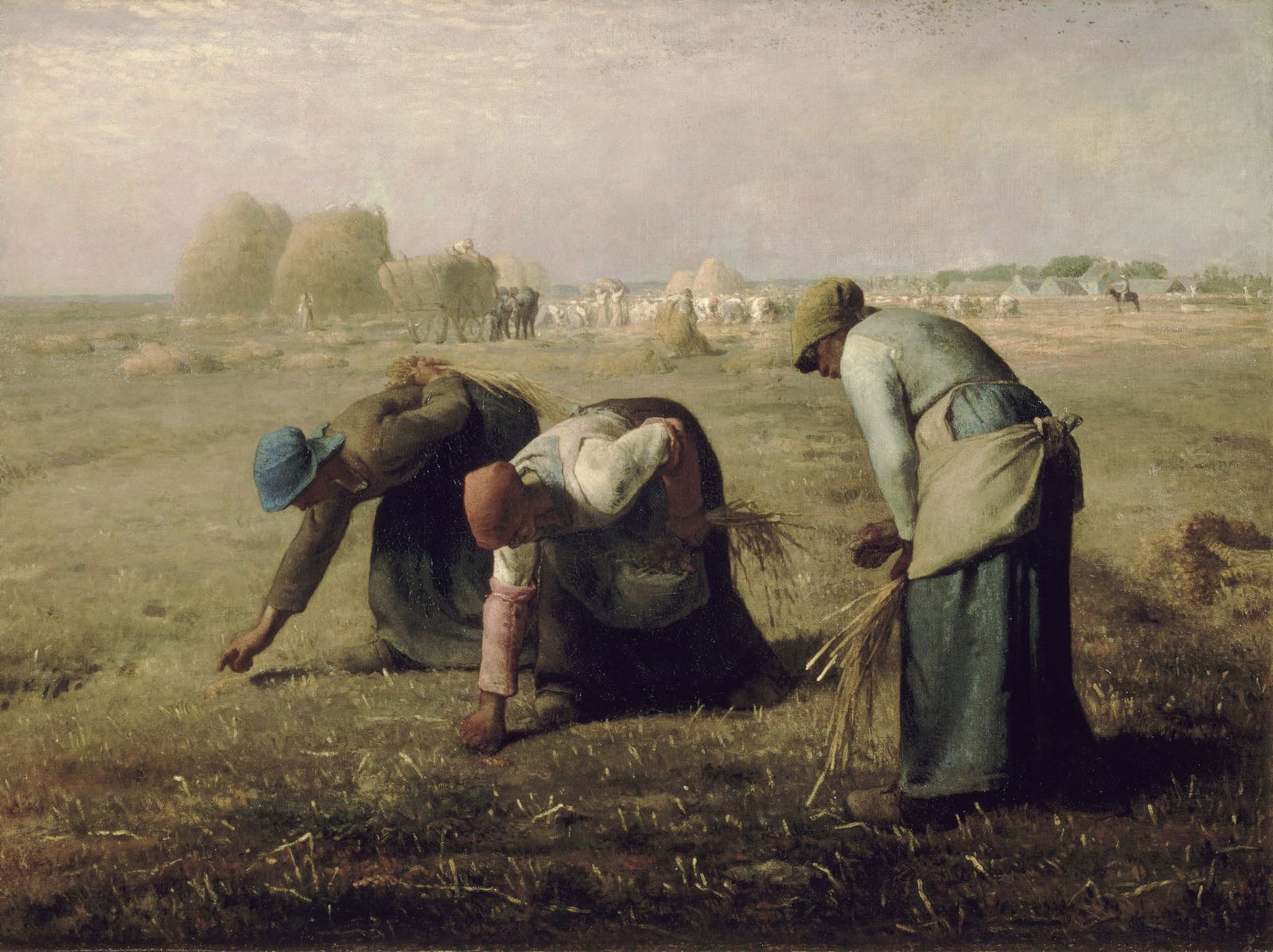
Millet settled in the village of Barbizon and devoted himself to peasant life. The Gleaners (1857) shows three women stooping to collect the stray grain left after the harvest, the poorest work in the field. Critics read it as a political protest; Millet saw it as a picture of dignity in labor.
Honoré Daumier
Best known as a caricaturist who mocked politicians and lawyers in the Paris press, Daumier also painted the urban poor, as in The Third-Class Carriage (about 1862 to 1864).
Rosa Bonheur
The most famous woman painter of her day, Bonheur studied animals with scientific care. The Horse Fair (1852 to 1855) is now in the Metropolitan Museum of Art in New York.
Realism beyond France
In Russia, the group known as the Wanderers (Peredvizhniki) took art to the provinces; Ilya Repin’s Barge Haulers on the Volga (1870 to 1873) is its best-known image. In the United States, Winslow Homer and Thomas Eakins brought a similar honesty to American subjects.
Key characteristics
Ordinary subjects
Workers, peasants and the middle class replace gods, saints and heroes.
Truth over beauty
Figures are shown as they are, tired, plain or poor, without idealization.
Everyday scale made monumental
Scenes of common life are painted at the size once reserved for history painting.
Social awareness
Many Realist works point, directly or quietly, to poverty, labor and social inequality.
Realism vs Impressionism
Realism cleared the way for Impressionism. Both painted modern, everyday life, but where Realists focused on solid figures and social truth, the Impressionists cared about fleeting light and color. Édouard Manet, who bridged the two, was the link between Courbet’s generation and Monet’s.
Before and after Realism
- Came before: Romanticism (c. 1790–1850)
- Came after: Impressionism (c. 1867–1886)
Mediums and era
- Medium: Oil painting
- Era: 19th century
Frequently asked questions
What is Realism in art?
A movement that began in France in the 1840s and painted ordinary people and everyday life truthfully, without idealizing them. It rejected both the classical heroes of academic art and the drama and imagination of Romanticism.
Who started the Realism movement?
Gustave Courbet is regarded as its leader. In 1855, when the jury of the Paris World's Fair rejected some of his works, he built his own 'Pavilion of Realism' nearby and published a manifesto explaining his aims.
Why was Realism controversial?
Academic tradition reserved large canvases for noble subjects from history, religion and myth. Realists painted peasants, laborers and village funerals on the same heroic scale, which critics saw as vulgar and, after the revolutions of 1848, as politically dangerous.
Is Realism the same as realistic painting?
Not quite. 'Realism' with a capital R is the specific 19th-century movement. Realistic painting, meaning accurate depiction, is much older and is found in many periods.