Artist · Dutch
Johannes Vermeer: Life, Paintings and Legacy
- Born
- October 31, 1632, Delft, Dutch Republic
- Died
- December 15, 1675, Delft, Dutch Republic
- Nationality
- Dutch
- Movement
- Baroque
- Mediums
- Oil painting
Life in Delft
Johannes Vermeer was baptized in Delft, in the Dutch Republic, on 31 October 1632, and lived there all his life. His father was a silk weaver who also dealt in paintings, a business Vermeer later took over. In 1653 he married Catharina Bolnes, a Catholic, and the same year joined the Guild of St. Luke, the local painters’ guild, which later elected him one of its heads. The couple had fifteen children, eleven of whom were living when he died.
Almost nothing he wrote survives, and no portrait of him is known for certain. What we know comes from guild records, legal papers and his paintings.
Quiet rooms full of light
Vermeer’s mature works show one or two figures in a corner of a room, usually lit by a window on the left: a maid pouring milk, a woman reading a letter, a lady weighing pearls. The Milkmaid (about 1660, Rijksmuseum, Amsterdam) turns a simple kitchen task into something almost sacred through its light, its stillness and its tiny dots of bright paint on the bread and the jug.
He used costly pigments, above all natural ultramarine made from ground lapis lazuli, for his famous blues, and built up his pictures in careful layers. His perspective is exact, and many scholars think he may have studied images made with a camera obscura.
Girl with a Pearl Earring and View of Delft
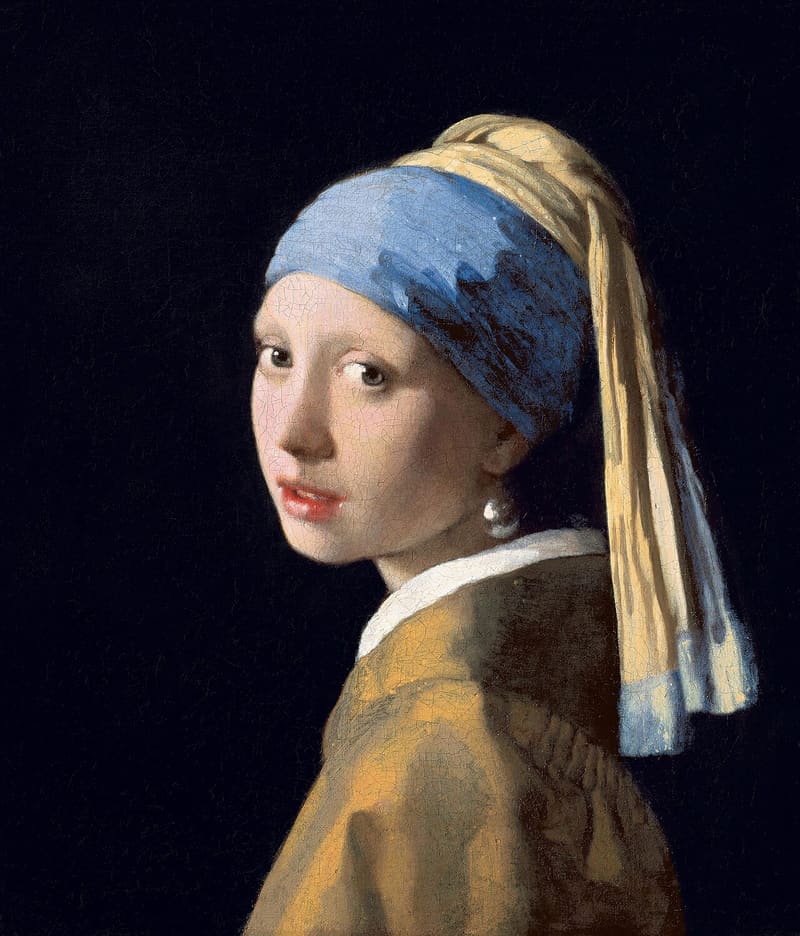
Girl with a Pearl Earring (about 1665, Mauritshuis, The Hague) is his most famous work: a girl in a blue and yellow turban glancing over her shoulder, the pearl catching the light. It is not a portrait of a known person but a tronie, a study of a face and costume. His View of Delft (about 1660–1661), also in the Mauritshuis, is one of the great city views in European art. In The Art of Painting (about 1666–1668, Kunsthistorisches Museum, Vienna) he showed a painter at work, seen from behind, a statement about his own craft.
Debt, death and rediscovery
In 1672 France invaded the Dutch Republic and the art market collapsed. Vermeer could sell neither his own paintings nor his stock as a dealer. He fell into debt and died in Delft in December 1675, aged about 43; he was buried on 15 December. His widow had to give paintings to creditors.
Vermeer was respected in Delft but soon largely forgotten outside it. In the 1860s the French critic Théophile Thoré-Bürger championed him in a series of articles, and he has been counted among the greatest painters of the Baroque era, alongside his countryman Rembrandt, ever since.
Works by Johannes Vermeer
- The Milkmaid · c. 1660
Frequently asked questions
How many paintings did Vermeer make?
Only about 34 to 37 paintings are accepted as his today; scholars disagree about a few. He seems to have worked slowly and carefully, perhaps two or three pictures a year, which is one reason his works are so rare and treasured.
Who is the Girl with a Pearl Earring?
Nobody knows. The painting is not a portrait of a particular sitter but a 'tronie', a Dutch type of study of a face, an expression or an exotic costume. Theories that she was Vermeer's daughter or a servant are guesses.
Did Vermeer use a camera obscura?
Possibly. Some effects in his paintings, such as soft, blurred highlights and strong perspective, resemble images seen through a camera obscura, a darkened box with a lens. There is no document proving he owned one, and the question is still debated.