Artwork · c. 1660
The Milkmaid by Johannes Vermeer: Meaning and History
- Artist
- Johannes Vermeer
- Date
- c. 1660
- Medium
- Oil on canvas
- Dimensions
- 45.5 × 41 cm
- Collection
- Rijksmuseum, Amsterdam
- Movement
- Baroque
- Medium guide
- Oil painting
What the painting shows
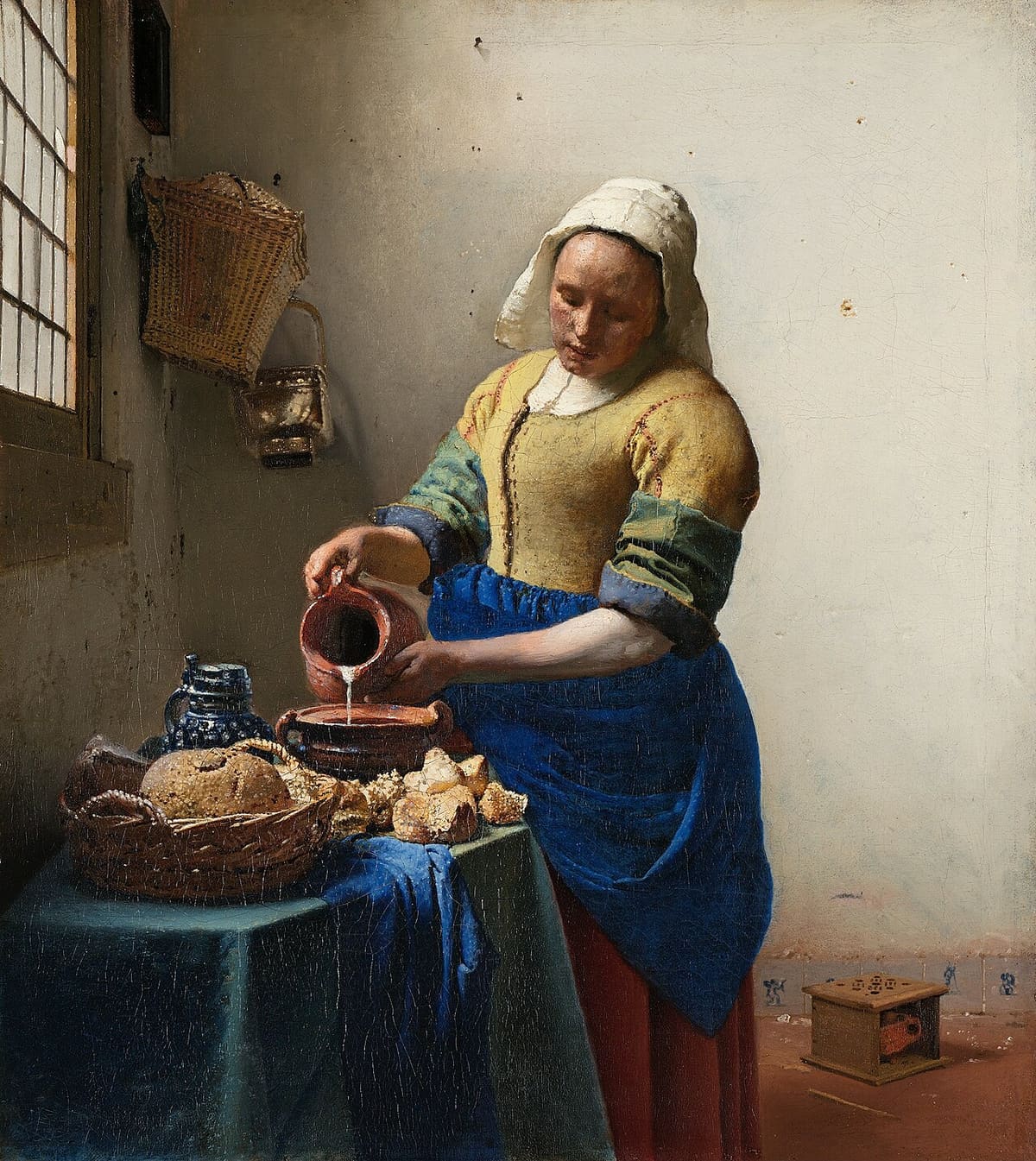
A kitchen maid stands at a table by a window, pouring milk from a jug into a bowl. She is strong and solid, her sleeves pushed up over muscular forearms, and completely absorbed in her task. Nothing else happens. Yet the picture holds attention like few others: the thin white stream of milk seems to move, and the whole room is quiet.
Maids in Dutch paintings of the time were often shown as lazy or flirtatious. Vermeer’s milkmaid is neither. She is careful, capable and dignified, and the painting treats her ordinary work with something close to reverence.
Light and color
Daylight enters from the window on the left, falling across the bare, whitewashed wall and the maid’s figure. Vermeer gave the wall its own life, with nail holes, a nail and its shadow, and subtle shifts from warm to cool. Her blue apron and the cloth on the table are painted with natural ultramarine, made from ground lapis lazuli and more expensive than gold; her bodice is a glowing lead-tin yellow.
On the crusty bread and the basket, he scattered tiny dots of light-colored paint, sometimes called pointillé. They make the surfaces sparkle as if catching the light, and some scholars connect them to the blurred highlights seen through a camera obscura.
Details in the room
Look at the lower right corner. On the floor stands a foot warmer, a wooden box that held a pot of hot coals. Along the base of the wall runs a row of Delft tiles, one of which shows Cupid. Some writers read these as hints that the maid is thinking of love; others see them simply as the furnishings of a real Dutch kitchen. Vermeer leaves the question open.
Fame then and now
The painting was admired even in Vermeer’s time. When it was sold at auction in Amsterdam in 1696, the catalog described it as “extremely well done”. It changed hands among Dutch collectors for two centuries before the Rijksmuseum bought it in 1908, after a public debate about keeping it in the country. It has been one of the museum’s most famous works ever since.
Where to see it
The Milkmaid is in the Rijksmuseum in Amsterdam, in the Gallery of Honour. Rembrandt’s Night Watch is in the same part of the museum.
Frequently asked questions
What is the milkmaid doing?
She is pouring milk slowly into an earthenware bowl, next to broken pieces of bread. She is probably making bread pudding, a common way of using up stale bread in Dutch kitchens.
How big is The Milkmaid?
Much smaller than most people expect: about 45.5 by 41 centimeters (18 by 16 inches). Like most of Vermeer's paintings it was made to be seen up close in a private home.
Where is The Milkmaid?
In the Rijksmuseum in Amsterdam, which bought it in 1908. It hangs in the museum's Gallery of Honour, near Rembrandt's Night Watch.