Artwork · 1814
The Third of May 1808 by Goya: Meaning and History
- Artist
- Francisco Goya
- Date
- 1814
- Medium
- Oil on canvas
- Dimensions
- 268 × 347 cm
- Collection
- Museo del Prado, Madrid
- Movement
- Romanticism
- Medium guide
- Oil painting
What the painting shows
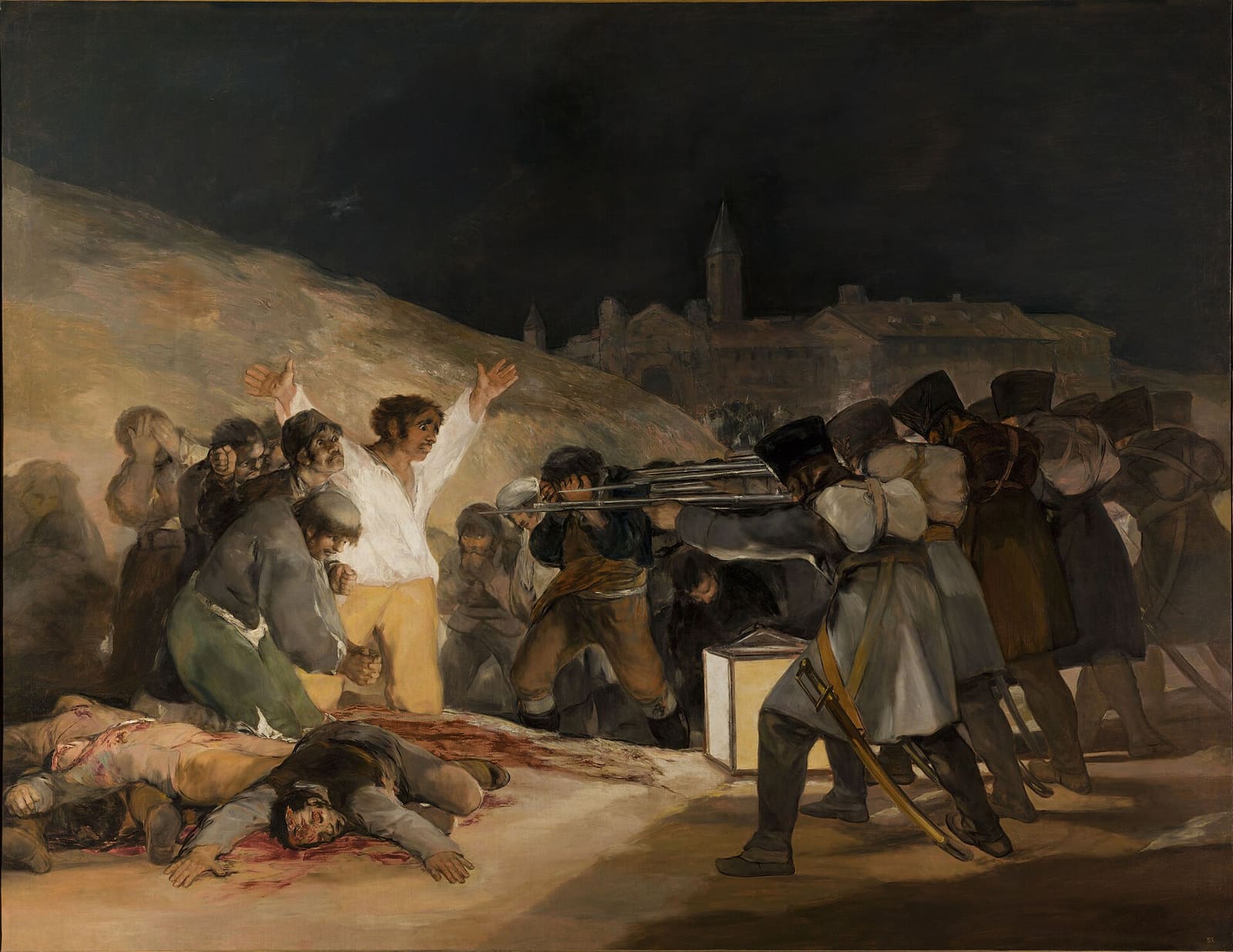
It is night on a hillside outside Madrid. On the right, a tight line of French soldiers aims their rifles, their faces hidden, their bodies leaning forward in one mechanical movement. On the left, a group of Spanish civilians faces them. One man in a white shirt and yellow trousers throws his arms wide, lit by a great square lantern on the ground. Before him lie bodies in pools of blood; behind him, more prisoners wait their turn, some covering their faces. A monk kneels in prayer. In the distance, a city and a church tower stand dark against the sky.
The events of 1808
In 1808 Napoleon’s armies occupied Spain. On 2 May the people of Madrid rose against the French troops in the city, and the uprising was put down with great force. Through that night and the following day, French firing squads shot hundreds of people in reprisal. The executions began six years of war, which Spaniards call the War of Independence.
Painted for the restored Spain
In 1814, after the French had been driven out, Goya asked the government to let him “perpetuate by means of the brush the most notable and heroic actions” of the uprising. He painted two large canvases: The Second of May 1808, showing Madrid citizens attacking Napoleon’s Egyptian cavalry, and The Third of May 1808, showing the reprisals.
A new kind of war painting
Earlier battle paintings celebrated generals and heroic deaths. Goya showed something else: ordinary people killed by soldiers who have no faces at all. The man in white is no hero in uniform; he is a laborer, and his raised arms and the mark on his palm make him a modern martyr. The loose brushwork, the harsh lantern light and the darkness around it all serve the horror of the moment, which is why the picture is counted among the founding works of Romanticism and of modern art.
Later artists answered it directly. Édouard Manet based his Execution of Emperor Maximilian (1867–1869) on its composition, and in the 20th century Pablo Picasso returned to it in Massacre in Korea (1951).
Where to see it
The Third of May 1808 hangs in the Museo del Prado in Madrid, beside its companion The Second of May 1808. The Prado also holds Goya’s Black Paintings.
Frequently asked questions
What happened on the third of May 1808?
On 2 May 1808 the people of Madrid rose up against the French troops occupying the city. The uprising was crushed, and through that night and the next day French firing squads executed hundreds of Spaniards in reprisal, including on the hill of Príncipe Pío.
Why is the man in the white shirt important?
He is the emotional center of the painting. Lit by the lantern, he throws his arms out in a pose that recalls the Crucifixion, and a wound-like mark on his right palm echoes Christ's stigmata. He turns an anonymous victim into a martyr.
Did Goya see the executions?
There is no evidence that he did, despite a popular story that he watched from his window and sketched the bodies afterward. He painted the scene six years later, after the French had been driven out of Spain.