Artist · Spanish
Francisco Goya: Life, Paintings and Legacy
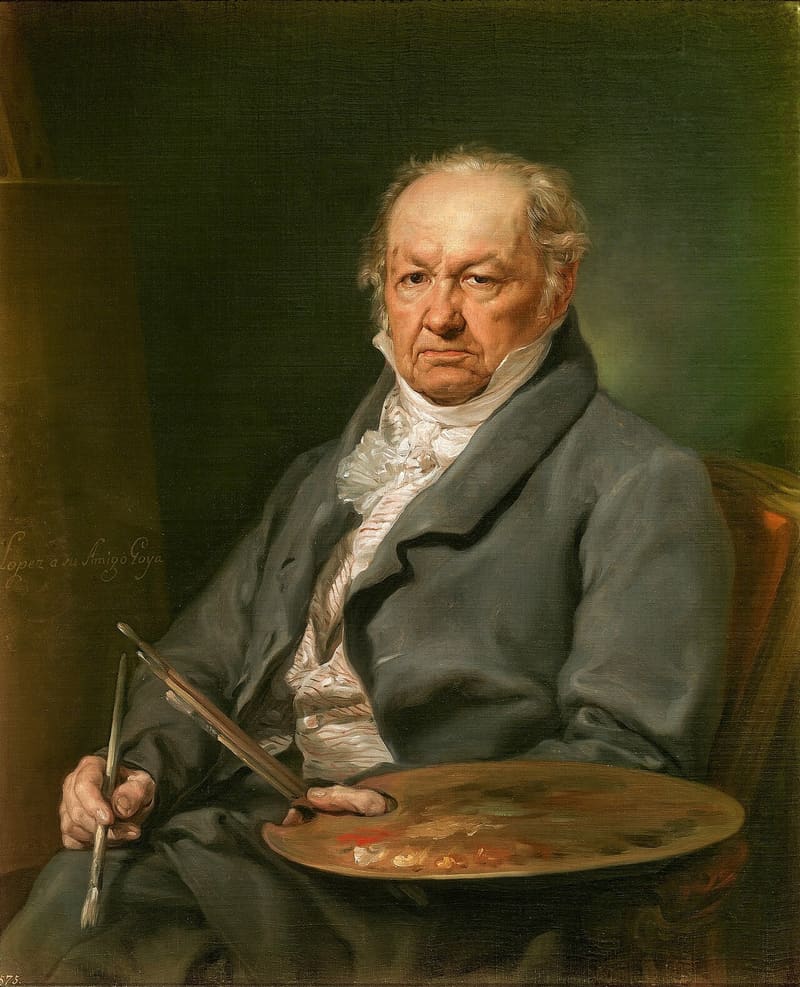
- Born
- March 30, 1746, Fuendetodos, Aragon, Spain
- Died
- April 16, 1828, Bordeaux, France
- Nationality
- Spanish
- Movements
- Romanticism, Rococo
- Mediums
- Oil painting
- Era
- 19th century
From Aragon to the royal court
Francisco José de Goya y Lucientes was born on 30 March 1746 in Fuendetodos, a village in Aragon, and grew up in nearby Zaragoza, where he trained with a local painter. After failing twice to win a prize at the Royal Academy in Madrid and traveling to Italy, he began designing tapestry cartoons for the Royal Tapestry Factory in 1775. These full-size paintings of picnics, dances and games are light and cheerful in the Rococo manner.
His portraits brought steady promotion. He became a painter to the king in 1786, and in 1799 First Court Painter, the highest post an artist could hold in Spain.
Deafness and the Caprichos
In late 1792 Goya fell gravely ill, and the illness left him completely deaf. His art turned inward. In 1799 he published Los Caprichos, a set of 80 etchings mocking superstition, greed, vanity and the abuses of the Church and the nobility. Its best-known plate is titled The Sleep of Reason Produces Monsters.
At the same time he painted his patrons with unsparing honesty. In Charles IV of Spain and His Family (1800–1801, Prado) the royal family glitters with silk and jewels, but the faces are plain and unflattered. He also painted the two Majas, one clothed and one nude, which later brought him before the Inquisition.
War: The Third of May 1808
In 1808 Napoleon’s army occupied Spain, beginning six years of brutal war. After the French were driven out, Goya painted The Second of May 1808 and The Third of May 1808 (both 1814, Prado). The second shows French soldiers executing Madrid civilians at night, a faceless firing squad aimed at a man in a white shirt who flings his arms wide. It is one of the first great paintings to show war as horror rather than glory, and a key work of Romanticism.
He also etched The Disasters of War, more than 80 prints of atrocities, famine and death made between about 1810 and 1820. They were too dangerous to publish in his lifetime and appeared only in 1863.
The Black Paintings and exile
In 1819 Goya bought a house outside Madrid that became known as the Quinta del Sordo, “the Deaf Man’s Villa”. There, on the walls, he painted fourteen dark visions now called the Black Paintings, including Saturn Devouring His Son. In 1824, fearing the repressive government of Ferdinand VII, he moved to Bordeaux in France, where he kept working, experimenting with the new technique of lithography. He died there on 16 April 1828, aged 82.
Legacy
Goya’s freedom of handling and his willingness to show cruelty and madness made him a hero to later artists. Édouard Manet studied him closely and based his Execution of Emperor Maximilian on The Third of May, and many see Goya as the first modern painter.
Works by Francisco Goya
- The Third of May 1808 · 1814
Frequently asked questions
What are Goya's Black Paintings?
Fourteen dark, nightmarish scenes Goya painted directly on the walls of his house outside Madrid between about 1819 and 1823, including Saturn Devouring His Son. They were never meant for the public. Decades after his death they were transferred to canvas, and they now hang in the Prado.
Why did Goya go deaf?
In late 1792 he suffered a severe illness that left him permanently deaf. Its cause is unknown; suggestions range from lead poisoning from his paints to a viral infection. His work became darker and more personal afterward.
Is Goya a Romantic painter?
He is usually grouped with Romanticism for his emotional intensity, dark imagination and depictions of war and cruelty, but he belongs to no single movement. His early work is Rococo, and his late work points ahead to Realism and Expressionism.