Artist · French
Édouard Manet: Life, Paintings and Legacy
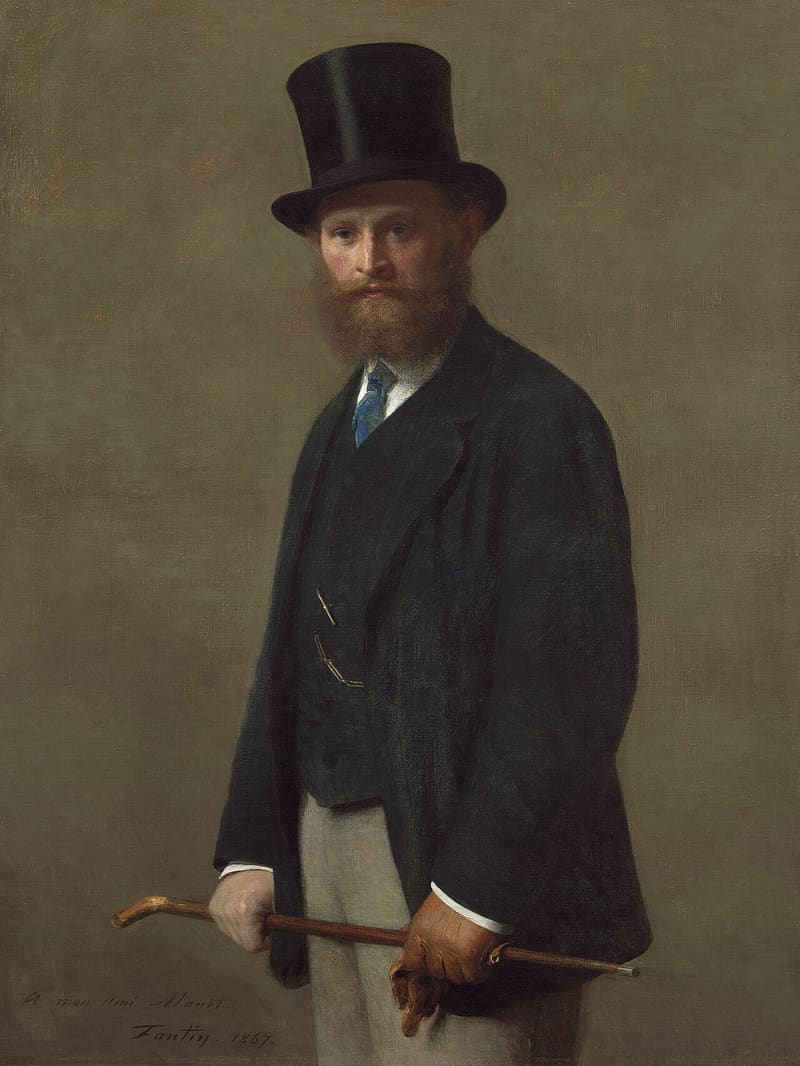
- Born
- January 23, 1832, Paris, France
- Died
- April 30, 1883, Paris, France
- Nationality
- French
- Movements
- Realism, Impressionism
- Mediums
- Oil painting
- Era
- 19th century
Early life and training
Édouard Manet was born in Paris on 23 January 1832 into a wealthy, well-connected family; his father was a senior official in the Ministry of Justice who hoped his son would study law. After failing the entrance exam for the naval school, Manet was allowed to become a painter. He spent six years in the studio of the academic painter Thomas Couture and taught himself even more by copying old masters in the Louvre, above all Velázquez, Goya, Titian and Frans Hals.
Scandal at the Salon
Manet wanted official success at the Salon, the state-sponsored annual exhibition, but on his own terms: old-master grandeur applied to modern Paris. In 1863 his Le Déjeuner sur l’herbe, with a naked woman picnicking beside two fully dressed young men, was the sensation of the Salon des Refusés, the exhibition of rejected works. Two years later his Olympia, a modern courtesan posed like Titian’s Venus of Urbino, caused uproar at the Salon itself. Both stories are told in Paintings That Caused Scandals.
His flat areas of color, abrupt contrasts and refusal to smooth or idealize made him the leading painter of Realism in its new, urban form.
Manet and the Impressionists
Younger artists, including Claude Monet, Renoir and Degas, gathered around Manet at the Café Guerbois. He became a close friend of Berthe Morisot, who married his brother Eugène. But when the group organized its independent exhibitions from 1874, he refused to take part. In the 1870s his palette lightened and his brushwork loosened, and he painted outdoors with Monet at Argenteuil, so his late work belongs to Impressionism in all but name.
Late work
His last major painting, A Bar at the Folies-Bergère (1882), now at the Courtauld Gallery in London, shows a barmaid standing before a mirror that reflects the crowded music hall, and her customer, in ways that don’t quite add up. Manet was already seriously ill, and in April 1883 his left leg was amputated. He died in Paris on 30 April 1883, aged 51.
Legacy
Manet is often called the first modern painter. By treating paint as paint and choosing the life of his own city as his subject, he opened the way for the Impressionists and for much of the art that followed. In 1890 Monet organized a public subscription to buy Olympia from Manet’s widow and give it to the French state; it now hangs in the Musée d’Orsay.
Works by Édouard Manet
- Olympia · 1863
Frequently asked questions
Was Manet an Impressionist?
Not formally. He was a friend and inspiration to the Impressionists and painted outdoors with Monet in the 1870s, but he never exhibited at their independent shows, preferring to fight for acceptance at the official Salon.
What is the difference between Manet and Monet?
Two different painters with confusingly similar names. Édouard Manet (1832–1883) was the older provocateur of modern-life painting; Claude Monet (1840–1926) was the landscape painter whose Impression, Sunrise gave Impressionism its name.
Why was Olympia so shocking?
Because Manet painted a recognizably modern Parisian courtesan in the pose of a classical Venus, staring directly at the viewer. Critics and crowds at the 1865 Salon were outraged; guards were posted to protect the canvas.