Artist · French
Paul Cézanne: Life, Paintings and Legacy
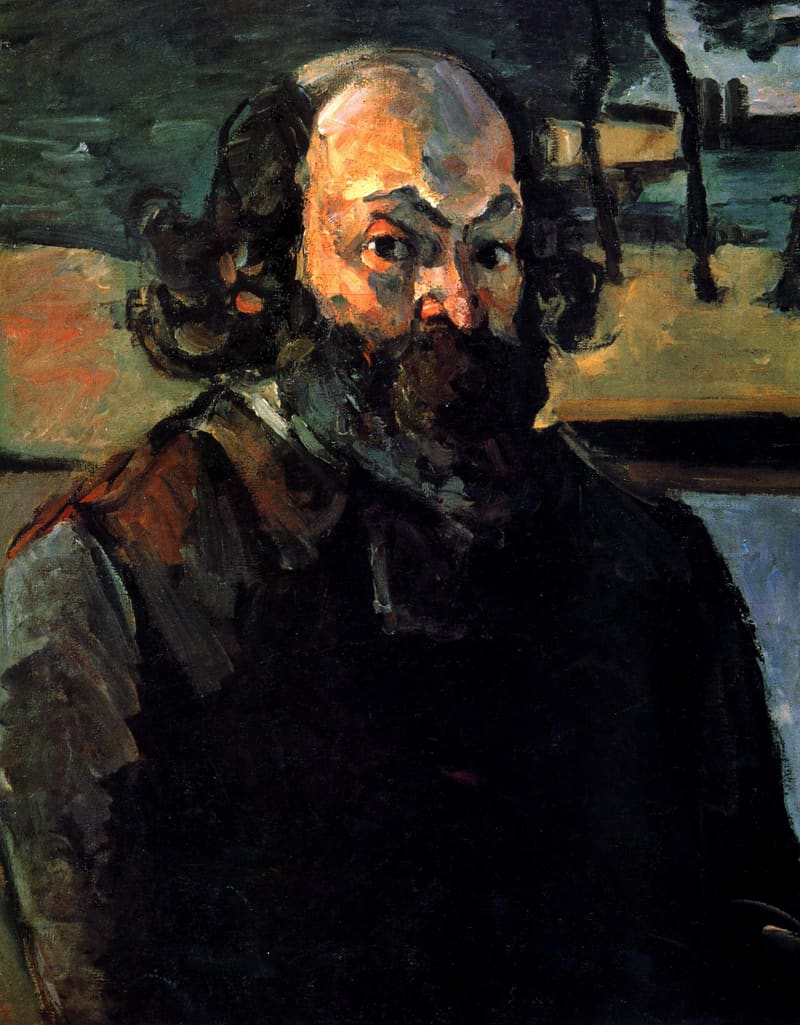
- Born
- January 19, 1839, Aix-en-Provence, France
- Died
- October 22, 1906, Aix-en-Provence, France
- Nationality
- French
- Movement
- Post-Impressionism
- Mediums
- Oil painting
- Era
- 19th century
Early life in Aix
Paul Cézanne was born on 19 January 1839 in Aix-en-Provence, in the south of France, the son of a prosperous hatter who became a banker. At school in Aix he formed a close friendship with the future novelist Émile Zola. His father insisted he study law, but in 1861, encouraged by Zola, Cézanne went to Paris to become a painter.
Rejection in Paris
In Paris he worked at the Académie Suisse, an informal studio where he met Camille Pissarro, and copied in the Louvre. The official Salon rejected his dark, thickly painted early works year after year. Pissarro became his mentor in the early 1870s, painting beside him outdoors at Pontoise and Auvers, and persuading him to lighten his palette. Cézanne showed with the Impressionists at their first exhibition in 1874 and again in 1877, where critics singled him out for ridicule.
Making Impressionism solid
Cézanne said he wanted “to make of Impressionism something solid and durable, like the art of museums.” From the late 1870s, working mostly alone in Provence, he built his pictures with parallel, block-like brushstrokes and modeled form through changes of color rather than light and shade. He would bend perspective, tilting a tabletop or showing a bowl from two angles at once, if the picture needed it.
He returned again and again to a few subjects: apples and jugs on a rumpled tablecloth; the card players and peasants of Aix; bathers in a landscape; and above all Mont Sainte-Victoire, the limestone mountain east of Aix, which he painted dozens of times. In a 1904 letter he advised treating nature “by means of the cylinder, the sphere and the cone.”
Recognition at last
In 1886 Cézanne’s father died, leaving him financially independent, and that same year he broke with Zola, who had published a novel about a failed painter that Cézanne saw as a portrait of himself. In 1895 the young dealer Ambroise Vollard gave him his first solo exhibition in Paris, and younger artists began to make the pilgrimage to Aix. In October 1906, painting outdoors, he was caught in a storm, collapsed, and died a few days later, on 22 October, aged 67.
Legacy
The year after his death, a large retrospective at the Salon d’Automne in Paris made an enormous impression on young painters, among them Picasso and Braque, who went on to invent Cubism. Cézanne is one of the four central figures of Post-Impressionism, alongside Vincent van Gogh, Paul Gauguin and Georges Seurat, and perhaps the most influential painter of his century.
Frequently asked questions
Why is Cézanne called the father of modern art?
Because his way of building pictures from blocks of color and simplified geometric forms, and of showing objects from slightly different viewpoints at once, opened the way to Cubism and abstraction. Picasso and Matisse are both reported to have called him 'the father of us all'.
What is Cézanne's most famous painting?
There is no single one, but his views of Mont Sainte-Victoire, his still lifes of apples, his five versions of The Card Players and his late Bathers are the best known. A version of The Card Players is among the most expensive paintings ever sold.
Was Cézanne an Impressionist?
He exhibited with the Impressionists in 1874 and 1877 and learned to paint outdoors with Camille Pissarro, but he wanted something more solid than fleeting light. He is usually classed as a Post-Impressionist.