Art movement · c. 1520–1600
Mannerism: History, Artists and Key Works
What is Mannerism?
Mannerism is the style that followed the High Renaissance in Italy, from about 1520 to the end of the 16th century. Leonardo, Michelangelo and Raphael seemed to have perfected painting, so the next generation looked for something new. Instead of calm balance and natural proportions, they chose elegance, complexity and surprise: figures with stretched limbs and tiny heads, bodies twisted into spirals, crowded and ambiguous spaces, and sharp, artificial colors.
It is art made for sophisticated viewers who already knew the rules and enjoyed seeing them bent.
Origins after the High Renaissance
Two events are often linked to the turn. Raphael died in 1520, and in 1527 imperial troops sacked Rome, scattering its artists across Italy and beyond. Michelangelo’s own later works, with their muscular, contorted figures, gave younger painters a model to follow.
In Florence, Jacopo Pontormo painted his Deposition from the Cross (about 1525 to 1528) for the church of Santa Felicita: there is no cross, no ground and no clear space, only a cluster of weightless figures in pale pinks and blues. Rosso Fiorentino painted similarly unsettling, angular scenes.
Key Mannerist artists
Parmigianino
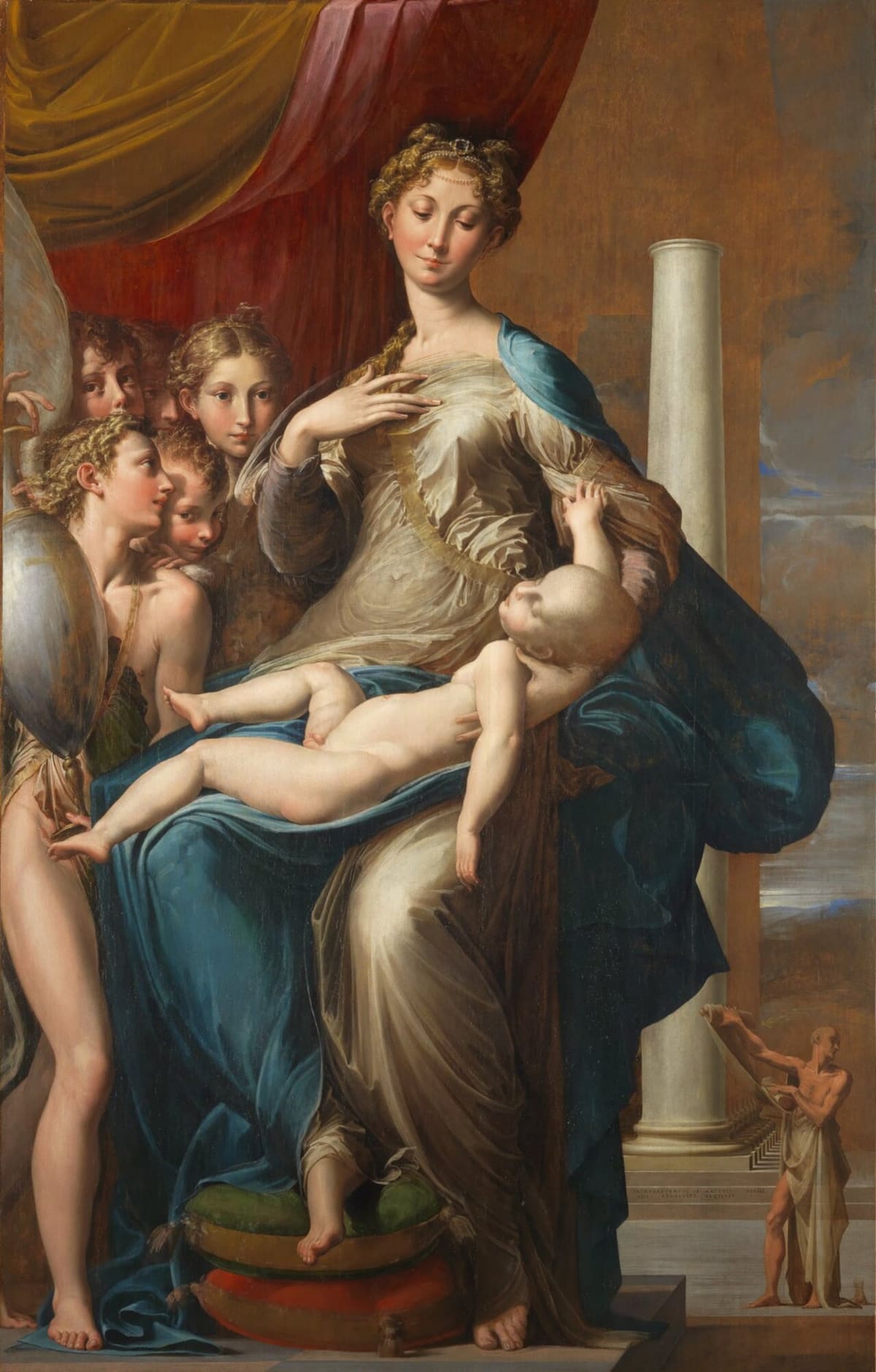
Working in Parma and Bologna, Parmigianino created an ideal of exaggerated grace. His Madonna with the Long Neck (1534 to 1540) stretches the Virgin’s neck and fingers far beyond nature, and his early Self-Portrait in a Convex Mirror plays with distortion itself.
Bronzino
Court painter to the Medici in Florence, Agnolo Bronzino painted cool, polished portraits of aristocrats with porcelain skin and impassive faces, and the complex, erotic Allegory with Venus and Cupid (about 1545), now in the National Gallery, London.
Giambologna and Cellini
In sculpture, the figura serpentinata, a figure twisting in a spiral, became an ideal. Giambologna’s Abduction of a Sabine Woman (1579 to 1583) has no single main view: you must walk around it. Benvenuto Cellini’s bronze Perseus with the Head of Medusa stands nearby in Florence’s Loggia dei Lanzi.
El Greco
The Greek-born Domenikos Theotokopoulos, known as El Greco, carried Mannerism to Spain. In Toledo he painted visionary religious scenes, such as The Burial of the Count of Orgaz (1586 to 1588), with elongated, flame-like figures and cold, flickering light.
Key characteristics
Elongated figures
Long limbs and necks, small heads and slender bodies follow an ideal of elegance rather than anatomy.
Twisting poses
Figures turn in complex spirals, often in poses no real body could hold comfortably.
Ambiguous space
Crowded compositions, unclear depth and figures pushed to the edges unsettle the viewer.
Artificial color
Acidic pinks, greens and blues replace natural flesh tones and harmonious color.
Mannerism vs Baroque
Mannerism is cool, intellectual and deliberately artificial. The Baroque that replaced it around 1600 kept the energy and movement but returned to natural bodies and real light, aiming at direct emotion that any viewer could feel.
Major Mannerist artists
- Michelangelo · 1475–1564
Before and after Mannerism
- Came before: Renaissance (c. 1400–1600)
- Came after: Baroque (c. 1600–1750)
Mediums and era
- Medium: Oil painting
Frequently asked questions
What does Mannerism mean?
It comes from the Italian 'maniera', meaning style or manner. In the 16th century, Giorgio Vasari used 'maniera' as praise for graceful, sophisticated art. Later critics turned it into an insult for art they saw as artificial, and 20th-century historians made 'Mannerism' a neutral name for the period.
Why does the Madonna with the Long Neck look so strange?
Parmigianino deliberately stretched the Virgin's neck, fingers and body, and enlarged the Christ child, to create an ideal of elegance rather than a natural figure. The tiny man beside the unfinished column adds to the disorienting sense of scale. The painting was left incomplete at his death in 1540.
Is El Greco a Mannerist?
He is usually classed as a late Mannerist. Trained in Crete and Venice and working in Toledo, Spain, he pushed elongated figures, flickering light and unnatural color to a uniquely intense, spiritual extreme.