Artist · Italian
Michelangelo: Life, Sculpture, Painting and Legacy
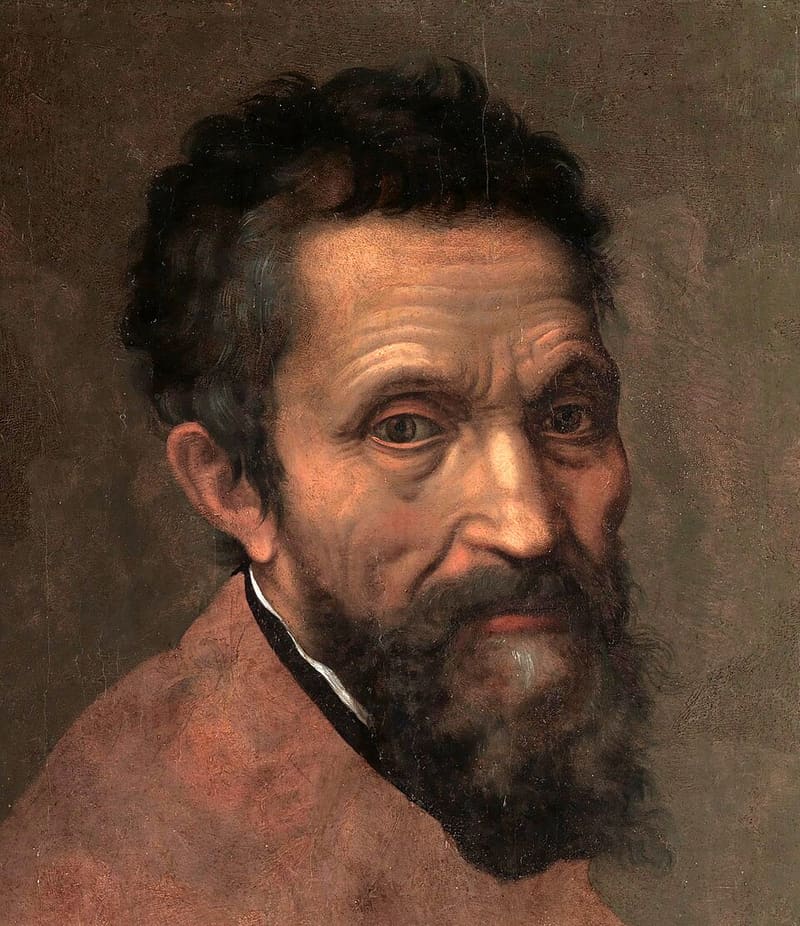
- Born
- March 6, 1475, Caprese, Republic of Florence
- Died
- February 18, 1564, Rome, Papal States
- Nationality
- Italian
- Movements
- Renaissance, Mannerism
Early life in Florence
Michelangelo Buonarroti was born on 6 March 1475 in Caprese, a village in Tuscany, and grew up in Florence. At thirteen he joined the workshop of the painter Domenico Ghirlandaio, but sculpture was his passion. He soon entered the circle of Lorenzo de’ Medici, studying ancient statues in the Medici garden and living in their household among poets and philosophers.
The Pietà and the David
In Rome, still in his early twenties, he carved the Pietà (1498 to 1499), showing the Virgin Mary holding the dead Christ across her lap. It is now in St. Peter’s Basilica and is the only work he ever signed.
Returning to Florence, he took on a huge block of marble that other sculptors had abandoned and carved the David (1501 to 1504). More than five meters tall, it shows the young hero tense and alert before his fight with Goliath, and it became a symbol of the Florentine Republic. It was moved indoors to the Galleria dell’Accademia in 1873.
The Sistine Chapel
In 1508 Pope Julius II ordered Michelangelo, who considered himself a sculptor, to paint the ceiling of the Sistine Chapel in the Vatican. Over four years, working largely alone on a scaffold, he covered the vault with more than three hundred figures, including scenes from Genesis such as The Creation of Adam. It was unveiled in 1512.
More than twenty years later he returned to paint The Last Judgment (1536 to 1541) on the chapel’s altar wall, a swirling mass of muscular bodies rising to heaven or falling to hell. Its many nudes caused a scandal, and after his death some were painted over with draperies.
Architect and poet
In his later decades Michelangelo turned increasingly to architecture. From 1546 he was chief architect of St. Peter’s Basilica, and its great dome follows his design, although he did not live to see it finished. He also wrote hundreds of poems, including sonnets of intense religious feeling.
He died in Rome on 18 February 1564, aged 88, and was buried in Santa Croce in Florence.
Legacy
In his own lifetime Michelangelo was called “the divine,” and Giorgio Vasari’s Lives of the Artists presented him as the culmination of the whole Renaissance. His twisting, muscular figures and dramatic compositions pointed the way to Mannerism and the Baroque.
Frequently asked questions
Did Michelangelo paint the Sistine Chapel ceiling lying on his back?
No. He painted standing on a scaffold he designed himself, with his head bent back to reach the vault. He wrote a comic poem complaining about the strain on his neck and back.
Where is Michelangelo's David?
The original has been in the Galleria dell'Accademia in Florence since 1873. A copy stands in its first location, in front of the Palazzo Vecchio in the Piazza della Signoria.
What is the only work Michelangelo signed?
The Pietà in St. Peter's Basilica. According to Vasari, he carved his name across the Virgin's sash after hearing visitors credit the work to another sculptor.