Artwork · 1871–1874
The Ballet Class by Edgar Degas: Meaning and History
- Artist
- Edgar Degas
- Date
- 1871–1874
- Medium
- Oil on canvas
- Dimensions
- 85 × 75 cm
- Collection
- Musée d'Orsay, Paris
- Movement
- Impressionism
- Medium guide
- Oil painting
What the painting shows
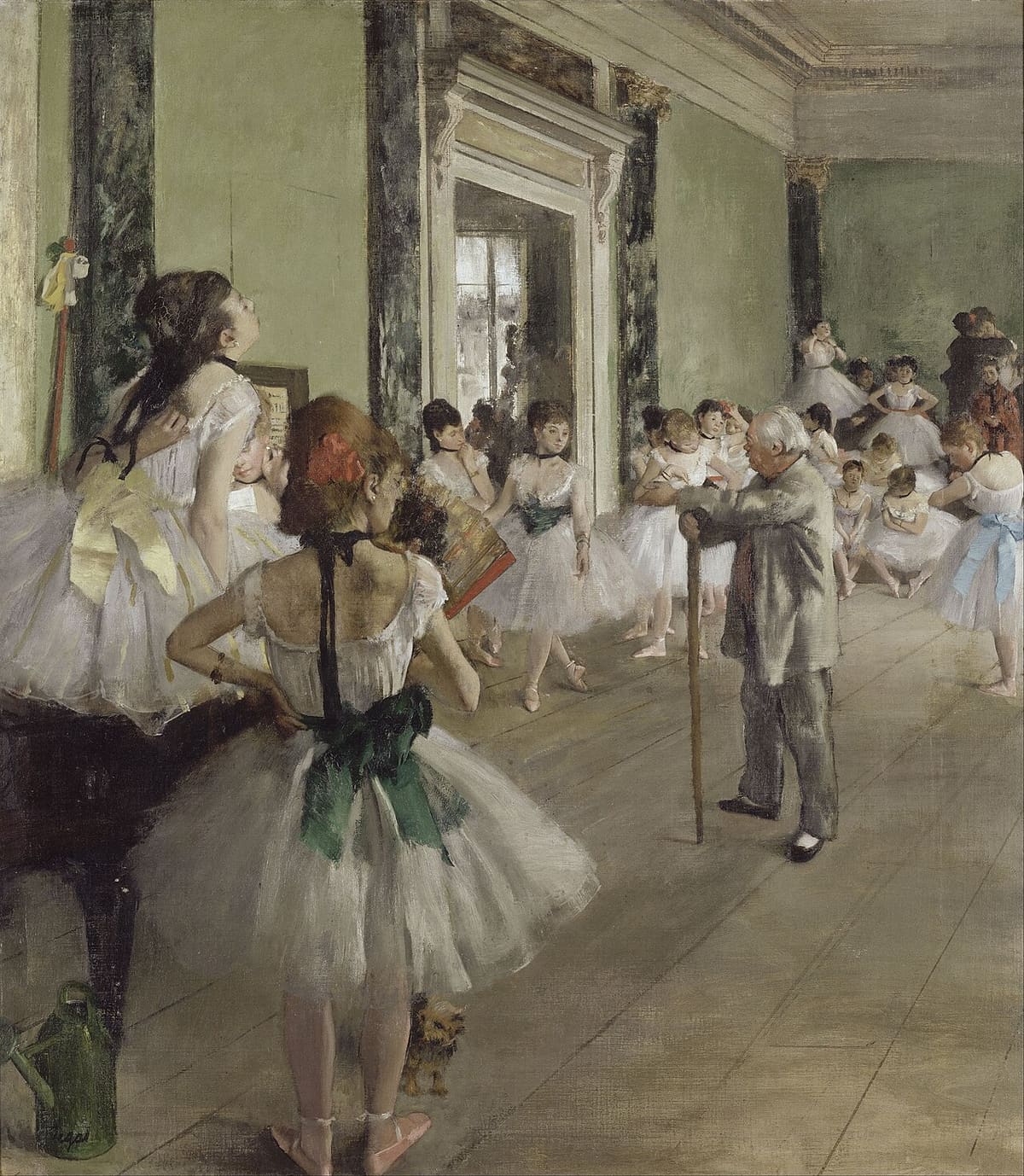
A lesson is in progress in a tall, light rehearsal room. At its center stands an elderly ballet master in a loose suit, leaning on a long stick, watching a dancer perform her steps. All around the room, young ballerinas in white tutus with colored sashes wait their turn. Few of them are paying attention. One scratches her back, others chat, fan themselves, fix their costumes or stare into space. Along the far wall, a few mothers watch over their daughters.
The ballet master
The old man is Jules Perrot, one of the greatest dancers and choreographers of the Romantic ballet, who had created Giselle in 1841. By the time Degas painted him he was retired from the stage. With the stick he would beat time on the floor; here he simply leans on it, judging the dancer in front of him.
Behind the scenes
Degas was fascinated less by performances than by rehearsals and waiting, the hard, unglamorous work behind the illusion on stage. The girls in the picture were “petits rats”, students of the Opéra ballet school, many from poor families, who hoped dancing would bring them a better life. Degas shows them as tired, bored and human, not as fairies.
Look closely at the small details, such as the watering can, used to dampen the wooden floor so the dancers would not slip, and the way the room’s light falls from tall windows onto the floorboards.
A room that no longer existed
The setting is a rehearsal room of the old Paris Opéra on the rue Le Peletier, which was destroyed by fire in October 1873. Degas, who often worked for years on a picture, built up the scene in his studio from drawings of posed dancers, and the composition was reworked several times. The tilted floor, the cut-off figures at the edges and the open space in the foreground are typical of his snapshot-like compositions, influenced by photography and Japanese prints.
Where to see it
The Ballet Class is in the Musée d’Orsay in Paris; it came to the national museums in 1911 with the bequest of the collector Count Isaac de Camondo. The Orsay also has Degas’s wax-and-fabric Little Dancer Aged Fourteen in a bronze cast, and Renoir’s Bal du moulin de la Galette.
Frequently asked questions
Who is the ballet master in The Ballet Class?
Jules Perrot, one of the most celebrated dancers and choreographers of the 19th century, who had created the ballet Giselle in 1841. By the 1870s he was in his sixties, and Degas shows him leaning on a tall stick he used to beat time.
Is this The Dance Class or The Ballet Class?
Both names are used. The French title is La Classe de danse. The Metropolitan Museum of Art in New York owns a closely related painting of a similar scene, The Dance Class (1874), so the Orsay picture is often called The Ballet Class in English to tell them apart.
Did Degas paint the class from life?
Not directly. He made many drawings of dancers from posed models in his studio and assembled the scene there. The rehearsal room he shows, in the old Paris Opéra on the rue Le Peletier, burned down in October 1873, before the painting was finished.