Artist · French
Edgar Degas: Life, Paintings and Legacy
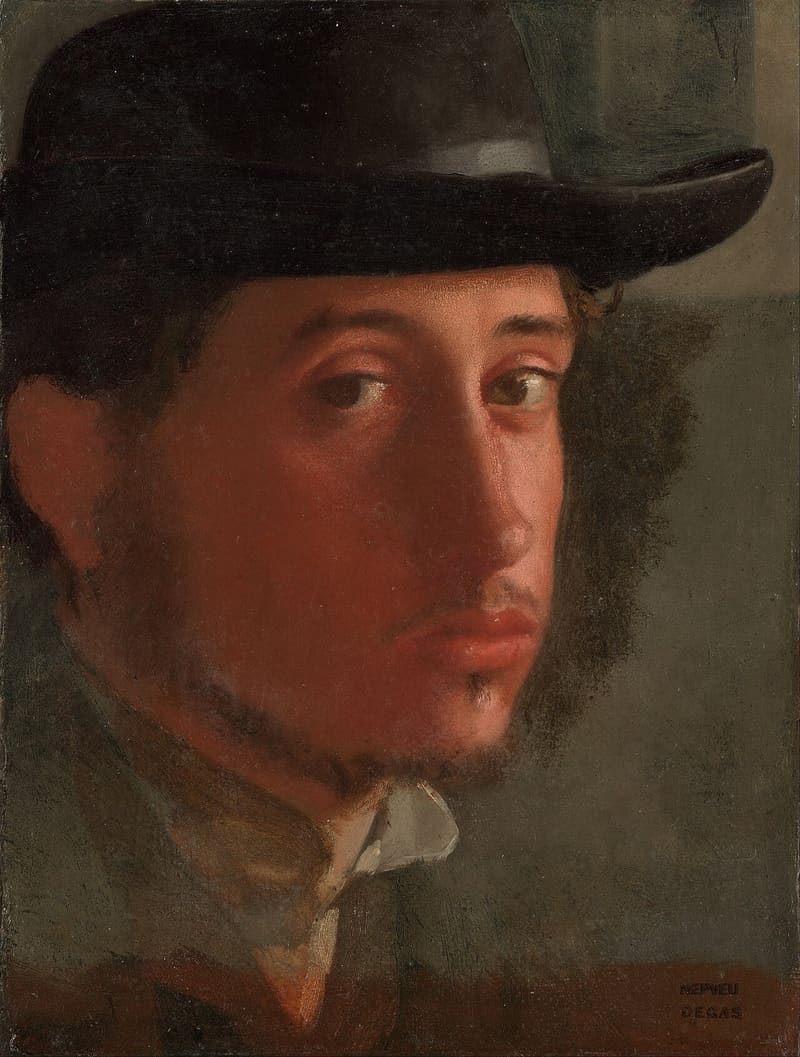
- Born
- July 19, 1834, Paris, France
- Died
- September 27, 1917, Paris, France
- Nationality
- French
- Movements
- Impressionism, Realism
- Mediums
- Oil painting
- Era
- 19th century
A classical beginning
Edgar Degas was born in Paris on 19 July 1834 into a wealthy banking family. He started law studies to please his father but soon turned to art, briefly attending the École des Beaux-Arts in 1855. He admired Ingres, who reportedly advised him to “draw lines, young man, many lines”. From 1856 to 1859 he lived in Italy, copying Renaissance masters and visiting relatives; there he began The Bellelli Family, a large, tense portrait of his aunt’s household now in the Musée d’Orsay.
His early ambition was history painting, but in the early 1860s he met Édouard Manet, reportedly while copying a Velázquez in the Louvre, and he soon turned to modern subjects.
Modern Paris
Degas painted the city’s racecourses, cafés, laundries, milliners’ shops and theaters. In a Café (also called L’Absinthe, 1875–1876, Musée d’Orsay) shows two figures sitting side by side in silence. During a visit to his mother’s family in New Orleans in 1872–1873 he painted A Cotton Office in New Orleans (1873), the first of his works bought by a museum.
He helped organize the independent exhibitions that launched Impressionism and showed in seven of the eight, but he never liked the name. His compositions are cut off at the edges like snapshots and seen from unusual angles, influenced by photography and Japanese prints, and he worked mostly from memory and drawings in the studio rather than outdoors.
The dancers
From the 1870s ballet became his great subject. The Ballet Class (1871–1874, Musée d’Orsay) shows young dancers waiting, stretching and fidgeting while an old ballet master leads a lesson. Increasingly he worked in pastel, building up layers of brilliant color, and he made small sculptures of dancers and horses in wax. Little Dancer Aged Fourteen, shown in 1881 wearing a real tutu and hair ribbon, shocked critics with its realism.
Later years
Degas’s eyesight began to trouble him in the 1870s, and in later years he worked with ever bolder color and broader strokes. He became increasingly reclusive. During the Dreyfus Affair of the 1890s he sided bitterly against Alfred Dreyfus, the Jewish army officer falsely convicted of treason, and broke with Jewish friends including the painter Camille Pissarro. By about 1912 he had stopped working. He died in Paris on 27 September 1917, aged 83.
Legacy
After his death about 150 wax sculptures were found in his studio, and many were cast in bronze, revealing him as an important sculptor. His bold cropping and his drawing of the body in motion influenced later artists from Toulouse-Lautrec onward, and his dancers are among the most popular images in art. His friendships with Berthe Morisot, Mary Cassatt and Renoir placed him at the center of the Impressionist circle.
Works by Edgar Degas
- The Ballet Class · 1871–1874
Frequently asked questions
Was Degas an Impressionist?
He showed in seven of the eight Impressionist exhibitions and helped organize them, but he disliked the label and preferred to call himself a Realist or an Independent. Unlike Monet he rarely painted outdoors, worked mostly in the studio and cared above all about drawing.
Why did Degas paint so many ballet dancers?
The Paris Opéra ballet let him study the body in movement from every angle, under dramatic stage lighting, in rehearsal as much as in performance. Dancers appear in more than half of his works, in oil, pastel and sculpture.
What is the Little Dancer Aged Fourteen?
A wax sculpture of a young ballet student, dressed in a real cloth tutu and bodice with a satin ribbon in her hair, which Degas showed at the Impressionist exhibition of 1881. Critics were shocked by its realism. The bronze versions in museums today were cast after his death.