Artwork · 1876
Bal du moulin de la Galette by Renoir: Meaning and History
- Artist
- Pierre-Auguste Renoir
- Date
- 1876
- Medium
- Oil on canvas
- Dimensions
- 131 × 175 cm
- Collection
- Musée d'Orsay, Paris
- Movement
- Impressionism
- Medium guide
- Oil painting
What the painting shows
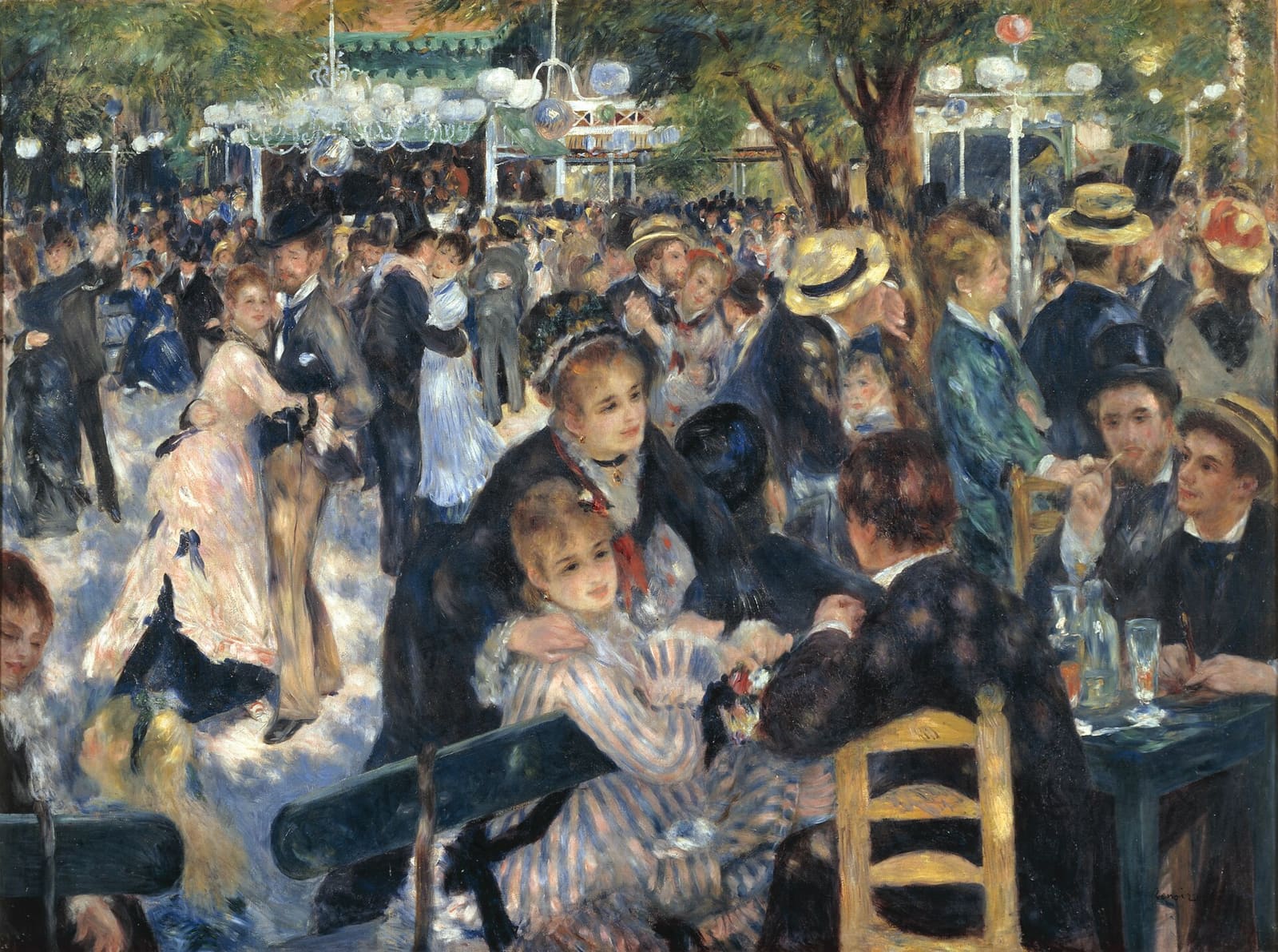
It is a sunny Sunday afternoon in an open-air garden in Montmartre. Couples dance in the middle distance under the trees; in the foreground young men and women talk, flirt and drink around a table and a bench. Gas lamps hang overhead, unlit. Nobody poses or looks especially important; it is simply a crowd enjoying itself, caught in a single, happy moment.
Sunlight through the leaves
The real subject is light. Sun filters through the leaves above and falls in soft, bright patches on hats, shoulders, jackets and the dusty ground, while everything else is in cool blue shadow. Renoir painted those patches in quick, feathery strokes of pale yellow, pink and white, and he made the shadows blue and violet rather than brown or black, a key discovery of Impressionism. The effect is so lively that the whole canvas seems to flicker.
Painted on the spot
The canvas is large, about 1.3 by 1.75 meters, which made painting outdoors difficult. Renoir rented a studio with a garden on the rue Cortot nearby, and according to his friend Georges Rivière he and his friends carried the canvas to the dance garden day after day. Rivière, other painter friends and young women from the neighborhood posed for him. He probably finished it in the studio.
Exhibited and bequeathed
Renoir showed the painting at the third Impressionist exhibition in 1877. It was bought by his friend Gustave Caillebotte, a fellow painter and wealthy collector. When Caillebotte died in 1894 he left his collection of Impressionist paintings to the French state, and Bal du moulin de la Galette was among the works accepted, though officials turned down others. It is now one of the most famous paintings in the Musée d’Orsay.
Where to see it
Bal du moulin de la Galette is in the Musée d’Orsay in Paris, which also holds major works by Claude Monet, Edgar Degas and Berthe Morisot.
Frequently asked questions
What was the Moulin de la Galette?
An open-air dance hall and garden on the hill of Montmartre, then a village on the edge of Paris, next to one of its old windmills (moulins). It was named after the galettes, small flat cakes, sold there. Working people and artists danced there on Sunday afternoons.
Who are the people in the painting?
Many were Renoir's friends. Painters and writers including Georges Rivière, Norbert Goeneutte and Pierre-Franc Lamy sit at the table on the right, and young women from Montmartre posed as well; the girl in the striped dress on the bench is usually identified as Estelle, the sister of another of Renoir's models.
Is there more than one version?
Yes. A smaller version, painted the same year, is in a private collection. It made headlines in 1990 when it sold at auction in New York for $78.1 million, then one of the highest prices ever paid for a painting.