Artist · French
Pierre-Auguste Renoir: Life, Paintings and Legacy
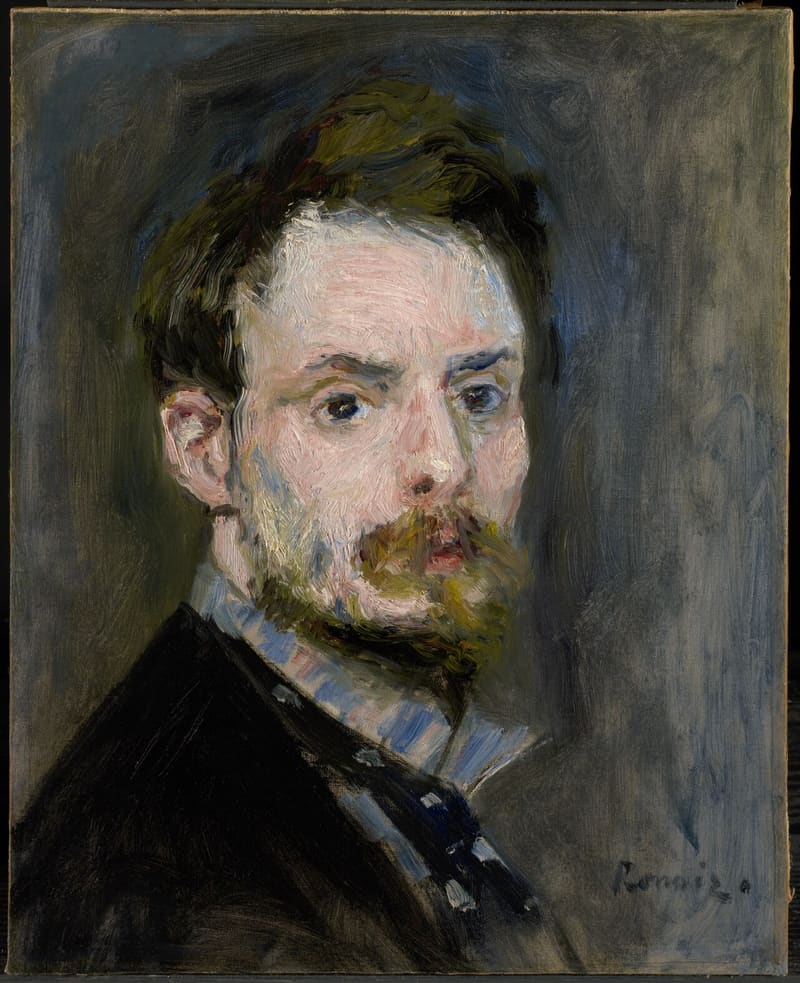
- Born
- February 25, 1841, Limoges, France
- Died
- December 3, 1919, Cagnes-sur-Mer, France
- Nationality
- French
- Movement
- Impressionism
- Mediums
- Oil painting
- Era
- 19th century
From porcelain to painting
Pierre-Auguste Renoir was born in Limoges on 25 February 1841, the son of a tailor, and grew up in Paris. At 13 he was apprenticed to a porcelain factory, painting flowers on plates and cups, a job that trained his hand and his love of bright color. When machines replaced hand-painting he decorated fans and blinds, and he spent his free hours copying paintings in the Louvre.
In 1862 he entered the studio of Charles Gleyre, where he met Claude Monet, Alfred Sisley and Frédéric Bazille. The friends painted outdoors together in the Forest of Fontainebleau and, in the summer of 1869, Renoir and Monet set up their easels side by side at La Grenouillère on the Seine.
Impressionism
Renoir showed at the first independent exhibition of 1874, the show that gave Impressionism its name, and at several of those that followed. Where Monet’s main subject was landscape, Renoir’s was people enjoying themselves. Bal du moulin de la Galette (1876, Musée d’Orsay) shows a Sunday afternoon dance in Montmartre, with sunlight falling through the trees in dappled patches on clothes and faces. Luncheon of the Boating Party (1880–1881, The Phillips Collection, Washington) gathers his friends, including his future wife Aline Charigot, on a restaurant terrace by the river.
Unlike some of his friends, he also kept sending work to the official Salon, where his Madame Georges Charpentier and Her Children was a success in 1879.
A change of direction
A trip to Italy in 1881, where he saw Raphael’s frescoes, convinced Renoir that he had gone as far as he could with Impressionism. For several years he painted with crisp outlines and smooth surfaces, a phase sometimes called his “dry” or “Ingresque” period, culminating in The Large Bathers (1884–1887, Philadelphia Museum of Art). Later his style softened again into the warm, glowing color of his many late nudes and portraits.
Late years in the south
From the 1890s rheumatoid arthritis increasingly crippled him. In 1907 he bought Les Collettes, a farm at Cagnes-sur-Mer on the Mediterranean, where he kept painting from a wheelchair and, with assistants, even made sculpture. He died there on 3 December 1919, aged 78. His son Jean Renoir became one of the great film directors of the 20th century.
Works by Pierre-Auguste Renoir
- Bal du moulin de la Galette · 1876
Frequently asked questions
What is Renoir's most famous painting?
Two compete for the title: Bal du moulin de la Galette (1876, Musée d'Orsay, Paris), a crowded open-air dance in Montmartre, and Luncheon of the Boating Party (1880–1881, The Phillips Collection, Washington), a group of friends relaxing on a riverside terrace.
How did Renoir paint with arthritis?
Rheumatoid arthritis began to cripple him in the 1890s and eventually left his hands badly deformed and him using a wheelchair. He kept painting until his death, with a brush placed between his stiffened fingers.
Were Renoir and Monet friends?
Yes. They met as students in Charles Gleyre's studio in the early 1860s and in 1869 painted side by side at La Grenouillère, a bathing spot on the Seine. Those paintings are often seen as a birthplace of the Impressionist style.