Artwork · 1509–1511
The School of Athens by Raphael: Meaning and History
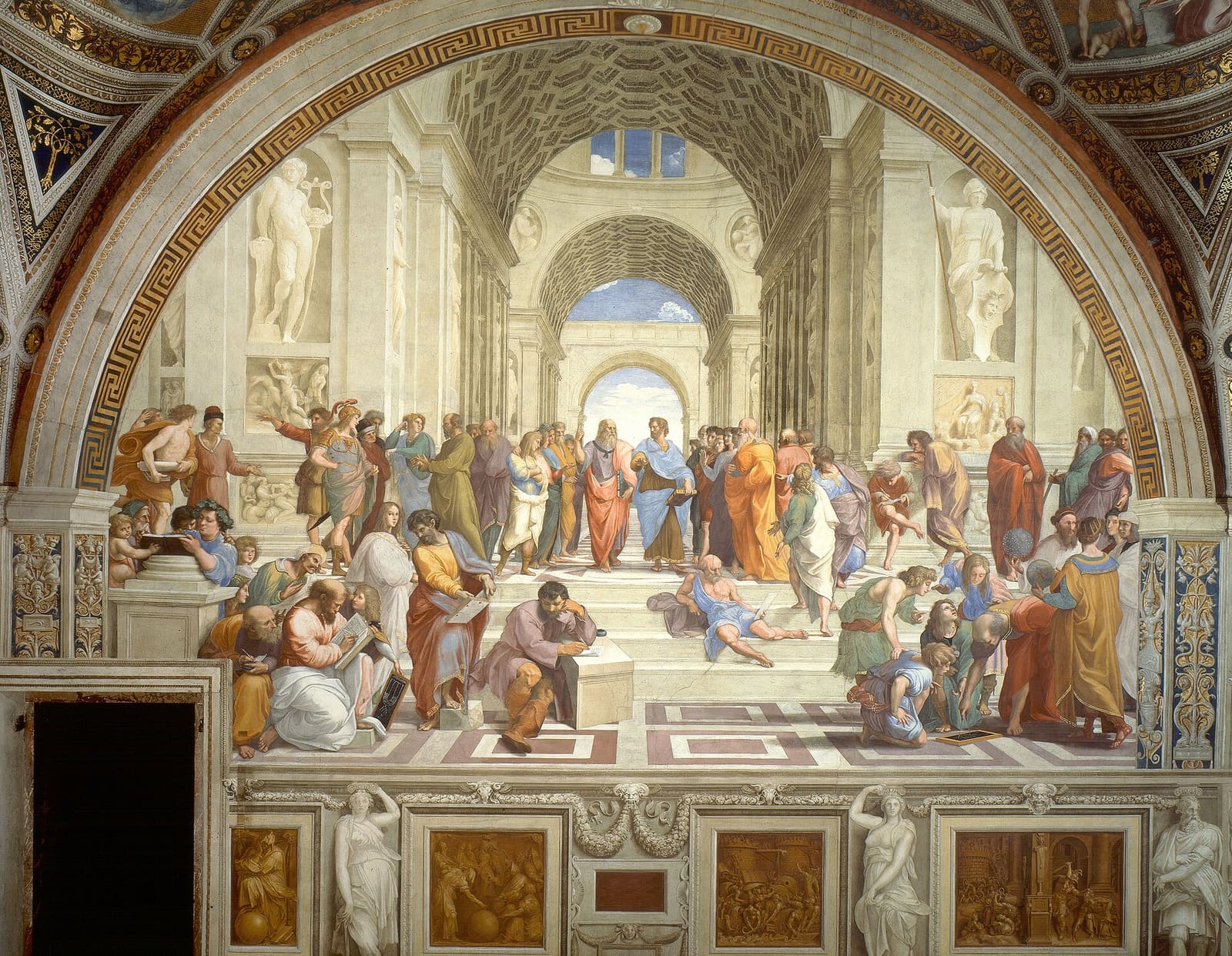
- Artist
- Raphael
- Date
- 1509–1511
- Medium
- Fresco
- Dimensions
- 500 × 770 cm
- Collection
- Vatican Museums, Vatican City
- Movement
- Renaissance
What the painting shows
Under a series of soaring, coffered arches, more than fifty figures fill a grand hall open to the sky. They are the great thinkers of the ancient world, talking, arguing, writing, teaching and thinking alone. At the exact center, framed by the farthest arch, two men walk toward us deep in discussion: Plato and Aristotle. Every line of the floor and the architecture leads the eye to them.
The title was not Raphael’s; it was given to the fresco long after his death. He probably thought of it simply as an image of Philosophy.
Who is who
Only a few figures can be named with confidence, and scholars still debate the rest. On the left, the bald Socrates counts off arguments on his fingers, and Pythagoras writes in a book while a boy holds up a tablet. Sprawled alone across the steps lies Diogenes, who rejected all comforts. At the lower right, a man bends over a slate with a pair of compasses, showing a geometric figure to his students: Euclid or Archimedes. Behind him stand two men holding globes, the astronomer Ptolemy and, it is usually said, Zoroaster.
Hidden portraits
Raphael gave some ancient philosophers the faces of his contemporaries. Plato is widely believed to resemble Leonardo da Vinci. The man with the compasses is thought to be the architect Bramante, whose plans for the new St. Peter’s inspired the vast architecture. The solitary figure in the foreground, leaning on a block of marble and writing, is not in Raphael’s surviving full-size drawing; he was added later, and many see him as a tribute to Michelangelo, who was painting the Sistine Chapel ceiling a few rooms away. At the far right, a young man in a dark cap looks straight at us: Raphael himself.
The room
The fresco covers one wall of the Stanza della Segnatura, a room in the papal apartments that Pope Julius II probably used as his library. Raphael painted it between about 1509 and 1511, his first great commission in Rome. Its four walls represent four fields of knowledge: Philosophy (The School of Athens), Theology opposite it, Poetry and Law. Together they show the Renaissance ideal of ancient wisdom and Christian faith in harmony.
His full-size preparatory drawing, the cartoon, survives in the Biblioteca Ambrosiana in Milan, one of the largest Renaissance drawings to survive.
Where to see it
The School of Athens is in the Stanza della Segnatura, one of the Raphael Rooms in the Vatican Museums in Vatican City. The rooms are on the standard route through the museums toward the Sistine Chapel.
Frequently asked questions
Who are the two men in the middle of The School of Athens?
Plato, on the left, points up toward the heavens and holds his book the Timaeus; Aristotle, on the right, holds his Ethics and stretches his hand out flat toward the earth. Their gestures sum up their philosophies: Plato's world of ideal forms and Aristotle's study of the world around us.
Is Leonardo da Vinci in The School of Athens?
Plato's white-bearded face is widely thought to be modeled on Leonardo. The brooding figure leaning on a block in the foreground, usually identified as Heraclitus, is often thought to be a portrait of Michelangelo, and Raphael put himself near the right edge, looking out at us.
Is The School of Athens a painting?
It is a fresco: Raphael painted it in water-based pigment directly onto fresh, wet plaster on a wall of the Vatican Palace, a section at a time. It cannot be moved and can be seen only in the room it was made for.