Artist · Italian
Raphael: Life, Paintings and Legacy
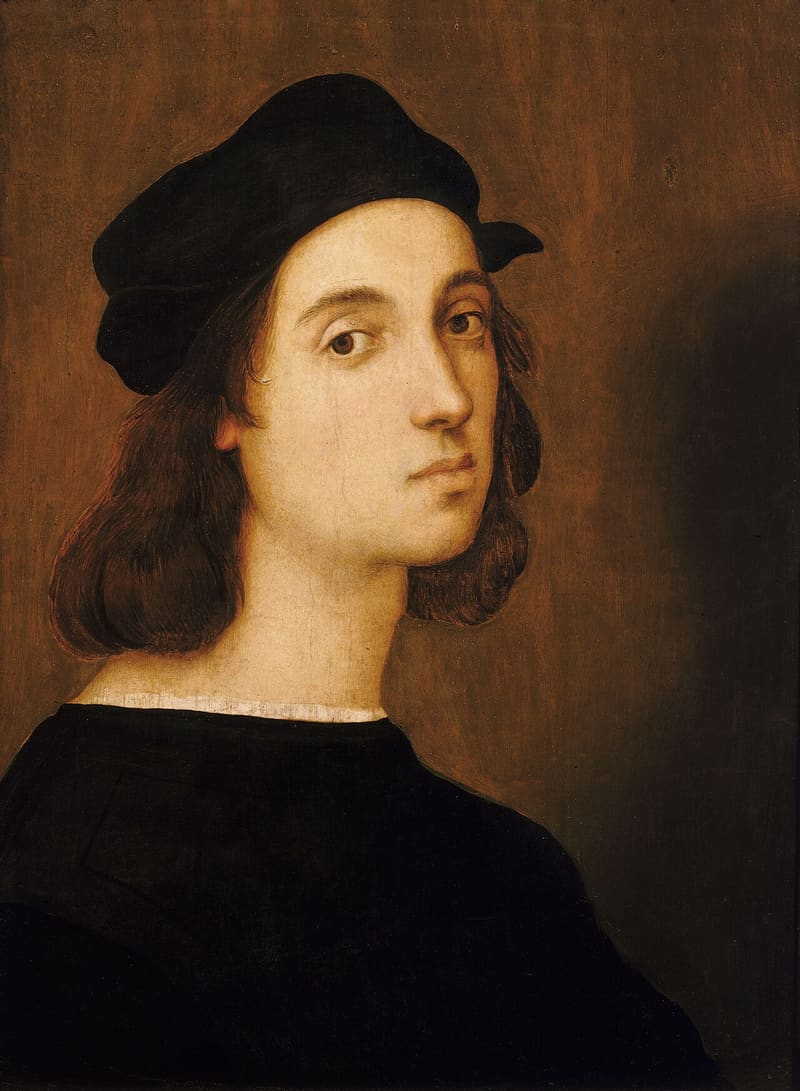
- Born
- April 6, 1483, Urbino, Italy
- Died
- April 6, 1520, Rome, Italy
- Nationality
- Italian
- Movement
- Renaissance
- Mediums
- Oil painting
Early life in Urbino
Raffaello Sanzio was born in Urbino, in central Italy, in 1483. His father, Giovanni Santi, was a painter and poet at the court of the Duke of Urbino, one of the most refined courts in Italy, so Raphael grew up among artists and scholars. Both his parents died while he was still a boy. By his late teens he was working closely with the Umbrian painter Pietro Perugino, whose calm, sweet style he absorbed so completely that some of their early works are hard to tell apart.
Florence: learning from Leonardo and Michelangelo
Around 1504 Raphael moved to Florence, where Leonardo da Vinci and Michelangelo were the talk of the city. He studied both. From Leonardo he took pyramid-shaped compositions and soft shading; from Michelangelo, a new sense of the body’s strength and movement. The result was a series of Madonnas, such as the Madonna of the Meadow (1505–1506, Vienna) and La Belle Jardinière (1507, Louvre), in which mother, child and landscape fit together with effortless harmony.
Rome and the Vatican rooms
In 1508 Pope Julius II called Raphael to Rome to decorate a suite of rooms in the Vatican Palace, now known as the Raphael Rooms. In the first of them he painted The School of Athens (about 1509–1511), a vast imaginary gathering of ancient philosophers under soaring arches, with Plato and Aristotle at the center. It is one of the defining images of the Renaissance: clear, balanced and full of life.
Raphael became the most sought-after painter in Rome. He ran a large, well-organized workshop, painted portraits such as Baldassare Castiglione (about 1514–1515, Louvre), designed tapestries for the Sistine Chapel, and painted the Sistine Madonna (about 1512, Dresden), with its two famous daydreaming cherubs. After Bramante’s death in 1514 he was also appointed architect of the new St. Peter’s Basilica.
Death and legacy
Raphael died in Rome on 6 April 1520 after a brief fever. His last great altarpiece, The Transfiguration, stood near his body as he lay in state, and he was buried in the Pantheon. His pupils finished his uncompleted projects, and their exaggerated versions of his style helped shape Mannerism.
For centuries afterward Raphael was the standard of perfection taught in every art academy in Europe. That reputation was so total that in 1848 a group of young English painters named themselves the Pre-Raphaelites in protest, wanting to return to art as it was before him.
Works by Raphael
- The School of Athens · 1509–1511
Frequently asked questions
Why is Raphael one of the great Renaissance artists?
With Leonardo and Michelangelo he is one of the three giants of the High Renaissance. Raphael combined Leonardo's soft modeling and Michelangelo's powerful figures into a balanced, graceful style that academies treated as the model of perfect painting for more than three centuries.
Where is The School of Athens?
It is a fresco painted directly on a wall of the Stanza della Segnatura, one of the papal rooms in the Vatican Palace in Rome, now part of the Vatican Museums. Raphael painted it between about 1509 and 1511.
How old was Raphael when he died?
He died in Rome on 6 April 1520, his 37th birthday by the traditional account, after a short illness with fever. He was buried in the Pantheon, an honor that showed how highly Rome regarded him.