Journal
Paintings That Caused Scandals: 8 Works That Shocked Their Time
Some of the most admired paintings in the world’s museums were once considered disgraceful. They were rejected by the patrons who paid for them, mocked in the press, guarded from angry crowds or even taken to court. Looking at what caused the outrage tells you a lot about the rules each artist was breaking, and often explains why the painting matters today.
1. Michelangelo, The Last Judgment (1536–1541)
When Michelangelo unveiled his huge fresco on the altar wall of the Sistine Chapel, it was crowded with hundreds of nude figures. The papal master of ceremonies, Biagio da Cesena, reportedly complained that it belonged in a bathhouse, not the pope’s chapel. Michelangelo answered by painting Biagio into hell as Minos, judge of the underworld, with donkey’s ears and a snake coiled around him.
The criticism outlived the artist. After the Council of Trent condemned improper religious images in 1563, Michelangelo’s former assistant Daniele da Volterra was hired to paint draperies over the most exposed figures, earning him the nickname “Il Braghettone,” the breeches-maker.
2. Caravaggio, Death of the Virgin (c. 1601–1606)
Caravaggio’s altarpiece for the Roman church of Santa Maria della Scala showed the Virgin Mary not as a serene queen of heaven but as a dead woman with a swollen body and bare, dirty feet, laid out among grieving, ordinary men. The church refused it. Rumors spread that Caravaggio had used a drowned woman, or a prostitute, as his model. The painter Peter Paul Rubens admired it and persuaded the Duke of Mantua to buy it; it now hangs in the Louvre. The painting shows why Baroque realism could be as troubling as it was moving.
3. Gustave Courbet, A Burial at Ornans (1849–1850)
At the Paris Salon of 1850 to 1851, Courbet showed a village funeral on a canvas more than six meters wide, a size reserved for heroes, saints and great battles. Its mourners were plain, life-size country people, neither beautiful nor noble. Critics called it ugly and vulgar, and some saw it as a political attack on the established order. For Courbet it was the manifesto of Realism.
4. Édouard Manet, Le Déjeuner sur l’herbe (1863)
In 1863 the Salon jury rejected so many works that Emperor Napoleon III ordered a separate exhibition for them, the Salon des Refusés. Its biggest scandal was Manet’s picnic scene: a naked woman sitting with two fully dressed young men in modern clothes, staring calmly out at the viewer. Nudes were acceptable as goddesses or nymphs. A nude among contemporary Parisians was not.
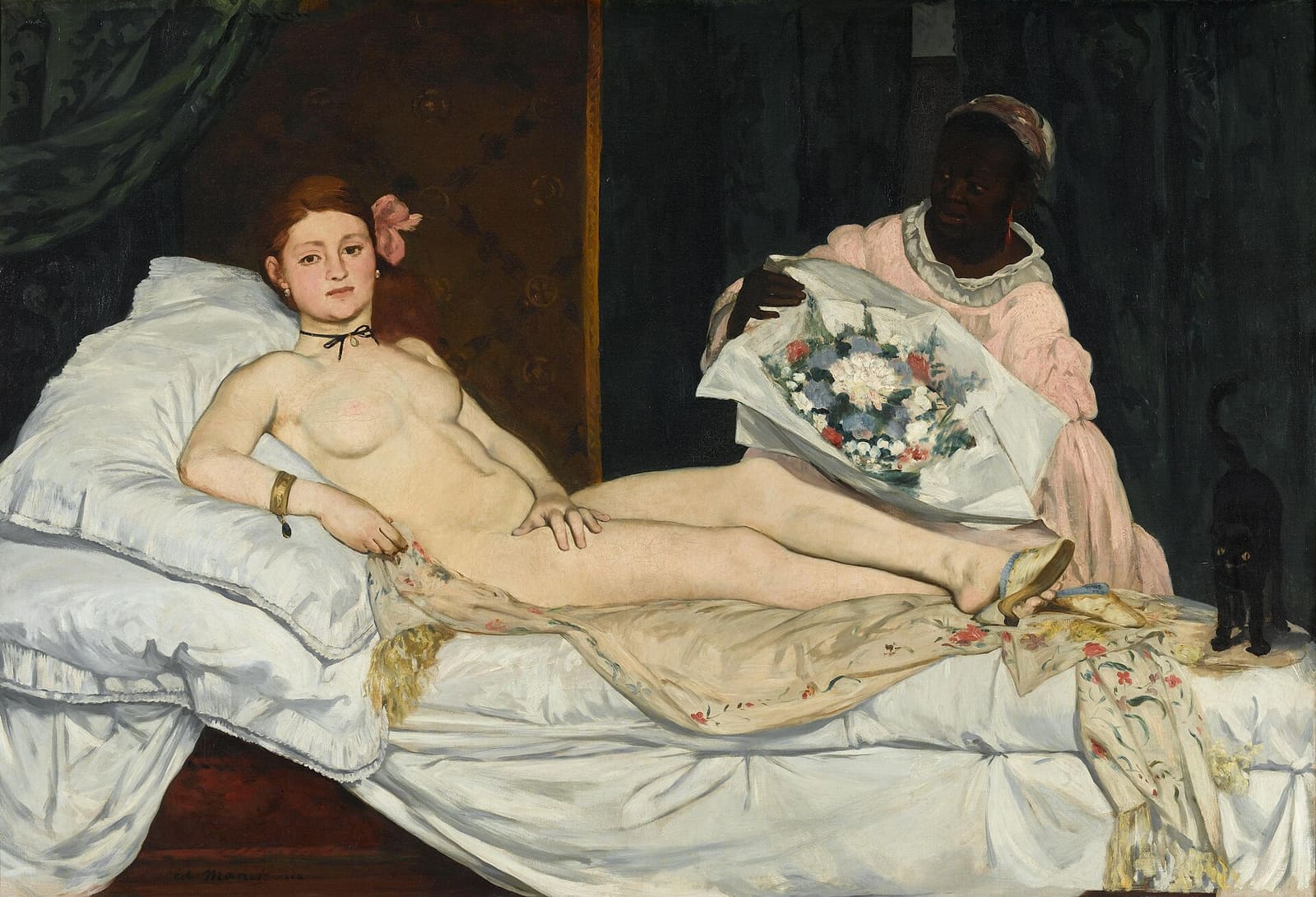
5. Édouard Manet, Olympia (1863, shown 1865)
Two years later Manet went further. Olympia reworked a famous Renaissance nude, Titian’s Venus of Urbino, but his model was obviously a modern Parisian courtesan, wearing only a ribbon, a bracelet and a slipper, and looking straight out with no shame at all. A maid brings her flowers from a client; a black cat arches its back at her feet. At the Salon of 1865 visitors jeered, and the painting had to be guarded and then rehung high above a doorway, out of reach. In 1890 Claude Monet organized a subscription to buy it for the French state, and it is now in the Musée d’Orsay.
6. Claude Monet, Impression, Sunrise (1872, shown 1874)
This scandal was one of mockery rather than morals. When Monet showed his hazy view of Le Havre harbor at the independent exhibition of 1874, critics thought it was barely begun. Louis Leroy used its title to sneer at the whole group as “Impressionists.” The insult gave a movement its name: read the full story of Impression, Sunrise.
7. James McNeill Whistler, Nocturne in Black and Gold: The Falling Rocket (c. 1875)
Whistler’s dark, almost abstract painting of fireworks over a London pleasure garden provoked the most influential critic in Britain, John Ruskin, who accused him in 1877 of “flinging a pot of paint in the public’s face” and asking two hundred guineas for it. Whistler sued for libel. In 1878 he won, but the jury awarded him a single farthing in damages, and the legal costs bankrupted him the following year. The trial became a famous debate about whether a painting had to be finished, or represent anything, to be art.
8. John Singer Sargent, Madame X (1884)
Sargent’s portrait of Virginie Amélie Avegno Gautreau, a Parisian society beauty, showed her in a black gown with powdered, pale skin, and in its original version one jeweled strap had slipped off her shoulder. At the Salon of 1884 it was considered indecent and her family was humiliated. Sargent repainted the strap in its proper place, but the damage was done, and he soon moved his career to London. He kept the painting for more than thirty years before selling it to the Metropolitan Museum of Art in 1916.
Why the scandals matter
Almost every painting on this list broke a rule about what art was allowed to show: nudity outside myth, holy figures as poor people, peasants at heroic scale, or a picture that looked unfinished. Within a generation each of those broken rules had become a new freedom, which is why so many art movements, from Realism to Impressionism, began with a scandal.